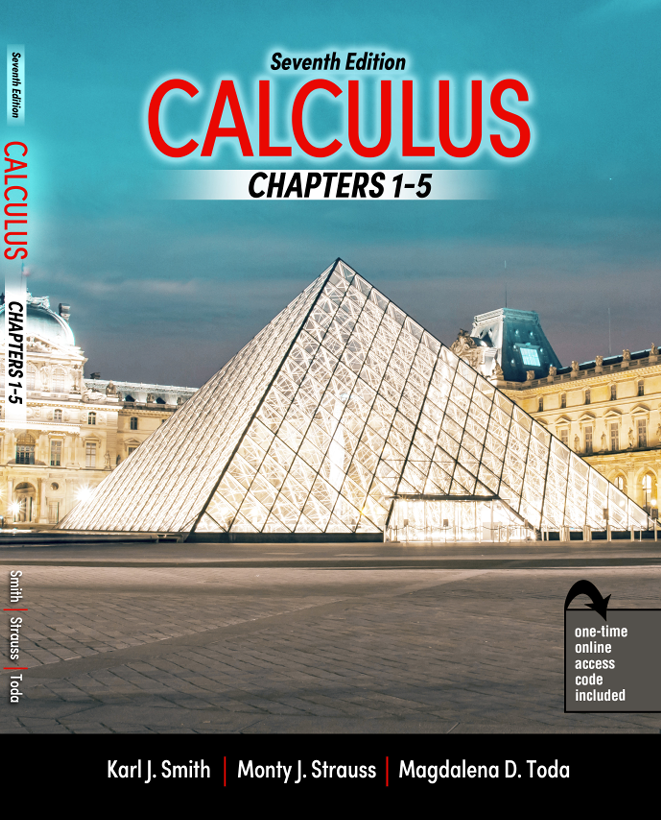
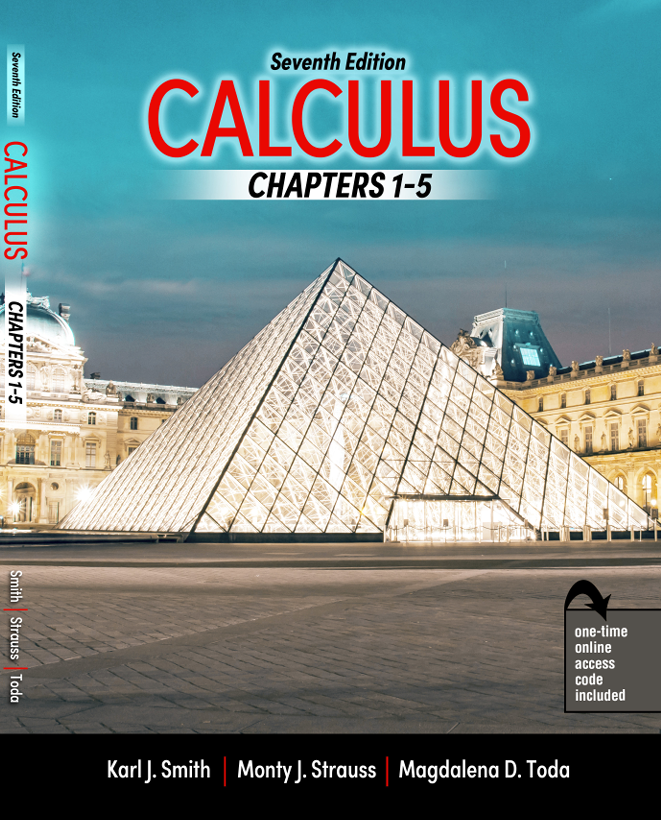
Calculus
Edition: 7
Copyright: 2026
Edition: 7
Copyright: 2026
Pages: 1292
Choose Your Format
Print Package
$108.99 USD
Ebook Package
$95.99 USD
Some of the distinguishing characteristics of the earlier editions are continued with this edition:
- It is possible to begin the course with either Chapter 1 or Chapter 2 (where the calculus topics begin).
- This edition offers an early presentation of transcendental functions: logarithms, exponential functions, and trigonometric functions are heavily integrated into all chapters of the book (especially Chapters 1–5).
- Because of user feedback, this edition has expanded drawing lessons for the student. We offer practical solutions to students on using engineering paper to draw curves in two and three dimensions. These drawing lessons include hints on plotting points in three dimensions, drawing circles, ellipses, hyperbolas, trigonometric curves, and polar-form curves, as well as planes and lines in three dimensions.
- We have taken the introduction of differential equations seriously. Students in many allied disciplines need to use differential equations early in their studies and consequently cannot wait for a postcalculus course. In this edition, we introduce differential equations in a natural and reasonable way. Slope fields are introduced as a geometric view of antidifferentiation in Section 5.1, and then are used to introduce a graphical solution to differential equations in Section 5.6. We consider separable differential equations in Chapter 5. The “early and often” approach to differential equations is intended to illustrate their value in continuous modeling and to provide a solid foundation for further study.
- We continue to utilize the humanness of mathematics. History is not presented as additional material to learn. Rather we have placed history into problems that lead the reader from the development of a concept to actually participating in the discovery process. The problems are designated as Historical Quest problems. The problems are not designed to be “add-on or challenge problems,” but rather to become an integral part of the assignment. The level of difficulty of Quest problems ranges from easy to difficult.
- This edition correctly reflects the precalculus mathematics being taught at most collegesand universities. We assume knowledge of the trigonometric functions, and in this edition we introduce ex and ln x in Chapter 2 after we have defined the notion of a limit. We also assume a knowledge of the conic sections and their graphs.
Preface
1 Functions and Graphs
1.1 What Is Calculus?
1.2 Preliminaries
1.3 Lines int he Plane; Parametric Equations
1.4 Functions and Graphs
1.5 Inverse Functions; Inverse Trigonometric Functions
Chapter1Review
Book Report Ethnomathematics by Marcia Ascher
Chapter 1 Group Research Project
2 Limits and Continuity
2.1 The Limit of a Function
2.2 Algebraic Computation of Limits
2.3 Continuity
2.4 Exponential and Logarithmic Functions
Chapter 2 Review
Chapter 2 Group Research Project
3 Differentiation
3.1 An Introduction to the Derivative: Tangents
3.2 Techniques of Differentiation
3.3 Derivatives of Trigonometric, Exponential, and Logarithmic Functions
3.4 Rates of Change: Modeling Rectilinear Motion
3.5 The Chain Rule
3.6 Implicit Differentiation
3.7 Related Rates and Applications
3.8 Linear Approximation and Differentials
Chapter 3 Review
Book Report Fermat’s Enigma by Simon Singh
Chapter 3 Group Research Project
4 Additional Applications of the Derivative
4.1 Extreme Values of a Continuous Function
4.2 The Mean Value Theorem
4.3 Using Derivatives to Sketch the Graph of a Function
4.4 Curve Sketching with Asymptotes: Limits Involving Infinity
4.5 l’Hopital’s Rule
4.6 Optimization in the Physical Sciences and Engineering
4.7 Optimization in Business, Economics ,and the Life Sciences
Chapter 4 Review
Chapter 4 Group Research Project
5 Integration
5.1 Antidifferentiation
5.2 Area as the Limit of a Sum
5.3 Riemann Sums and the Definite Integral
5.4 The Fundamental Theorems of Calculus
5.5 Integration by Substitution
5.6 Introduction to Differential Equations
5.7 The Mean Value Theorem for Integrals; Average Value
5.8 Numerical Integration: The Trapezoidal Rule and Simpson’s Rule
5.9 An Alternative Approach: The Logarithm as an Integral
Chapter 5 Review
Chapter 5 Group Research Project
Cumulative Review Problems— Chapters1–5
Appendices
A: Introduction tot he Theory of Limits
B: Selected Proofs
C: Significant Digits
D: Short Table of Integrals
E: Trigonometry
F: Parabolas
G: Ellipses
H: Hyperbolas
I: Determinants
J: Answers to Selected Problems
Index

Magdalena Toda holds a PhD in Mathematics from University of Kansas and a PhD in Applied Mathematics from University Politehnica Bucharest. She is employed as a Professor of Mathematics at Texas Tech University, in Lubbock, TX, where she has served as interim chairperson between 2015-2016, and as department chairperson since 2016.
She has authored and co-authored 35 refereed articles, in the areas of differential geometry and geometric PDEs, and has served as an editor for a research monograph that appeared in 2017. She has extensive experience in teaching Calculus, in both the traditional, face-to-face format (since 1995), and online (since 2011). She is a recipient of 6 teaching awards (2 at University of Kansas and 4 at Texas Tech University - including the President's Award for Excellence in Teaching, 2008).

Monty Strauss has been on the mathematics faculty at Texas Tech University for almost forty years. He has a Ph.D. from the Courant Institute of Mathematical Sciences at New York University and has taught all levels of mathematics at Texas Tech, from precollege mathematics to doctoral level. He particularly has enjoyed working with honors students and with mathematics and engineering majors. Among his administrative assignments have been departmental undergraduate programs chair and departmental associate chair.

Karl J. Smith received his B.A. and M.A. degrees in mathematics from UCLA. In 1968, he moved to northern California to teach mathematics at Santa Rosa Junior College, where he taught until his retirement in 1993. Along the way, he served as department chair, and he received a Ph.D. in 1979 in mathematics education at Southeastern University. A past president of the American Mathematical Association of Two-Year Colleges, Professor Smith is active nationally in mathematics education. He was the founding editor of the Western AMATYC News, a chairperson of the Committee on Mathematics Excellence, and an NSF grant reviewer. In 1979 he received an Outstanding Young Men of America Award, in 1980 an Outstanding Educator Award, and in 1989 an Outstanding Teacher Award. Professor Smith is the author of over 60 successful textbooks. Over two million students have learned mathematics from his textbooks.
Some of the distinguishing characteristics of the earlier editions are continued with this edition:
- It is possible to begin the course with either Chapter 1 or Chapter 2 (where the calculus topics begin).
- This edition offers an early presentation of transcendental functions: logarithms, exponential functions, and trigonometric functions are heavily integrated into all chapters of the book (especially Chapters 1–5).
- Because of user feedback, this edition has expanded drawing lessons for the student. We offer practical solutions to students on using engineering paper to draw curves in two and three dimensions. These drawing lessons include hints on plotting points in three dimensions, drawing circles, ellipses, hyperbolas, trigonometric curves, and polar-form curves, as well as planes and lines in three dimensions.
- We have taken the introduction of differential equations seriously. Students in many allied disciplines need to use differential equations early in their studies and consequently cannot wait for a postcalculus course. In this edition, we introduce differential equations in a natural and reasonable way. Slope fields are introduced as a geometric view of antidifferentiation in Section 5.1, and then are used to introduce a graphical solution to differential equations in Section 5.6. We consider separable differential equations in Chapter 5. The “early and often” approach to differential equations is intended to illustrate their value in continuous modeling and to provide a solid foundation for further study.
- We continue to utilize the humanness of mathematics. History is not presented as additional material to learn. Rather we have placed history into problems that lead the reader from the development of a concept to actually participating in the discovery process. The problems are designated as Historical Quest problems. The problems are not designed to be “add-on or challenge problems,” but rather to become an integral part of the assignment. The level of difficulty of Quest problems ranges from easy to difficult.
- This edition correctly reflects the precalculus mathematics being taught at most collegesand universities. We assume knowledge of the trigonometric functions, and in this edition we introduce ex and ln x in Chapter 2 after we have defined the notion of a limit. We also assume a knowledge of the conic sections and their graphs.
Preface
1 Functions and Graphs
1.1 What Is Calculus?
1.2 Preliminaries
1.3 Lines int he Plane; Parametric Equations
1.4 Functions and Graphs
1.5 Inverse Functions; Inverse Trigonometric Functions
Chapter1Review
Book Report Ethnomathematics by Marcia Ascher
Chapter 1 Group Research Project
2 Limits and Continuity
2.1 The Limit of a Function
2.2 Algebraic Computation of Limits
2.3 Continuity
2.4 Exponential and Logarithmic Functions
Chapter 2 Review
Chapter 2 Group Research Project
3 Differentiation
3.1 An Introduction to the Derivative: Tangents
3.2 Techniques of Differentiation
3.3 Derivatives of Trigonometric, Exponential, and Logarithmic Functions
3.4 Rates of Change: Modeling Rectilinear Motion
3.5 The Chain Rule
3.6 Implicit Differentiation
3.7 Related Rates and Applications
3.8 Linear Approximation and Differentials
Chapter 3 Review
Book Report Fermat’s Enigma by Simon Singh
Chapter 3 Group Research Project
4 Additional Applications of the Derivative
4.1 Extreme Values of a Continuous Function
4.2 The Mean Value Theorem
4.3 Using Derivatives to Sketch the Graph of a Function
4.4 Curve Sketching with Asymptotes: Limits Involving Infinity
4.5 l’Hopital’s Rule
4.6 Optimization in the Physical Sciences and Engineering
4.7 Optimization in Business, Economics ,and the Life Sciences
Chapter 4 Review
Chapter 4 Group Research Project
5 Integration
5.1 Antidifferentiation
5.2 Area as the Limit of a Sum
5.3 Riemann Sums and the Definite Integral
5.4 The Fundamental Theorems of Calculus
5.5 Integration by Substitution
5.6 Introduction to Differential Equations
5.7 The Mean Value Theorem for Integrals; Average Value
5.8 Numerical Integration: The Trapezoidal Rule and Simpson’s Rule
5.9 An Alternative Approach: The Logarithm as an Integral
Chapter 5 Review
Chapter 5 Group Research Project
Cumulative Review Problems— Chapters1–5
Appendices
A: Introduction tot he Theory of Limits
B: Selected Proofs
C: Significant Digits
D: Short Table of Integrals
E: Trigonometry
F: Parabolas
G: Ellipses
H: Hyperbolas
I: Determinants
J: Answers to Selected Problems
Index
Magdalena Toda holds a PhD in Mathematics from University of Kansas and a PhD in Applied Mathematics from University Politehnica Bucharest. She is employed as a Professor of Mathematics at Texas Tech University, in Lubbock, TX, where she has served as interim chairperson between 2015-2016, and as department chairperson since 2016.
She has authored and co-authored 35 refereed articles, in the areas of differential geometry and geometric PDEs, and has served as an editor for a research monograph that appeared in 2017. She has extensive experience in teaching Calculus, in both the traditional, face-to-face format (since 1995), and online (since 2011). She is a recipient of 6 teaching awards (2 at University of Kansas and 4 at Texas Tech University - including the President's Award for Excellence in Teaching, 2008).
Monty Strauss has been on the mathematics faculty at Texas Tech University for almost forty years. He has a Ph.D. from the Courant Institute of Mathematical Sciences at New York University and has taught all levels of mathematics at Texas Tech, from precollege mathematics to doctoral level. He particularly has enjoyed working with honors students and with mathematics and engineering majors. Among his administrative assignments have been departmental undergraduate programs chair and departmental associate chair.
Karl J. Smith received his B.A. and M.A. degrees in mathematics from UCLA. In 1968, he moved to northern California to teach mathematics at Santa Rosa Junior College, where he taught until his retirement in 1993. Along the way, he served as department chair, and he received a Ph.D. in 1979 in mathematics education at Southeastern University. A past president of the American Mathematical Association of Two-Year Colleges, Professor Smith is active nationally in mathematics education. He was the founding editor of the Western AMATYC News, a chairperson of the Committee on Mathematics Excellence, and an NSF grant reviewer. In 1979 he received an Outstanding Young Men of America Award, in 1980 an Outstanding Educator Award, and in 1989 an Outstanding Teacher Award. Professor Smith is the author of over 60 successful textbooks. Over two million students have learned mathematics from his textbooks.