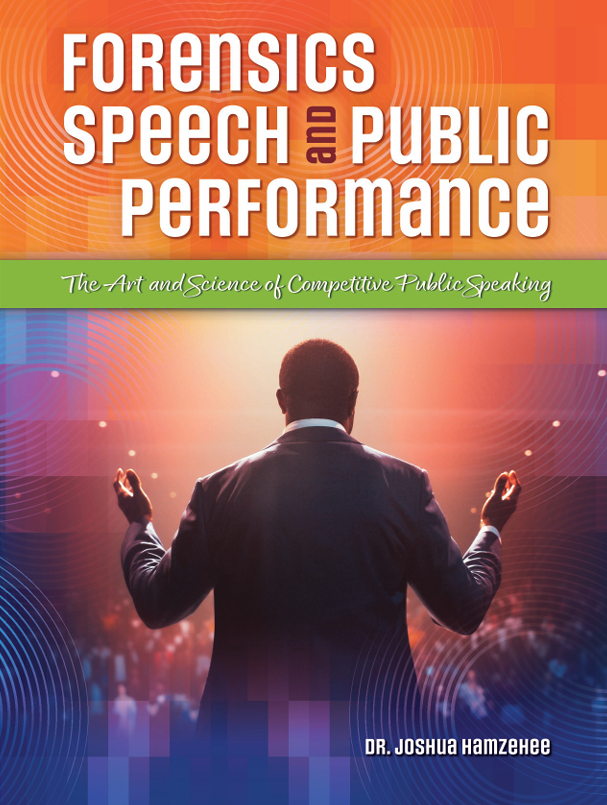
Forensics Speech and Public Performance: The Art and Science of Competitive Public Speaking
Edition: 1
Copyright: 2026
Pages: 310
Edition: 1
Copyright: 2026
Pages: 310
Choose Your Format
Ebook
$65.00 USD
$85.00 USD
Forensics Speech and Public Performance: The Art and Science of Competitive Public Speaking wins by being a comprehensive, competition-focused resource designed specifically for the individual events needs of forensics educators, coaches, and competitors, as well as for public speaking, oral interpretation, and argumentation classrooms.
Unlike other texts that treat speaking as a broad skill, this book directly bridges theory and tournament practice. Here, Dr. Joshua Hamzehee offers a clear, structured pathway from communication skill-building to public ready prepared speech, performance, and limited preparation events.
Whether you are coaching or performing, guiding students through their first or final tournament, are building a new program, or are a self-coached student, this text is for you! Hamzehee provides practical and immediately usable strategies grounded in 20 years of experience engaging performance, public speaking, pedagogy, practice, and passion.
Designed as a season-long coaching companion, Dr. Hamzehee invites you into a coach-student partnership. This book covers preparation, execution, and reflection, making it the most effective and accessible option for forensicators and public performers who want a guide for approaching the journey and achieving results.
Some championship features at a glance:
- Prepared speech guidance – Step-by-step frameworks for crafting and refining competitive speeches and developing student voices.
- Performance events coverage – In-depth strategies for interpretation, characterization, and delivery to craft memorable performances.
- Limited preparation events– Practical tools for organizing and speaking under pressure.
- Checkpoints – Event construction assignments to maintain progress and achieve goals.
- Tournament and post-forensics support – Before, during, and after competition guides to maximize growth beyond the page and stage, and into the community.
Forensics Speech and Public Performance will be an invaluable resource that guides students and coaches for years to come. And, it provides educators and performers with the tools to guide others, too.
Acknowledgments
The Van Ride to the Tournament
Foreword 1: Coach Becomes Colleague
Casey Garcia
Foreword 2: Student Becomes Coach
Yaw Osafo-Kantanka Kyeremateng
How to Use This Text
A. Forensics Coach in a Book
B. How This Book Works
C. Features and Contributions
Introduction: Warming Up
A. What Is Forensics?
B. Forensics as Dialogue
C. Choose Your Own Adventure
D. Embracing the Journey
UNIT 1: PREPARED SPEECH EVENTS
Stage 1: Forensics Speech Events and Structures
A. The Art and Science of Prepared Speech Events
B. Speech Events Descriptions
C. Similarities in Speech Structures
D. Informative Speech Structure
E. Persuasive Speech Structure
F. After-Dinner Speech Structures
G. Communication Analysis Structures
H. Checkpoint: Topic Pitch and Prepared Speech Blueprint
Stage 2: Doing Research and Writing First Drafts
A. Researching and Building an Argument
B. Writing Your First Draft
C. Checkpoint: First Outline Draft
Stage 3: Editing and Developing Your Draft
A. Incorporating Edits and Feedback
B. Layering Your Speech
C. Checkpoint: Final Draft
Stage 4: Practicing and Playing with Purpose
A. Delivery and the Self
B. Making Hot Choices
C. Delivery with Others
D. Advanced Public Speaking Styles
E. Checkpoint: Speaker Persona Worksheet
F. Checkpoint: Self-Evaluation
G. Checkpoint: Block and Perform
Section 5: Final Thoughts on Prepared Speech Events
UNIT 2: PERFORMANCE AND INTERPRETATION EVENTS
Stage 1: Understanding Performance and Interpretation Events
A. A Teaser to Start This Unit
B. The Art and Science of Performance Events
C. Performance Events Descriptions
D. Checkpoint: Scavenger Hunt for Performance Material
Stage 2: Finding Literature and Selecting a Piece
A. Where and How to Look for Texts?
B. The Lifeline: Narrative Arc and Structure
C. Checkpoint: Selecting Text(s) and Building a Concept Map
Stage 3: Developing Your Performance and Argument
A. 6 “Cs” of Script Construction and Adaptation
B. Considerations When Cutting and Collaging Texts
C. Single Text and Multiple Text Cuttings
D. Building a Program for a Multiple Text Event
E. Building a Duo Interpretation Event
F. Ethical Considerations with Adapting Texts
F. Introductions and Advocacy
G. Checkpoint: Putting Your Performance Together
Stage 4: Rehearsing and Playing with Purpose
A. Internal Characterization
B. Making Hot Choices
C. Checkpoint: Character Profile
D. External Characterization
E. Adding Depth to Your Performance
F. Advanced Performance Techniques
G. Checkpoint: Internal Monologue
H. Checkpoint: Self-Evaluation
Section 5: Final Thoughts on Performance and Interpretation Events
UNIT 3: LIMITED PREPARATION SPEECH EVENTS
Stage 1: Understanding Forensics Limited Preparation Events
A. The Art and Science of Limited Preparation Events
B. Limited Preparation Events Descriptions
C. Checkpoint: Giving Your First LP Speech
Stage 2: Understanding Structure and Finding Examples
A. Understanding Impromptu Speech Structure: 3 × 1
B. Understanding Impromptu Speech Structure: 2 × 2
C. Other Impromptu Speech Structures
D. Preparation, Notecards, and Strategies
E. Finding Examples for Impromptu
F. Checkpoint: Creating an Example Book and Doing Impromptus
Stage 3: Understanding Extemporaneous Structure and Research
A. Understanding Extemporaneous Speech Structures
B. Extemporaneous Expectations
C. 30-Minute Preparation Time
D. Extemporaneous Research Skills
E. Checkpoint: Structuring, Researching, and Giving an Extemporaneous Speech
Stage 4: Practicing and Playing with Purpose
A. Impromptu Delivery and the Self
B. Impromptu Delivery With Others
C. Extemporaneous Delivery and the Self
D. Extemporaneous Delivery with Others
E. Checkpoint: Self-Evaluation
F. Checkpoint: Building on Example Books and Filing Systems
Section 5: Final Thoughts on Limited Preparation Events
UNIT 4: PERFORMING FORENSICS EVENTS
Section 1: At the Tournament
What Should I Wear to a Tournament?
How Can I Calm My Nerves?
How Should I Warm-Up?
What Is the Difference Between a Preliminary-Round and Final-Round Performance?
What Do You Mean by “Van Talk”?
How Can I Be a Good Teammate and Competitor?
How Is an Online Tournament Different Than an In-Person Tournament?
Should I Include a Content Warning for My Event?
How Should I Act if I Make It to Outrounds?
Section 2: After the Tournament
How Do I Keep My Event Fresh?
How Can I Keep Advocating Outside of Forensics Competitions?
How Should I Document and Preserve My Performance?
Should I Try Other Events?
Section 3: Outside of Forensics
Academic Research and Higher Education
Careers in Communication, Law, and Advocacy
Careers in Media, Business, and Public Speaking
Careers in Performance and the Arts
Education, Speech Coaching, and Curriculum Design
Creative Entrepreneurship, Thought Leadership, and Digital Storytelling
Section 4: Developing Team Culture
Team Meetings and Practices
Community Outreach and Events
Fundraising Opportunities
Students Coaching Students
Section 5: Final Advice and Further Readings
Further Readings
The Van Ride Home
Glossary
Sources and References
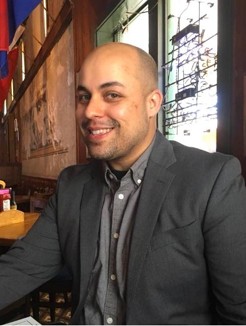
Dr. Joshua Hamzehee is a Communication Studies Professor at Santa Rosa Junior College and Director of the college's nationally recognized Forensics Speech, Debate, and Performance Team. As a performance artist, scholar, and coach, Josh engages in critical ethnographic methods, spoken word roots, and remixed performance techniques to excavate how community is built and how power is challenged through live, digital, and ritual performance.
In addition to authoring two books, Forensics Speech and Public Performance (Kendall Hunt, 2026) and Baton Rouge SLAM! An Obituary for Summer 2016 (Innovative Ink, 2026)—Josh’s academic and creative work is published in peer-reviewed journals like Text & Performance Quarterly, Liminalities, Pedagogy and Theatre of the Oppressed, Florida Communication Journal, National Forensic Journal, and the Professional Wrestling Studies Journal.
For more than two decades, Josh has toured award-winning original solo and ensemble performance projects—like Burnt City: A Dystopian Bilingual One-Persian Show! and The Deported: A “Reality” Show! —and led workshops and institutes in over 30 states. In addition to private public speaking coaching, Josh is an engaged citizen, serving on local boards and commissions.
For updates, information, and bookings, visit: joshhamzehee.com.
Forensics Speech and Public Performance: The Art and Science of Competitive Public Speaking wins by being a comprehensive, competition-focused resource designed specifically for the individual events needs of forensics educators, coaches, and competitors, as well as for public speaking, oral interpretation, and argumentation classrooms.
Unlike other texts that treat speaking as a broad skill, this book directly bridges theory and tournament practice. Here, Dr. Joshua Hamzehee offers a clear, structured pathway from communication skill-building to public ready prepared speech, performance, and limited preparation events.
Whether you are coaching or performing, guiding students through their first or final tournament, are building a new program, or are a self-coached student, this text is for you! Hamzehee provides practical and immediately usable strategies grounded in 20 years of experience engaging performance, public speaking, pedagogy, practice, and passion.
Designed as a season-long coaching companion, Dr. Hamzehee invites you into a coach-student partnership. This book covers preparation, execution, and reflection, making it the most effective and accessible option for forensicators and public performers who want a guide for approaching the journey and achieving results.
Some championship features at a glance:
- Prepared speech guidance – Step-by-step frameworks for crafting and refining competitive speeches and developing student voices.
- Performance events coverage – In-depth strategies for interpretation, characterization, and delivery to craft memorable performances.
- Limited preparation events– Practical tools for organizing and speaking under pressure.
- Checkpoints – Event construction assignments to maintain progress and achieve goals.
- Tournament and post-forensics support – Before, during, and after competition guides to maximize growth beyond the page and stage, and into the community.
Forensics Speech and Public Performance will be an invaluable resource that guides students and coaches for years to come. And, it provides educators and performers with the tools to guide others, too.
Acknowledgments
The Van Ride to the Tournament
Foreword 1: Coach Becomes Colleague
Casey Garcia
Foreword 2: Student Becomes Coach
Yaw Osafo-Kantanka Kyeremateng
How to Use This Text
A. Forensics Coach in a Book
B. How This Book Works
C. Features and Contributions
Introduction: Warming Up
A. What Is Forensics?
B. Forensics as Dialogue
C. Choose Your Own Adventure
D. Embracing the Journey
UNIT 1: PREPARED SPEECH EVENTS
Stage 1: Forensics Speech Events and Structures
A. The Art and Science of Prepared Speech Events
B. Speech Events Descriptions
C. Similarities in Speech Structures
D. Informative Speech Structure
E. Persuasive Speech Structure
F. After-Dinner Speech Structures
G. Communication Analysis Structures
H. Checkpoint: Topic Pitch and Prepared Speech Blueprint
Stage 2: Doing Research and Writing First Drafts
A. Researching and Building an Argument
B. Writing Your First Draft
C. Checkpoint: First Outline Draft
Stage 3: Editing and Developing Your Draft
A. Incorporating Edits and Feedback
B. Layering Your Speech
C. Checkpoint: Final Draft
Stage 4: Practicing and Playing with Purpose
A. Delivery and the Self
B. Making Hot Choices
C. Delivery with Others
D. Advanced Public Speaking Styles
E. Checkpoint: Speaker Persona Worksheet
F. Checkpoint: Self-Evaluation
G. Checkpoint: Block and Perform
Section 5: Final Thoughts on Prepared Speech Events
UNIT 2: PERFORMANCE AND INTERPRETATION EVENTS
Stage 1: Understanding Performance and Interpretation Events
A. A Teaser to Start This Unit
B. The Art and Science of Performance Events
C. Performance Events Descriptions
D. Checkpoint: Scavenger Hunt for Performance Material
Stage 2: Finding Literature and Selecting a Piece
A. Where and How to Look for Texts?
B. The Lifeline: Narrative Arc and Structure
C. Checkpoint: Selecting Text(s) and Building a Concept Map
Stage 3: Developing Your Performance and Argument
A. 6 “Cs” of Script Construction and Adaptation
B. Considerations When Cutting and Collaging Texts
C. Single Text and Multiple Text Cuttings
D. Building a Program for a Multiple Text Event
E. Building a Duo Interpretation Event
F. Ethical Considerations with Adapting Texts
F. Introductions and Advocacy
G. Checkpoint: Putting Your Performance Together
Stage 4: Rehearsing and Playing with Purpose
A. Internal Characterization
B. Making Hot Choices
C. Checkpoint: Character Profile
D. External Characterization
E. Adding Depth to Your Performance
F. Advanced Performance Techniques
G. Checkpoint: Internal Monologue
H. Checkpoint: Self-Evaluation
Section 5: Final Thoughts on Performance and Interpretation Events
UNIT 3: LIMITED PREPARATION SPEECH EVENTS
Stage 1: Understanding Forensics Limited Preparation Events
A. The Art and Science of Limited Preparation Events
B. Limited Preparation Events Descriptions
C. Checkpoint: Giving Your First LP Speech
Stage 2: Understanding Structure and Finding Examples
A. Understanding Impromptu Speech Structure: 3 × 1
B. Understanding Impromptu Speech Structure: 2 × 2
C. Other Impromptu Speech Structures
D. Preparation, Notecards, and Strategies
E. Finding Examples for Impromptu
F. Checkpoint: Creating an Example Book and Doing Impromptus
Stage 3: Understanding Extemporaneous Structure and Research
A. Understanding Extemporaneous Speech Structures
B. Extemporaneous Expectations
C. 30-Minute Preparation Time
D. Extemporaneous Research Skills
E. Checkpoint: Structuring, Researching, and Giving an Extemporaneous Speech
Stage 4: Practicing and Playing with Purpose
A. Impromptu Delivery and the Self
B. Impromptu Delivery With Others
C. Extemporaneous Delivery and the Self
D. Extemporaneous Delivery with Others
E. Checkpoint: Self-Evaluation
F. Checkpoint: Building on Example Books and Filing Systems
Section 5: Final Thoughts on Limited Preparation Events
UNIT 4: PERFORMING FORENSICS EVENTS
Section 1: At the Tournament
What Should I Wear to a Tournament?
How Can I Calm My Nerves?
How Should I Warm-Up?
What Is the Difference Between a Preliminary-Round and Final-Round Performance?
What Do You Mean by “Van Talk”?
How Can I Be a Good Teammate and Competitor?
How Is an Online Tournament Different Than an In-Person Tournament?
Should I Include a Content Warning for My Event?
How Should I Act if I Make It to Outrounds?
Section 2: After the Tournament
How Do I Keep My Event Fresh?
How Can I Keep Advocating Outside of Forensics Competitions?
How Should I Document and Preserve My Performance?
Should I Try Other Events?
Section 3: Outside of Forensics
Academic Research and Higher Education
Careers in Communication, Law, and Advocacy
Careers in Media, Business, and Public Speaking
Careers in Performance and the Arts
Education, Speech Coaching, and Curriculum Design
Creative Entrepreneurship, Thought Leadership, and Digital Storytelling
Section 4: Developing Team Culture
Team Meetings and Practices
Community Outreach and Events
Fundraising Opportunities
Students Coaching Students
Section 5: Final Advice and Further Readings
Further Readings
The Van Ride Home
Glossary
Sources and References
Dr. Joshua Hamzehee is a Communication Studies Professor at Santa Rosa Junior College and Director of the college's nationally recognized Forensics Speech, Debate, and Performance Team. As a performance artist, scholar, and coach, Josh engages in critical ethnographic methods, spoken word roots, and remixed performance techniques to excavate how community is built and how power is challenged through live, digital, and ritual performance.
In addition to authoring two books, Forensics Speech and Public Performance (Kendall Hunt, 2026) and Baton Rouge SLAM! An Obituary for Summer 2016 (Innovative Ink, 2026)—Josh’s academic and creative work is published in peer-reviewed journals like Text & Performance Quarterly, Liminalities, Pedagogy and Theatre of the Oppressed, Florida Communication Journal, National Forensic Journal, and the Professional Wrestling Studies Journal.
For more than two decades, Josh has toured award-winning original solo and ensemble performance projects—like Burnt City: A Dystopian Bilingual One-Persian Show! and The Deported: A “Reality” Show! —and led workshops and institutes in over 30 states. In addition to private public speaking coaching, Josh is an engaged citizen, serving on local boards and commissions.
For updates, information, and bookings, visit: joshhamzehee.com.