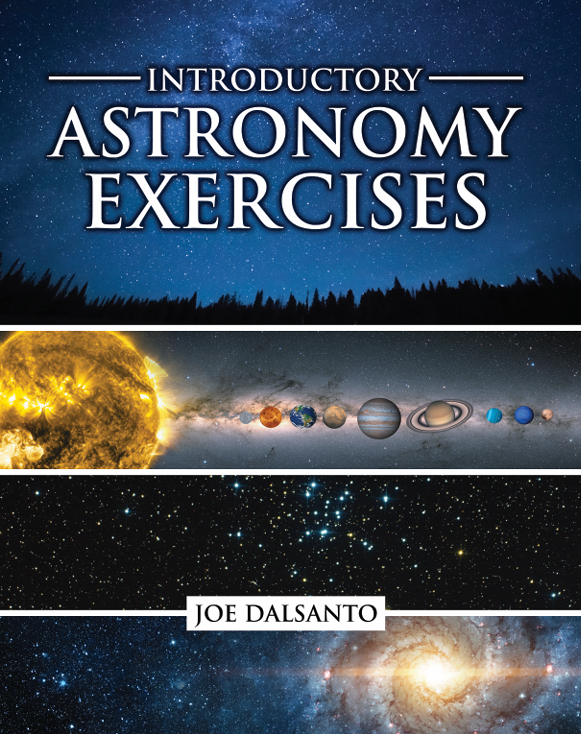
Introductory Astronomy Exercises

Author(s): Joseph DalSanto

Edition: 1

Copyright: 2026

Pages: 60

Choose Your Format

Ebook

$30.00 USD

ISBN 9798319748973

Details Electronic Delivery EBOOK 180 days

This astronomy resource provides a comprehensive introduction to the study of the universe, beginning with the observable features of the night sky and the fundamental principles that govern celestial motion. Students explore basic sky concepts, the phases of the Moon, eclipses, gravity, and the behavior of light, developing an understanding of how astronomers observe and explain phenomena in space. These topics establish the scientific foundation needed to investigate more complex astronomical systems and processes.

The course continues with an examination of the formation and structure of planetary systems, including the characteristics of planets, moons, and extrasolar worlds. Students then investigate the properties of stars through the analysis of spectra, stellar classification, and evolutionary processes. The study expands further to include the Milky Way, the diversity of galaxies, and the large-scale structure of the universe. Special attention is given to dark matter and dark energy, providing insight into some of the most significant and unresolved questions in modern astronomy.

Introduction 
Section 1 The Night Sky 
Astronomy Exercise 1 Basic Sky Concepts 
Astronomy Exercise 2 Moon Phases and Eclipses 
Astronomy Exercise 3 Explaining the Night Sky 
Astronomy Exercise 4 Gravity and Light 

Section 2 Solar Systems 
Astronomy Exercise 5 Formation of the Solar System 
Astronomy Exercise 6 Terrestrial Planets 
Astronomy Exercise 7 Jovian Moons 
Astronomy Exercise 8 Extrasolar Planets 

Section 3 The Stars 
Astronomy Exercise 9 Spectra 
Astronomy Exercise 10 Stellar Properties 
Astronomy Exercise 11 The HR Diagram 
Astronomy Exercise 12 Stellar Evolution 

Section 4 Galaxies and the Universe 
Astronomy Exercise 13 The Milky Way 
Astronomy Exercise 14 Galaxy Types and Classification 
Astronomy Exercise 15 The Dark Side of the Universe

Joseph DalSanto