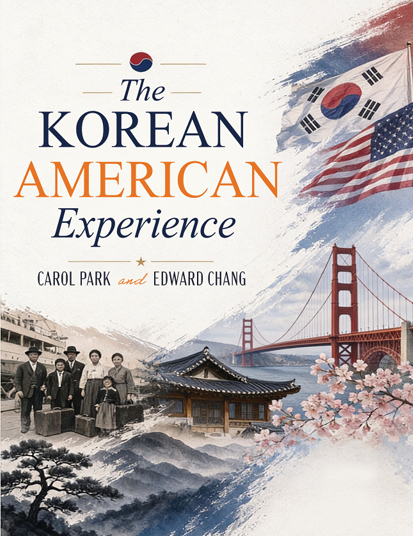
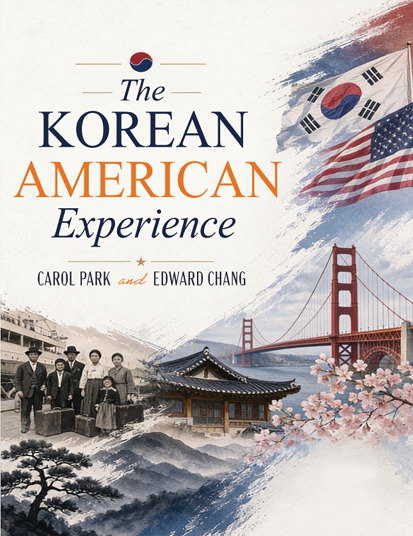
The Korean American Experience

Edition: 1

Copyright: 2026

Pages: 106

Choose Your Format

Ebook

$35.00 USD

ISBN 9798319713384

Details Electronic Delivery EBOOK 180 days

The Korean American Experience provides an accessible overview of the Korean American experience, tracing Korean American history, identity, community development, and cultural contributions from early immigration through the present. It examines Korean picture brides, early settlements such as Pachappa Camp, the Korean independence movement, the World Wars and Korean War, post-1965 immigration, the development of Koreatown in Los Angeles, the model minority image, the 1992 Los Angeles civil unrest, and the influence of the Hallyu Wave. Through historical events, personal highlights, and notable Korean Americans, the book explores how Korean Americans have shaped and navigated American society while maintaining and evolving their cultural identity.

About the Authors    
Introduction and Acknowledgement  
Chapter 1 Korea and Korean America: Beginnings 
Korean Picture Brides: Women of Strength  
Notes      
Chapter 2 Korean Americans in the Early 1900s and Pachappa 
Camp, the First Koreatown, USA  
Pachappa Camp, the First Organized Korean American 
Settlement, “Koreatown,” USA 
The Hemet Valley Incident of 1913 
Armed Resistance for the Korean Independence Movement 
Korean American Highlight 
   Violet Catherine Kim   
Notes  
Chapter 3 Korean Americans and World War I 
The Korean American Community in the Interwar Period, 1918 to 1941 
The Role of Churches and Christianity in the Korean American Community
Notes    
Chapter 4 World War II, Korean American Heroes, and the Korean War 
Korean Americans Serving during WW II 
Korean American Identity after WW II   
The Korean War    
Korean War Adoptees   
Korean War Brides and the Korean American Community
Notes  
Chapter 5 The Korean American Community Post-1965 Immigration and 
Nationality Act 
Koreatown in LA 
Korean American Identity: 1960s to 1980s  
Korean Americans and the Model Minority 
Korean American Highlight 
   K. W. Lee   
   Julie Ha 
   Jacqueline Eurn Hai Young   
Notes 
Chapter 6 The Black-Korean Conflict, Media Images, Korean American Identity, and the 1992 LA Civil Unrest 
The Beating of Rodney King and the Murder of Latasha Harlins
The Verdicts and the 1992 LA Civil Unrest: Sa-i-gu (4–29)16 
Korean American Highlight
   Angela Oh  
   Dr. Myung Ki Hong  
Notes 
Chapter 7: Korean America Today and Beyond  
The Hallyu Wave (Korean Wave) and Korean Americans
Korean American Characteristics 
Conclusion    
Notes
Appendix A: Korean American History Timeline   
Appendix B: Notable Korean Americans  

Carol Park

Carol K. Park is a researcher at the Yong Oak Kim Center for Korean American Studies at the University of 
California (UC) Riverside, a filmmaker, lecturer, and a former journalist. She is also the author of Memoir of 
a Cashier: Korean Americans, Racism, and Riots. Park holds a PhD and an MA in Ethnic Studies, as well as a 
Master of Fine Arts in creative writing from UC Riverside. Park also wrote and produced two documentaries: “The 1992 L.A. Riots: Reflections on Our Future” (2011) and “Footsteps of Korean Americans” (2018). Her 
work has appeared in various newspapers, journals, and magazines.

Edward Chang

Edward T. Chang holds a PhD in ethnic studies from University of California (UC) Berkeley and an MA in Asian American Studies from UC Los Angeles (UCLA). He is professor of ethnic studies at the UC Riverside (UCR) and the founding director of the Young Oak Kim Center for Korean American Studies at UCR. He is an established author with more than ten published works covering a variety of topics, including the 1992 Los Angeles Civil Unrest. His work includes Korean American Pioneer Aviators: The Willows Airmen and Pachappa Camp: The First Koreatown in the United States. He is a respected academic and has been the voice of the Korean American community for more than thirty years. Dr. Chang is a renowned Korean American studies scholar whose work has garnered him the Order of Civil Merit from South Korea on two separate occasions.