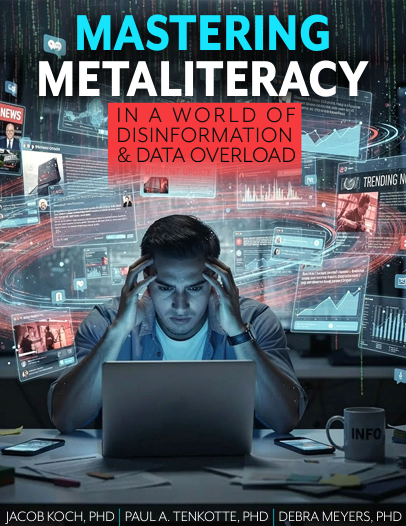
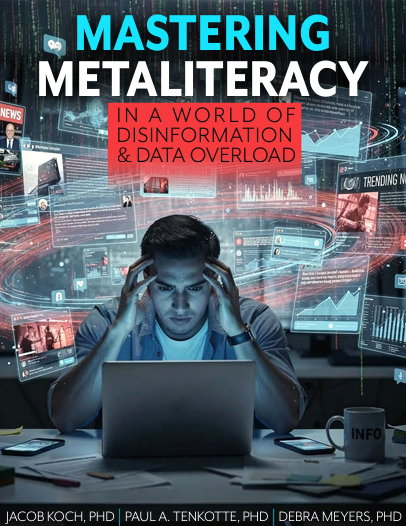
Mastering Metaliteracy in a World of Disinformation and Data Overload

Edition: 1

Copyright: 2026

Pages: 154

Choose Your Format

Ebook

$40.00 USD

ISBN 9798319714589

Details Electronic Delivery EBOOK 180 days

We are currently living through the most volatile, complex, and information-dense era in human history. The traditional definitions of literacy—the simple capacity to read, write, comprehend, and utilize basic computing tools—are no longer sufficient to guarantee personal autonomy and professional success. Today, our shared information ecosystem is saturated with an unprecedented volume of raw data, accelerated by sophisticated algorithms, and frequently contaminated by varying shades of cognitive pollution: disinformation, misinformation, and malinformation. In this new world, individuals are not passive consumers of media. Humans are active nodes in a global network, constantly producing and distributing content. To navigate this reality safely and effectively requires a profound evolutionary leap in how we think about knowledge itself. It requires metaliteracy. Metaliteracy expands traditional information literacy into a comprehensive framework for self-reflective, continuous learning. It shifts the focus from static skill acquisition to dynamic metacognition—the practice of thinking about one’s own thinking, evaluating one’s own digital biases, and deliberately auditing the digital environments we inhabit. Mastering Metaliteracy in a World of Disinformation and Data Overload provides an essential blueprint for this educational transformation, giving readers the concrete, hands-on technical competencies necessary to reclaim agency over their digital lives and build resilient careers.

Chapter 1 The New Literacy: Navigating the Information Ecosystem

1.1 Introduction

1.2 Connecting the Wrong Dots

1.3 Misinformation, Disinformation, and Malinformation

1.4 Metaliteracy and Rapid Change

1.5 Metaliteracy and Generative Artificial Intelligence

1.6 Avoiding Irrational Thinking Patterns

1.7 Many Routes to the Same Destination

1.8 The Limits of Traditional Critical Thinking

1.9 CASHIER: The 7 Steps of Metaliteracy

1.10 C Stands for Choosing, Collecting, and Context

1.11 A Stands for Analyze

1.12 S Stands for Synthesize

1.13 H Stands for Honesty

1.14 I Stands for Integrating

1.15 E Stands for End Product and Evidence

1.16 R Stands for Reflection

1.17 Conclusion

1.18 Assignment: The New Literacy, Navigating the Information Ecosystem – Metaliteracy Application

1.19 Endnotes


Chapter 2 Tool-Task Alignment and Digital Literacy
2.1 Introduction
2.2 Mastering the Learning Process
2.3 Essential Technology Concepts
2.4 The WHY and HOW of Information Flow
2.5 Industry Standard Solutions
2.6 Freeware/Freemiumware
2.7 Open Source Technologies
2.8 Assignment: Technological Fluency and Concept Application
2.9 Endnotes


Chapter 2A Deep Dive Lab Exercise: Data Presentation and Workflow Visualization
2A.1 Introduction
2A.2 Lab 1 Modern Office Suites and Data Visualization


Chapter 3 Creating Your Metaliteracy Career Plan
3.1 Introduction
3.2 Walking Slowly Forward, Not Backwards
3.3 Reviewing the CASHIER Model
3.4 Adding another “C”: Career
3.5 Analysis
3.6 Synthesis and Honesty
3.7 Integrating New Technology and Skills
3.8 Achieving an End Product Using Evidence
3.9 Reflecting
3.10 Programming Languages
3.11 The Structure of Language
3.12 Assignment: Creating a Metaliteracy Career Plan
3.13 Endnotes


Chapter 4 Fundamental Tools for Success
4.1 Introduction
4.2 Operating Systems
4.3 Never Install a Different Operating System Unless You Want to Completely Erase Everything on Your Device
4.4 Why Open-Source? What is Linux and Why Use It?
4.5 Basics of Navigating Linux
4.6 Steps to Upload Linux Alpine to Navigate This Chapter
4.7 Using Alpine Linux
4.8 The Root Directory and Subfolders
4.9 Scripting and Python
4.10 Writing and Running Code
4.11 Conclusion
4.12 Endnotes


Chapter 4A Deep Dive Lab Exercises: Working with Linux and Python in the Browser
4A.1 Introduction
4A.2 Lab 01 Setting Up Your Linux Workspace and Performing Basic Navigation
4A.3 Lab 02 Creating Your Anaconda Account and Setting up Your Environment
4A.4 Lab 03 Creating Basic Python Scripts to Demonstrate Fundamentals
4A.5 Conclusion


Chapter 5 From Raw Data to Actionable Insights
5.1 Introduction
5.2 Clean Data for Analysis
5.3 Libraries and Visualizing Data in Python
5.4 Visualizing Data and Matplotlib

5.5 Bar Chart Function
5.6 Histograms
5.7 Pie Charts
5.8 Scatter Plots
5.9 Seaborn
5.10 Bar Plot Function
5.11 Histogram Function
5.12 Scatter Plot Function
5.13 More Complex Features of Python and the Basics of Machine Learning
5.14 The Basics of Lists in Python
5.15 Basics of AI
5.16 Endnotes


Chapter 5A Deep Dive Lab Exercises” Exploring Python Libraries and Functions in Greater Depth
5A.1 Introduction
5A.2 Lab Protocol: Technical Configuration and Visualization
5A.3 Accessibility and Resources
5A.4 Review of When to Use Quotation Marks, Brackets/Parentheses, Commas, and Hashtags in Coding
5A.5 A Review of the Print Code
5A.6 Lab: Matplotlib in More Depth
5A.7 Setting Up Your Workspace and Testing a Basic Machine Learning Function
5A.8 Crafting Visualizations and Graphics Using Matplotlib and Seaborn
5A.9 Performing Calculations Using NumPy
5A.10 Working with Different Data Types: BeautifulSoup


Chapter 6 Generative Artificial Intelligence (Gen AI) and Data Privacy
6.1 Introduction
6.2 Tool-Task Alignment and AI
6.3 AI Fundamentals and AI Platforms
6.4 Functional Models of AI
6.5 Primary Leaders in Generative AI
6.6 Applications of AI Across the Spectrum
6.7 Data Privacy and Ethical Considerations Using AI
6.8 How to Alleviate Privacy and Ethical Considerations When Using AI
6.9 AI Decision-Making Framework
6.10 Prompt Engineering
6.11 Assignment: Generative AI Platform Analysis and Policy Proposal Learning Assessment
6.12 Endnotes


Chapter 6A Deep Dive Lab Exercise: Data Presentation and Workflow Visualization
6A.1 Introduction
6A.2 Lab Mastering Prompt Engineering
6A.3 Conclusion
6A.4 Endnote

Glossary of Terminology 

Jacob Koch

Dr. Jacob Koch is an Assistant Professor of Cyber Security and Information Technology in the School of Computing and Analytics at Northern Kentucky University. He earned his Ph.D. in Information Technology from the University of Cincinnati in 2025. His research focuses on cloud computing, virtualization technologies, the Internet of Things (IoT), cybersecurity, and artificial intelligence.

Dr. Koch has received Best Paper Awards for his work, including “Practical Applications of Edge Computing to Accelerate Cloud Hosted Web Content” and “Securing HTTP/3 Web Architecture in the Cloud.” His research collaborations have included partnerships with state and government officials on projects involving historical preservation, bat population studies, virtual systems, and cloud computing technologies.

His current efforts center on advancing technology standardization policies at the university level, while fostering student engagement in the broader regional IEEE community through research and professional development initiatives.

Paul A Tenkotte

Paul A. Tenkotte, PhD is Professor of History at Northern Kentucky University. He has published 19 books, authored chapters and essays for 13 additional books, and written/edited more than 600 articles and book reviews for a wide range of publications. In addition, he has participated in 23 television documentaries, including his 2018 national PBS debut, Ten That Changed America: Engineering Marvels. Tenkotte is editor of the weekly "Our Rich History" column in the NKyTribune, an online publication of the non-profit Kentucky Center for Public Service Journalism: https://www.nkytribune.com/category/our-rich-history/. Currently, he is co-directing a non-profit regional initiative of the Kenton County Public library (KY) entitled ORVILLE (Ohio River Valley Innovation Library and Learning Engagement): https://orvillelearning.org/. He also serves as Chair of the History and Heritage Committee of Ohio River Way: https://www.ohioriverway.org/.  

Debra Meyers

Dr. Debra Meyers received her PhD from the University of Rochester and has a master’s degree in religious studies from Mount St. Joseph University. Meyers was recognized for her achievements with Northern Kentucky University’s 2019 Frank Sinton Milburn Outstanding Professor Award, which honors a faculty member who has demonstrated excellence in teaching, scholarship and service over the course of her career.  Meyers’ students also extol the ways in which she encourages each one to succeed.  In 2017, she received the Outstanding Faculty Advisor Award, nominated by online students she had never met face to face, but who were still so impacted by her tireless work as a teacher, mentor, and service-oriented faculty member.  Meyers has published a dozen books as a professor of history, religion, and gender studies and dozens of articles and book chapters.  

We are currently living through the most volatile, complex, and information-dense era in human history. The traditional definitions of literacy—the simple capacity to read, write, comprehend, and utilize basic computing tools—are no longer sufficient to guarantee personal autonomy and professional success. Today, our shared information ecosystem is saturated with an unprecedented volume of raw data, accelerated by sophisticated algorithms, and frequently contaminated by varying shades of cognitive pollution: disinformation, misinformation, and malinformation. In this new world, individuals are not passive consumers of media. Humans are active nodes in a global network, constantly producing and distributing content. To navigate this reality safely and effectively requires a profound evolutionary leap in how we think about knowledge itself. It requires metaliteracy. Metaliteracy expands traditional information literacy into a comprehensive framework for self-reflective, continuous learning. It shifts the focus from static skill acquisition to dynamic metacognition—the practice of thinking about one’s own thinking, evaluating one’s own digital biases, and deliberately auditing the digital environments we inhabit. Mastering Metaliteracy in a World of Disinformation and Data Overload provides an essential blueprint for this educational transformation, giving readers the concrete, hands-on technical competencies necessary to reclaim agency over their digital lives and build resilient careers.

Chapter 1 The New Literacy: Navigating the Information Ecosystem

1.1 Introduction

1.2 Connecting the Wrong Dots

1.3 Misinformation, Disinformation, and Malinformation

1.4 Metaliteracy and Rapid Change

1.5 Metaliteracy and Generative Artificial Intelligence

1.6 Avoiding Irrational Thinking Patterns

1.7 Many Routes to the Same Destination

1.8 The Limits of Traditional Critical Thinking

1.9 CASHIER: The 7 Steps of Metaliteracy

1.10 C Stands for Choosing, Collecting, and Context

1.11 A Stands for Analyze

1.12 S Stands for Synthesize

1.13 H Stands for Honesty

1.14 I Stands for Integrating

1.15 E Stands for End Product and Evidence

1.16 R Stands for Reflection

1.17 Conclusion

1.18 Assignment: The New Literacy, Navigating the Information Ecosystem – Metaliteracy Application

1.19 Endnotes


Chapter 2 Tool-Task Alignment and Digital Literacy
2.1 Introduction
2.2 Mastering the Learning Process
2.3 Essential Technology Concepts
2.4 The WHY and HOW of Information Flow
2.5 Industry Standard Solutions
2.6 Freeware/Freemiumware
2.7 Open Source Technologies
2.8 Assignment: Technological Fluency and Concept Application
2.9 Endnotes


Chapter 2A Deep Dive Lab Exercise: Data Presentation and Workflow Visualization
2A.1 Introduction
2A.2 Lab 1 Modern Office Suites and Data Visualization


Chapter 3 Creating Your Metaliteracy Career Plan
3.1 Introduction
3.2 Walking Slowly Forward, Not Backwards
3.3 Reviewing the CASHIER Model
3.4 Adding another “C”: Career
3.5 Analysis
3.6 Synthesis and Honesty
3.7 Integrating New Technology and Skills
3.8 Achieving an End Product Using Evidence
3.9 Reflecting
3.10 Programming Languages
3.11 The Structure of Language
3.12 Assignment: Creating a Metaliteracy Career Plan
3.13 Endnotes


Chapter 4 Fundamental Tools for Success
4.1 Introduction
4.2 Operating Systems
4.3 Never Install a Different Operating System Unless You Want to Completely Erase Everything on Your Device
4.4 Why Open-Source? What is Linux and Why Use It?
4.5 Basics of Navigating Linux
4.6 Steps to Upload Linux Alpine to Navigate This Chapter
4.7 Using Alpine Linux
4.8 The Root Directory and Subfolders
4.9 Scripting and Python
4.10 Writing and Running Code
4.11 Conclusion
4.12 Endnotes


Chapter 4A Deep Dive Lab Exercises: Working with Linux and Python in the Browser
4A.1 Introduction
4A.2 Lab 01 Setting Up Your Linux Workspace and Performing Basic Navigation
4A.3 Lab 02 Creating Your Anaconda Account and Setting up Your Environment
4A.4 Lab 03 Creating Basic Python Scripts to Demonstrate Fundamentals
4A.5 Conclusion


Chapter 5 From Raw Data to Actionable Insights
5.1 Introduction
5.2 Clean Data for Analysis
5.3 Libraries and Visualizing Data in Python
5.4 Visualizing Data and Matplotlib

5.5 Bar Chart Function
5.6 Histograms
5.7 Pie Charts
5.8 Scatter Plots
5.9 Seaborn
5.10 Bar Plot Function
5.11 Histogram Function
5.12 Scatter Plot Function
5.13 More Complex Features of Python and the Basics of Machine Learning
5.14 The Basics of Lists in Python
5.15 Basics of AI
5.16 Endnotes


Chapter 5A Deep Dive Lab Exercises” Exploring Python Libraries and Functions in Greater Depth
5A.1 Introduction
5A.2 Lab Protocol: Technical Configuration and Visualization
5A.3 Accessibility and Resources
5A.4 Review of When to Use Quotation Marks, Brackets/Parentheses, Commas, and Hashtags in Coding
5A.5 A Review of the Print Code
5A.6 Lab: Matplotlib in More Depth
5A.7 Setting Up Your Workspace and Testing a Basic Machine Learning Function
5A.8 Crafting Visualizations and Graphics Using Matplotlib and Seaborn
5A.9 Performing Calculations Using NumPy
5A.10 Working with Different Data Types: BeautifulSoup


Chapter 6 Generative Artificial Intelligence (Gen AI) and Data Privacy
6.1 Introduction
6.2 Tool-Task Alignment and AI
6.3 AI Fundamentals and AI Platforms
6.4 Functional Models of AI
6.5 Primary Leaders in Generative AI
6.6 Applications of AI Across the Spectrum
6.7 Data Privacy and Ethical Considerations Using AI
6.8 How to Alleviate Privacy and Ethical Considerations When Using AI
6.9 AI Decision-Making Framework
6.10 Prompt Engineering
6.11 Assignment: Generative AI Platform Analysis and Policy Proposal Learning Assessment
6.12 Endnotes


Chapter 6A Deep Dive Lab Exercise: Data Presentation and Workflow Visualization
6A.1 Introduction
6A.2 Lab Mastering Prompt Engineering
6A.3 Conclusion
6A.4 Endnote

Glossary of Terminology 

Jacob Koch

Dr. Jacob Koch is an Assistant Professor of Cyber Security and Information Technology in the School of Computing and Analytics at Northern Kentucky University. He earned his Ph.D. in Information Technology from the University of Cincinnati in 2025. His research focuses on cloud computing, virtualization technologies, the Internet of Things (IoT), cybersecurity, and artificial intelligence.

Dr. Koch has received Best Paper Awards for his work, including “Practical Applications of Edge Computing to Accelerate Cloud Hosted Web Content” and “Securing HTTP/3 Web Architecture in the Cloud.” His research collaborations have included partnerships with state and government officials on projects involving historical preservation, bat population studies, virtual systems, and cloud computing technologies.

His current efforts center on advancing technology standardization policies at the university level, while fostering student engagement in the broader regional IEEE community through research and professional development initiatives.

Paul A Tenkotte

Paul A. Tenkotte, PhD is Professor of History at Northern Kentucky University. He has published 19 books, authored chapters and essays for 13 additional books, and written/edited more than 600 articles and book reviews for a wide range of publications. In addition, he has participated in 23 television documentaries, including his 2018 national PBS debut, Ten That Changed America: Engineering Marvels. Tenkotte is editor of the weekly "Our Rich History" column in the NKyTribune, an online publication of the non-profit Kentucky Center for Public Service Journalism: https://www.nkytribune.com/category/our-rich-history/. Currently, he is co-directing a non-profit regional initiative of the Kenton County Public library (KY) entitled ORVILLE (Ohio River Valley Innovation Library and Learning Engagement): https://orvillelearning.org/. He also serves as Chair of the History and Heritage Committee of Ohio River Way: https://www.ohioriverway.org/.  

Debra Meyers

Dr. Debra Meyers received her PhD from the University of Rochester and has a master’s degree in religious studies from Mount St. Joseph University. Meyers was recognized for her achievements with Northern Kentucky University’s 2019 Frank Sinton Milburn Outstanding Professor Award, which honors a faculty member who has demonstrated excellence in teaching, scholarship and service over the course of her career.  Meyers’ students also extol the ways in which she encourages each one to succeed.  In 2017, she received the Outstanding Faculty Advisor Award, nominated by online students she had never met face to face, but who were still so impacted by her tireless work as a teacher, mentor, and service-oriented faculty member.  Meyers has published a dozen books as a professor of history, religion, and gender studies and dozens of articles and book chapters.