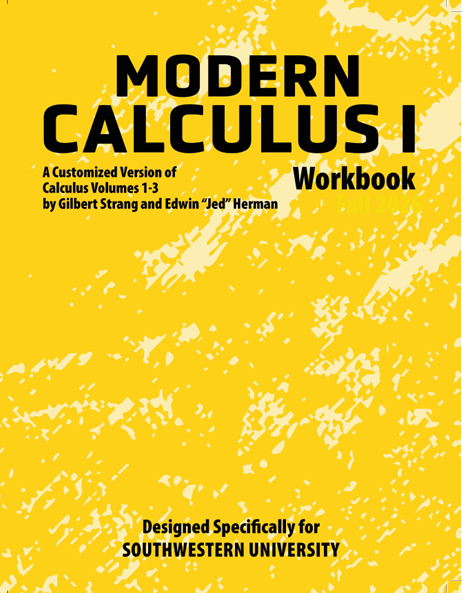
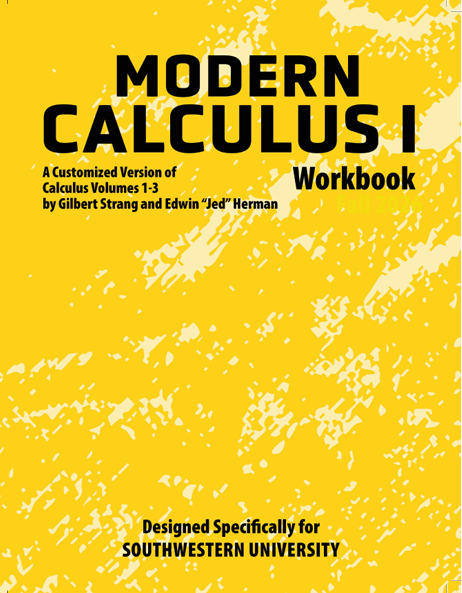
Modern Calculus I Workbook A Customized Version of Calculus Volumes 1-3 by Gilbert Strang and Edwin "Jed" Herman
Edition: 1
Copyright: 2026
Pages: 196
Choose Your Format
$27.00 USD
Modern Calculus provides a comprehensive introduction to calculus by building from foundational function concepts to advanced applications. The book begins with reviews of linear, power, inverse, exponential, logarithmic, and trigonometric functions, along with mathematical modeling and function transformations. It then develops the core concepts of differential calculus, including derivatives, differentiation rules, the chain rule, implicit differentiation, related rates, optimization, and antiderivatives. The text concludes with topics in multivariable calculus, vectors, partial derivatives, gradients, directional derivatives, integration, the Fundamental Theorem of Calculus, integration applications, and the Net Change Theorem. References and an appendix introducing SageMath are also included to support further study.
Topic 1: A review of Linear, Power, and other Basic Functions
Topic 2: Inverse Functions and Exponential & Logarithmic Functions
Topic 3: Modeling Data with Linear, Power, and Exponential Functions
Topic 4: Transforming Functions and Asymptotic Behavior of Functions
Topic 5: A Review of Trigonometric Functions
Topic 6: Modeling with Sinusoidal Functions
Topic 7: Introduction to the Derivative
Topic 8: The Derivatives as a Function
Topic 9: More on Derivatives
Topic 10: Derivatives Rules and Linear Approximation
Topic 11: Derivatives of Exponential, Logarithmic, and Trigonometric Functions
Topic 12: The Chain Rule
Topic 13: Implicit Differentiation and Related Rates
Topic 14: Optimization
Topic 15: Antiderivatives and Initial Value Problems
Topic 16: The Logistic Growth Model
Topic 17: Vectors in R2 and R3
Topic 18: Multivariable Functions
Topic 19: Partial Derivatives
Topic 20: The Gradient and Directional Derivative
Topic 21: Area and Accumulation
Topic 22: The Definite Integral
Topic 23: The Fundamental Theorem[s] of Calculus
Topic 24: Integration Applications and the Net Change Theorem
References
Appendix: A Brief Introduction to SageMath

Dr. Richards strives to engage students in the process of discovering the beauty and utility of mathematics.
He received his PhD from Texas Tech University in 1991 and his BS & MA from Eastern New Mexico University in 1984 & 1986, respectively.
Research Areas: Special Functions, Inequalities, Complex Analysis
Modern Calculus provides a comprehensive introduction to calculus by building from foundational function concepts to advanced applications. The book begins with reviews of linear, power, inverse, exponential, logarithmic, and trigonometric functions, along with mathematical modeling and function transformations. It then develops the core concepts of differential calculus, including derivatives, differentiation rules, the chain rule, implicit differentiation, related rates, optimization, and antiderivatives. The text concludes with topics in multivariable calculus, vectors, partial derivatives, gradients, directional derivatives, integration, the Fundamental Theorem of Calculus, integration applications, and the Net Change Theorem. References and an appendix introducing SageMath are also included to support further study.
Topic 1: A review of Linear, Power, and other Basic Functions
Topic 2: Inverse Functions and Exponential & Logarithmic Functions
Topic 3: Modeling Data with Linear, Power, and Exponential Functions
Topic 4: Transforming Functions and Asymptotic Behavior of Functions
Topic 5: A Review of Trigonometric Functions
Topic 6: Modeling with Sinusoidal Functions
Topic 7: Introduction to the Derivative
Topic 8: The Derivatives as a Function
Topic 9: More on Derivatives
Topic 10: Derivatives Rules and Linear Approximation
Topic 11: Derivatives of Exponential, Logarithmic, and Trigonometric Functions
Topic 12: The Chain Rule
Topic 13: Implicit Differentiation and Related Rates
Topic 14: Optimization
Topic 15: Antiderivatives and Initial Value Problems
Topic 16: The Logistic Growth Model
Topic 17: Vectors in R2 and R3
Topic 18: Multivariable Functions
Topic 19: Partial Derivatives
Topic 20: The Gradient and Directional Derivative
Topic 21: Area and Accumulation
Topic 22: The Definite Integral
Topic 23: The Fundamental Theorem[s] of Calculus
Topic 24: Integration Applications and the Net Change Theorem
References
Appendix: A Brief Introduction to SageMath
Dr. Richards strives to engage students in the process of discovering the beauty and utility of mathematics.
He received his PhD from Texas Tech University in 1991 and his BS & MA from Eastern New Mexico University in 1984 & 1986, respectively.
Research Areas: Special Functions, Inequalities, Complex Analysis