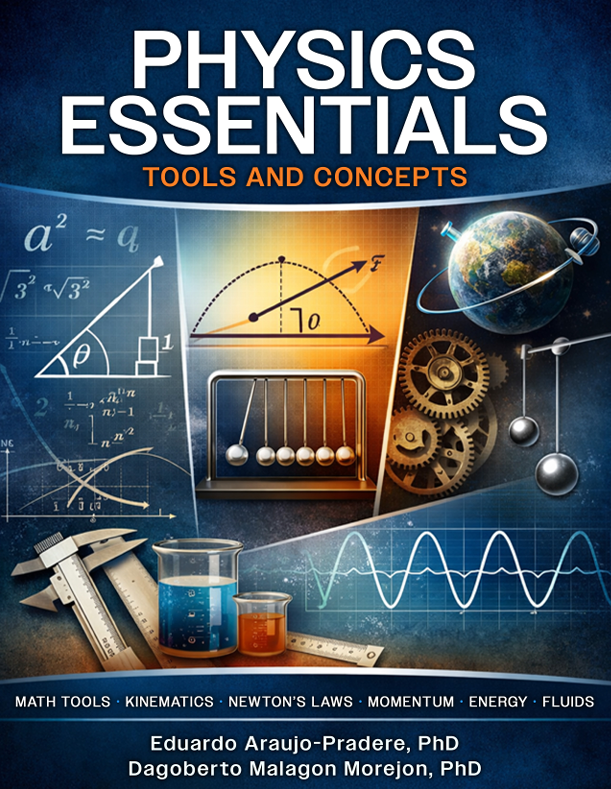
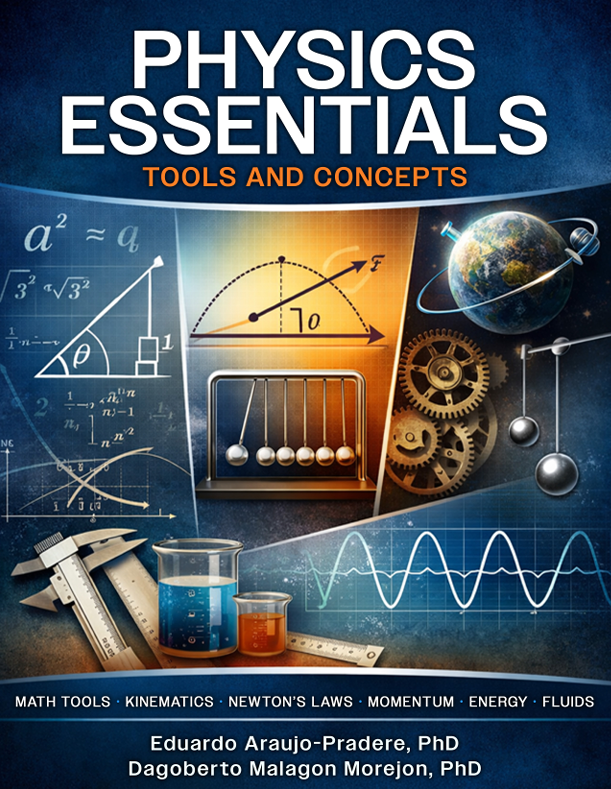
Physics Essentials: Tools and Concepts

Edition: 1

Copyright: 2026

Pages: 570

Choose Your Format

Ebook

$150.00 USD

ISBN 9798319719379

Details Electronic Delivery EBOOK 180 days

Physics Essentials: Tools and Concepts provides a comprehensive introduction to foundational physics concepts, beginning with the mathematical and measurement skills needed to solve physics problems. It covers kinematics, Newton’s laws of motion, circular motion, gravitation, work and energy, momentum and collisions, rotational motion, and statics. The later chapters apply these principles to real-world physical systems, including fluids, pressure, buoyancy, and fluid flow. Overall, it emphasizes how fundamental physics principles can be applied to motion, forces, equilibrium, and everyday physical phenomena.

Welcome to Physics Essentials 
Acknowledgments 
About the Authors 

Chapter 1 Physics Essential Tool Kit 
Introduction 
Part I: Mathematical Tool Kit 
1.1 Exponents and Common Notations 
1.2 Algebra Refresher 
1.3 A Review of Plane Geometry
1.4 Fundamentals of Trigonometry
1.5 Graphing in Physics 
1.6 An Introduction to Vectors
Part II: Physics and Measurement 
1.7 The Nature of Physics 
1.8 Physical Quantities and Standards 
1.9 Measurement, Uncertainty, and Significant Figures 
1.10 Working with Units and Estimates 
Chapter Review 

Chapter 2 Kinematics
2.1 Introduction: Kinematics in One Dimension 
2.2 Initial Definitions: Displacement, Velocity, Acceleration 
2.3 Equations of Kinematics (Constant Acceleration) 
2.4 Graphical Representations 
2.5 Freely Falling Objects 
2.6 Kinematics in Two Dimensions—Projectile Model and Assumptions 
2.7 Relative Motion Applications 

Chapter 3 Dynamics: Newton’s Laws of Motion 
Introduction
3.1 Force 
3.2 Newton’s First Law of Motion 
3.3 Newton’s Second Law of Motion 
3.4 Newton’s Third Law of Motion
3.5 Common Force Models
3.6 Problem Solving with Newton’s Laws

Chapter 4 Introduction: Uniform Circular Motion and Gravitation 
Introduction
4.1 Circular Motion: Angle of Rotation, Angular Speed, and Tangential Speed 
4.2 Uniform Circular Motion Kinematics 
4.3 Centripetal (Radial) Acceleration 
4.4 Dynamics of Uniform Circular Motion 
4.5 Applications of Uniform Circular Motion
4.6 Nonuniform Circular Motion: Centripetal and Tangential Acceleration 
4.7 Newton’s Law of Universal Gravitation
4.8 Gravity Near the Earth’s Surface 
4.9 Orbits and Satellites 
4.10 Kepler’s Laws of Planetary Motion 

Chapter 5 Work and Energy 
5.1 Work by a Constant Force
5.2 Kinetic Energy and the Work–Energy Theorem
5.3 Potential Energy 
5.4 Mechanical Energy and Its Conservation
5.5 Other Forms of Energy and Energy Transformations 
5.6 Power 

Chapter 6 Linear Momentum and Collisions 
6.1 Linear Momentum 
6.2 Linear Momentum and Force
6.3 Conservation of Momentum 
6.4 Impulse and Collisions
6.5 Collisions in Two and Three Dimensions 
6.6 Center of Mass 

Chapter 7 Rotational Motion
7.1 Linear and Angular Quantities
7.2 Rotational Kinematics (Constant Angular Acceleration) 
7.3 Rolling Motion without Slipping 
7.4 Rotational Dynamics: Torque and Rotational Inertia 
7.5 Rotational Kinetic Energy and Conservation of Energy
7.6 Angular Momentum and Its Conservation 

Chapter 8 Statics 
Introduction 
8.1 The First Condition for Equilibrium 
8.2 The Second Condition for Equilibrium 
8.3 Stability and Balance
8.4 Levers—Simple Machines 
8.5 Forces and Torques in Muscles and Joints

Chapter 9 Fluids 
Introduction 
9.1 Phases of Matter and Density 
9.2 Pressure 
9.3 Pascal’s Principle 
9.4 Flow Rate and the Continuity Equation
9.5 Bernoulli’s Principle and Applications 
9.6 Archimedes’ Principle and Buoyancy 
9.7 Viscosity 


Eduardo Araujo Pradere
Dagoberto Malagon Morejon