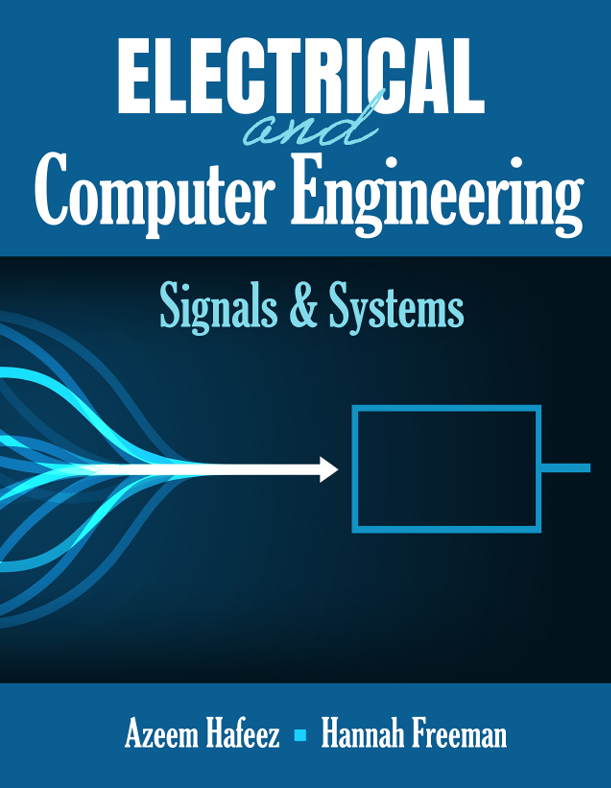
Signals & Systems
Edition: 1
Copyright: 2026
Pages: 170
Choose Your Format
Ebook
$90.00 USD
Signals and Systems provides a comprehensive introduction to the fundamental concepts of analog and digital signal processing. The book begins with analog signals, covering signal classifications, sampling, analog-to-digital conversion, memory requirements, sampling theorems, periodic signals, and signal energy and power. It then explains signal operations such as arithmetic, differentiation, integration, time transformations, amplitude scaling, and correlation.
The text introduces analog systems by examining system classifications, important signal functions, and the response of linear time-invariant (LTI) systems through convolution. It also develops the mathematical foundation with complex numbers before presenting key analysis techniques, including Fourier series, Fourier transforms, Laplace transforms, and their applications in frequency-domain analysis.
The later chapters focus on practical topics such as amplitude modulation, analog filters, digital signals, sampling, the Z-transform, the Discrete-Time Fourier Transform (DTFT), digital systems, and digital filters. Together, these topics provide a structured progression from basic signal concepts to advanced methods for analyzing and designing analog and digital systems.
Chapter 1: Introduction to Analog Signals
Chapter 2: Operations on Signals
Chapter 3: Introduction to Analog Systems with Classification
Chapter 4: Response of LTI System – Convolution
Chapter 5: Complex Numbers
Chapter 6: Fourier Series
Chapter 7: Fourier Transform
Chapter 8: Laplace Transform
Chapter 9: Amplitude Modulation
Chapter 10: Analog Filters
Chapter 11: Introduction to Digital Signals and Sampling
Chapter 12: Z-Transform and Discrete Time Fourier Transform
Chapter 13: Introduction to Digital Systems
Chapter 14: Digital Filters