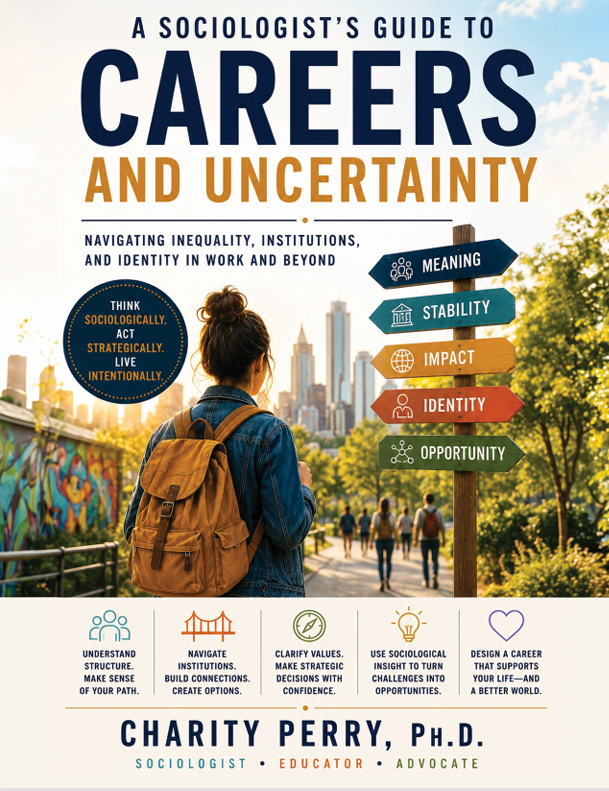
A Sociologist's Guide to Careers and Uncertainty: Navigating Inequality, Institutions and Identity in Work and Beyond

Author(s): Charity Perry

Edition: 1

Copyright: 2026

Pages: 105

Choose Your Format

Ebook

$75.00 USD

ISBN 9798319739476

Details Electronic Delivery EBOOK 180 days

This book is written for students who chose sociology—or are considering it—and have been asked, implicitly or explicitly, a question that feels both practical and unsettling: What are you going to do with that? Beneath this question sits a deeper concern about stability, success, legitimacy, and worth. For many undergraduates, especially first-generation students, students from working-class backgrounds, and students from marginalized racial and gender groups, career uncertainty does not feel like an abstract future problem. It feels immediate, personal, and moralized. 

Throughout this book, sociology is paired with psychology in a deliberate way. Each chapter concludes with a psychological perspective examining how structural conditions become emotionally lived experiences through anxiety, self-monitoring, imposter feelings, identity conflict, motivation, uncertainty, and decision-making. Psychology is used here not to individualize responsibility, but to explain how social structures shape internal experience. 

This integration is important because students do not experience institutions abstractly. Labor markets, classrooms, interviews, workplaces, and professional hierarchies affect how individuals feel about themselves. Economic precarity becomes anxiety. Institutional exclusion becomes belonging uncertainty. Unequal evaluation becomes chronic self-monitoring. Sociology and psychology together allow these experiences to be understood both structurally and emotionally. 

The chapters that follow examine: 

• career anxiety and the sociological imagination, 

• stratification and labor market inequality, 

• race, class, and gendered career outcomes, 

• cultural capital and the hidden curriculum,

• occupational cultures, 

• professional identity and impression management, 

• résumés and skill translation, 

• imposter syndrome, 

• networking and social capital, 

• hiring and rejection, 

• graduate education, 

• and the challenge of defining success within unequal institutions. 

Taken together, these chapters argue that careers are not merely personal achievements or failures. They are socially organized processes shaped by power, evaluation, institutional access, and historical inequality.

Introduction 
Chapter 1 Why Sociology Careers Matter 
  Career Anxiety as a Social Experience 
  The “What Can You Do With Sociology?” Question 
  Jobs, Careers, and Vocational Identity 
  Applying the Sociological Imagination to Careers 
  Psychological Perspective: Career Anxiety and Identity Formation Chapter 2 Power, Stratification, and Career Inequality 
  How This Chapter Has Been Expanded for Publication 
  Careers as Stratified Systems 
  Power in Labor Markets 
  Credentialism and Gatekeeping 
  Institutions and Opportunity Pipelines 
  Who Gets Access to Opportunity 
  Psychological Perspective: Power, Control, and Internalized Constraint 
Chapter 3 Race, Class, Gender, and Unequal Career Outcomes 
  Segmented Labor Markets 
  Gendered and Racialized Labor 
  Class Background and Professional Ease 
  Discrimination and Cumulative Advantage 
  Psychological Perspective: Stereotype Threat and Belonging 
Chapter 4 Cultural Capital and the Hidden Curriculum 
  Cultural Capital and Professional Life 
  Habitus and Professional Fit 
  The Hidden Curriculum 
  First-Generation Navigation 
  Psychological Perspective: Cognitive Load and Code-Switching 
Chapter 5 Occupational Cultures and Sociology Career Pathways
  Occupational Cultures as Structured Environments 
  Analytic Dimensions of Occupational Culture 
  Academic Sociology 
  Applied and Policy-Oriented Sociology 
  Nonprofit, Government, and Data-Oriented Roles 
  Psychological Perspective: Identity Sustainability 
Chapter 6 Professional Identity and Impression Management 
  Work as Performance 
  Frontstage and Backstage Selves 
  Authenticity and Survival 
  Learning Professional Performance 
  Psychological Perspective: Self-Monitoring and Burnout 
Chapter 7 Résumés, CVs, and Translating Sociology Skills 
  Audiences and Purposes 
  Common Mistakes 
  Translating Sociological Skills 
  Making Invisible Labor Visible 
  Psychological Perspective: Self-Efficacy and Imposter Feelings 
Chapter 8 Imposter Syndrome as a Sociological Phenomenon 
  What Is Imposter Syndrome? 
  Why Individual Explanations Fall Short 
  Tokenism and Organizational Culture 
  Normalizing Doubt Without Individualizing Failure 
  Psychological Perspective: Belonging Uncertainty 
Chapter 9 Professional Communication, Credibility, and Authority 
  Communication as Social Action 
  Written vs. Verbal Norms 
  Gendered and Racialized Evaluations 
  Strategic Communication 
  Psychological Perspective: Confidence Signaling and Misrecognition 
Chapter 10 Networking, Social Capital, and Professional Visibility 
  Rethinking Networking 
  Informational Interviews and Relationship-Building 
  LinkedIn as a Social Field 
  Weak Ties and Opportunity 
  Psychological Perspective: Social Anxiety and Relational Labor 
Chapter 11 Hiring, Rejection, and Emotional Labor
  How Hiring Actually Works 
  Informal Processes and Signaling 
  Rejection as a Structural Experience 
  Emotional Labor of Job Searching 
  Psychological Perspective: Rejection Sensitivity and Coping 
Chapter 12 Graduate Education and Strategic Decision-Making 
  Understanding Graduate Pathways 
  Academic Labor Markets 
  Costs, Benefits, and Timing 
  Nonlinear Pathways 
  Psychological Perspective: Decision-Making Under Uncertainty 
Chapter 13 Agency, Public Sociology, and Redefining Career Success 
  Agency Within Constraint 
  Public Sociology and Applied Impact 
  Ethics, Voice, and Representation 
  Redefining Success 
  Psychological Perspective: Narrative Identity and Purpose 
References and Suggested Readings

Charity Perry

Charity Perry, Ph.D., is a sociologist, educator, author, and therapist with nearly two decades of experience teaching in higher education. She currently teaches in the Sociology Department at California State University, Los Angeles, and has taught courses across sociology and psychology, bringing an interdisciplinary perspective to her work with students. Her teaching and scholarship examine careers, inequality, identity, uncertainty, mental health, and the social forces that shape people’s educational and professional opportunities. 

As both a professor and therapist, Dr. Perry understands that career development is not simply a matter of choosing a profession. It is also a deeply personal process shaped by social class, culture, family expectations, emotional well-being, access to resources, and confidence in one’s own abilities. She is especially committed to supporting first-generation college students, many of whom must learn to navigate higher education and the professional world without inherited networks or a clear roadmap. Her work seeks to make these often-unspoken systems more visible and manageable. 

Through her teaching, work with families, and writing, Dr. Perry encourages students to understand uncertainty not as personal failure, but as a normal part of building a meaningful life and career. Her textbook on sociology, careers, and uncertainty reflects her commitment to providing students with practical guidance while helping them recognize their own agency, resilience, and capacity to define success for themselves.