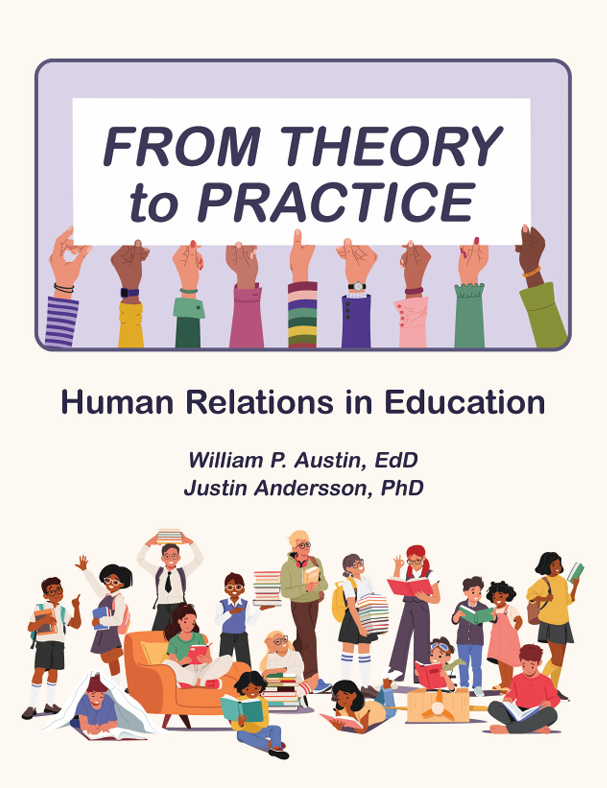
From Theory to Practice: Human Relations in Education

Edition: 1

Copyright: 2026

Pages: 74

Choose Your Format

Ebook

$50.00 USD

ISBN 9798319723086

Details Electronic Delivery EBOOK 180 days

This resource explores the principles of human relations and multicultural education, emphasizing the importance of equity, inclusion, and cultural competence in educational settings. Through topics such as identity, diversity, prejudice, individual differences, socioeconomic status, gender, exceptionalities, religion, and geography, users examine how human relationships influence teaching and learning while developing strategies for creating inclusive and equitable classrooms.

Part A: Human Relations in Education
MODULE 1: Relationships, Culture, Prejudice, and Discrimination 
MODULE 2: Toolbox A (Individual Differences That Affect Learning and Teaching) 
MODULE 3A: (Learning Styles Dictate Hybrid Teaching Styles)
MODULE 3B: (Exceptionalities Toolbox)
PRACTICE ANALYSIS 1: (Racist) Terms of Endearment
GROUP CASE ANALYSIS PROCESS: Th e Equity Literacy Approach
FROM THEORY TO PRACTICE


Part B: Human Relations Multicultural Education
Student Learning Outcomes (SLOs)
MODULE 0: Intrapersonal Relationships (Know Yourself) 
MODULE 1: Identity + Multicultural Education 
MODULE 2: Ethnicity (and Race) 
MODULE 3: Class and Socioeconomic Status 
MODULE 4: Gender and Sexual Orientation
MODULE 5: Exceptionalities
MODULE 6: Religion
MODULE 7: Geography
MODULE 8: Summary—Education Th at Is Multicultural
 

William P. Austin

William Patrick Austin is an Associate Professor of Teacher Education at the University of Nebraska at Omaha. His teaching emphasizes culturally responsive teaching, multicultural education, and STEM education, preparing future educators to create inclusive and engaging learning environments. Dr. Austin's research focuses on diversity awareness, cultural competence in education, health care, and business, inquiry-based learning, and the determinants of culture. His work promotes equitable educational practices and helps educators develop the knowledge and skills needed to serve diverse communities.

Justin Andersson

Justin Andersson, Ph.D. is Director of the Teacher Scholars Academy and a faculty member in Teacher Education at the University of Nebraska at Omaha. A former middle school science teacher in Title I schools in Maryland and Nebraska, he earned his training in educational psychology at the University of Nebraska–Lincoln. His teaching focuses on educational psychology, educational research, and qualitative and mixed methods research. Dr. Andersson's research examines teacher identity development, student motivation in scientific research, and strategies for expanding STEM participation among underrepresented students. His work is dedicated to preparing future educators to use evidence-based practices, compassion, and inclusive teaching to support diverse learners and strengthen educational communities.