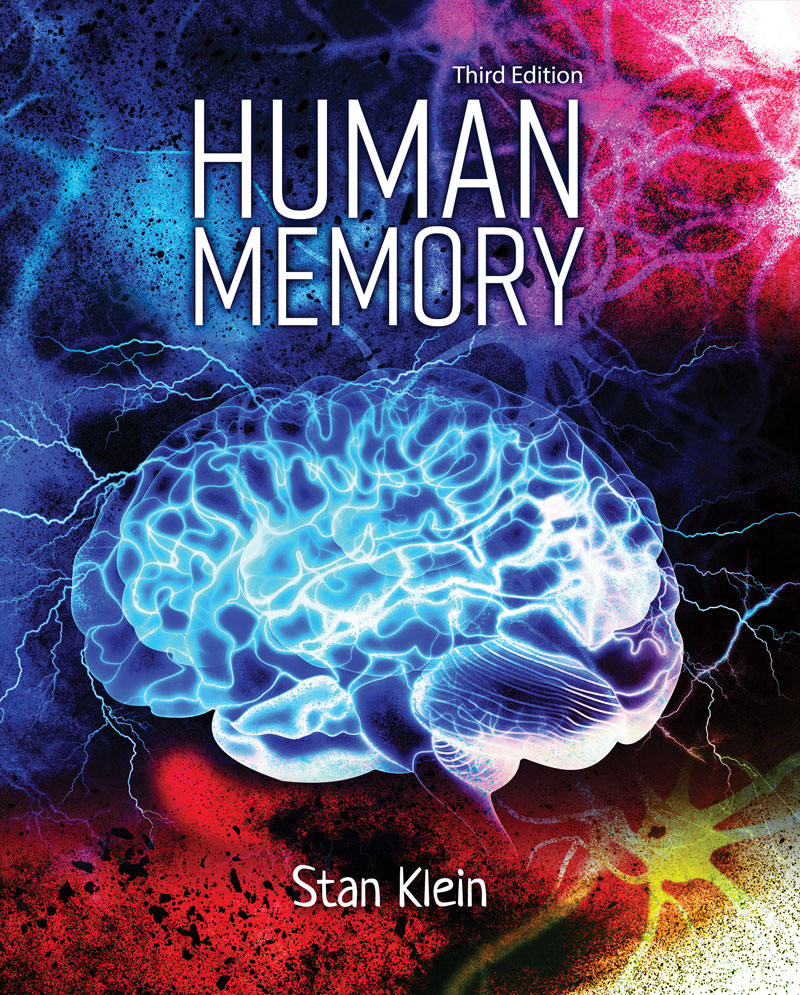

Human Memory
Edition: 3
Copyright: 2019
Pages: 157
Choose Your Format
Ebook
$120.34 USD
Human Memory examines the structure, function, and mechanisms of episodic memory, focusing on how individuals remember personal experiences, construct a sense of time, and maintain a sense of personal identity. The course explores the relationship between memory, consciousness, and the ability to mentally travel into the past and imagine future experiences, including the effects of memory loss and amnesia on these abilities.
The material also addresses the evolution and social functions of episodic memory, how memories are organized and retrieved, exceptional memory abilities, and the processes involved in forgetting. It integrates cognitive psychology, neuroscience, and evolutionary perspectives to explain how memories are formed, reconstructed, maintained, and lost.
Chapter 1: The Concept of Episodic Memory
Chapter 2: What Is Episodic Memory?
Chapter 3: Memory and Temporal Experience: The Effects of Episodic Memory Loss on an Amnesic Patient’s Ability to Remember the Past and Imagine the Future
Chapter 4: Evolution and Episodic Memory: An Analysis and Demonstration of a Social Function of Episodic Recollection
Chapter 5: The Occurrence of Clustering in the Recall of Randomly Arranged Associates
Chapter 6: Supernormal Memory: Mnemonics and Mnemonists
Chapter 7: Making The Case That Episodic Recollection is Attributable to Operations Occurring at Retrieval rather than to Content Stored in a Dedicated Subsystem of Long-Term Memory
Chapter 8: Autonoesis and Belief in a Personal Past: An Evolutionary Theory of Episodic Memory Indices
Chapter 9: Forgetting
Stan Klein, PhD is a professor of psychology at the University of California, Santa Barbara (UCSB), whose research focuses on the relationship between the self, memory, and consciousness. He earned his BA from Stanford University and his PhD from Harvard University. Before joining UCSB, he held academic positions at the University of Illinois at Urbana-Champaign and Trinity University in San Antonio, Texas.
Dr. Klein’s research examines assumptions about human identity, memory, and conscious experience, with particular interest in how psychological and neuroscientific findings inform our understanding of the self. His work explores topics such as self-knowledge, autobiographical memory, personal identity, mental time travel, and the cognitive processes that shape human experience.