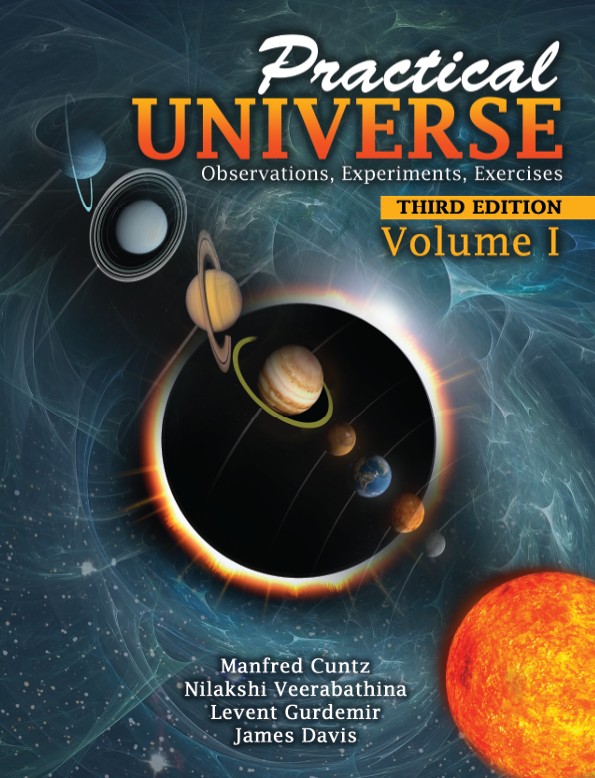
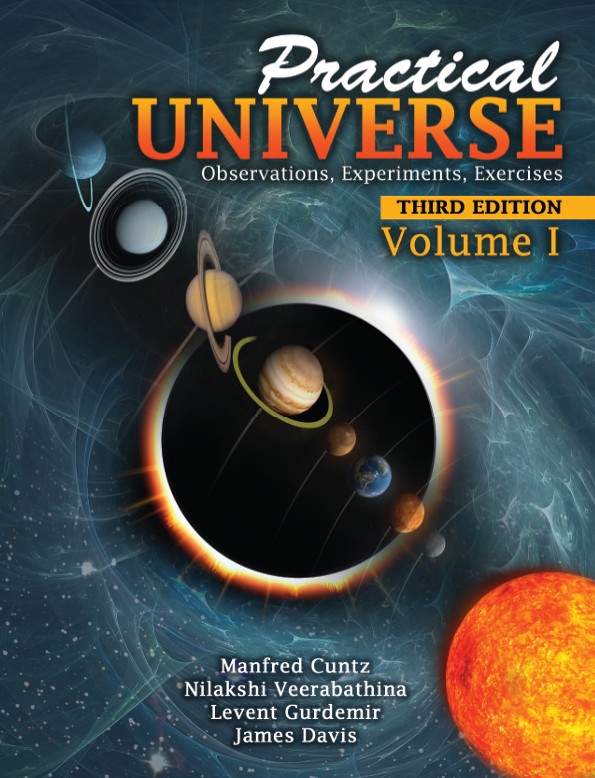
Practical Universe: Observations, Experiments, Exercises

Edition: 3

Copyright: 2026

Pages: 470

Choose Your Format

Ebook


This product is currently not available.

Ebook

$39.00 USD

ISBN 9798319746689

Details Electronic Delivery EBOOK 365 days

Practical Universe: Observations, Experiments, and Exercises has been in print for over twenty-five years. The progress in astronomy since that time, both regarding new observations and the development of new methods and techniques, is gigantic and almost beyond anybody’s comprehension.

Practical Universe: Observations, Experiments, and Exercises: 

  • Is designed to meet the needs and expectations of introductory astronomy courses for non-science majors – no advanced math skills are required.
  • Presents exercises for outdoor observations, regular laboratory experiments, and classroom and homework exercises.
  • Includes units about extrasolar planets, stellar and supermassive black holes and Kuiper Belt Objects.
  • Recognizes the new understanding of the Solar System, now considered to host eight planets instead of nine.
  • Includes exercises available for software packages such as Starry Night and Stellarium.

5. THE SOLAR SYSTEM 
Unit 5.1 – Astronauts’ Weights 
Unit 5.2 – Introduction to the Night Sky 
Unit 5.3 – Use of Star Maps 
Unit 5.4 – The Ecliptic 
Unit 5.5 – The Length of the Day 
Unit 5.6 – Earth’s Geographical Coordinate System 
Unit 5.7 – The Altitude and Azimuth of the Sun 
Unit 5.8 – The Apparent Path of the Moon 

6 FROM STARS TO GALAXIES 
Unit 6.1 – Exoplanetary Systems and Habitable Zones 
Unit 6.2 – Masses of Exoplanet Host Stars 
Unit 6.3 – Parallax: The Distance to a Star 
Unit 6.4 – The HR and MK Diagram 
Unit 6.5 – Cepheids and Other Pulsators 
Unit 6.6 – Globular Clusters and Molecular Clouds 
Unit 6.7 – The Hubble Distance-Redshift Relation 

7 A LITTLE BIT OF ASTROPHYSICS 
Unit 7.1 – The Solar Spectrum 
Unit 7.2 – The Doppler Effect 
Unit 7.3 – The Colors and Luminosities of Stars 
Unit 7.4 – Eclipsing Binaries 
Unit 7.5 – Spectroscopic Binaries 
Unit 7.6 – Black Holes 

TABLES 
1. Astronomical and Physical Constants 
2. The Nearest Stars 
3. The Brightest Stars 
4. Variable Stars 
5. The Messier Catalogue 

SOURCE INFORMATION AND SUGGESTED READINGS

Manfred Cuntz

Manfred Cuntz is a professor at The University of Texas at Arlington (UTA). Originally from Germany, he spent extended time at various science institutions in Colorado, Alabama, and Texas.  His network of collaborations spans all around the globe, including Europe, Japan, Mexico, and India.  He is strongly engaged in research, teaching and public engagements.  In 2020, he was inducted into UTA’s Academy of Distinguished Teachers.  In 2023, he became a fellow with the Committee for Skeptical Inquiry.  Manfred has spent more than 30 years studying the universe, especially stars and planets, including planets where life might be possible.  This book is loosely inspired by the Alpha Centauri system, a triple star system in our immediate cosmic neighborhood, consisting of three suns of different colors (although no effort was made to strictly map the various astronomical data).  Red dwarfs, like the third sun, are known to be especially violent.  Manfred has been involved in numerous public outreach activities, including being a script writer of planetarium shows, and events for kids and grownups of all ages.  Fun with Three Suns in the Sky is his picture book debut.

Nilakshi Veerabathina
Levent Gurdemir

Practical Universe: Observations, Experiments, and Exercises has been in print for over twenty-five years. The progress in astronomy since that time, both regarding new observations and the development of new methods and techniques, is gigantic and almost beyond anybody’s comprehension.

Practical Universe: Observations, Experiments, and Exercises: 

  • Is designed to meet the needs and expectations of introductory astronomy courses for non-science majors – no advanced math skills are required.
  • Presents exercises for outdoor observations, regular laboratory experiments, and classroom and homework exercises.
  • Includes units about extrasolar planets, stellar and supermassive black holes and Kuiper Belt Objects.
  • Recognizes the new understanding of the Solar System, now considered to host eight planets instead of nine.
  • Includes exercises available for software packages such as Starry Night and Stellarium.

5. THE SOLAR SYSTEM 
Unit 5.1 – Astronauts’ Weights 
Unit 5.2 – Introduction to the Night Sky 
Unit 5.3 – Use of Star Maps 
Unit 5.4 – The Ecliptic 
Unit 5.5 – The Length of the Day 
Unit 5.6 – Earth’s Geographical Coordinate System 
Unit 5.7 – The Altitude and Azimuth of the Sun 
Unit 5.8 – The Apparent Path of the Moon 

6 FROM STARS TO GALAXIES 
Unit 6.1 – Exoplanetary Systems and Habitable Zones 
Unit 6.2 – Masses of Exoplanet Host Stars 
Unit 6.3 – Parallax: The Distance to a Star 
Unit 6.4 – The HR and MK Diagram 
Unit 6.5 – Cepheids and Other Pulsators 
Unit 6.6 – Globular Clusters and Molecular Clouds 
Unit 6.7 – The Hubble Distance-Redshift Relation 

7 A LITTLE BIT OF ASTROPHYSICS 
Unit 7.1 – The Solar Spectrum 
Unit 7.2 – The Doppler Effect 
Unit 7.3 – The Colors and Luminosities of Stars 
Unit 7.4 – Eclipsing Binaries 
Unit 7.5 – Spectroscopic Binaries 
Unit 7.6 – Black Holes 

TABLES 
1. Astronomical and Physical Constants 
2. The Nearest Stars 
3. The Brightest Stars 
4. Variable Stars 
5. The Messier Catalogue 

SOURCE INFORMATION AND SUGGESTED READINGS

Manfred Cuntz

Manfred Cuntz is a professor at The University of Texas at Arlington (UTA). Originally from Germany, he spent extended time at various science institutions in Colorado, Alabama, and Texas.  His network of collaborations spans all around the globe, including Europe, Japan, Mexico, and India.  He is strongly engaged in research, teaching and public engagements.  In 2020, he was inducted into UTA’s Academy of Distinguished Teachers.  In 2023, he became a fellow with the Committee for Skeptical Inquiry.  Manfred has spent more than 30 years studying the universe, especially stars and planets, including planets where life might be possible.  This book is loosely inspired by the Alpha Centauri system, a triple star system in our immediate cosmic neighborhood, consisting of three suns of different colors (although no effort was made to strictly map the various astronomical data).  Red dwarfs, like the third sun, are known to be especially violent.  Manfred has been involved in numerous public outreach activities, including being a script writer of planetarium shows, and events for kids and grownups of all ages.  Fun with Three Suns in the Sky is his picture book debut.

Nilakshi Veerabathina
Levent Gurdemir