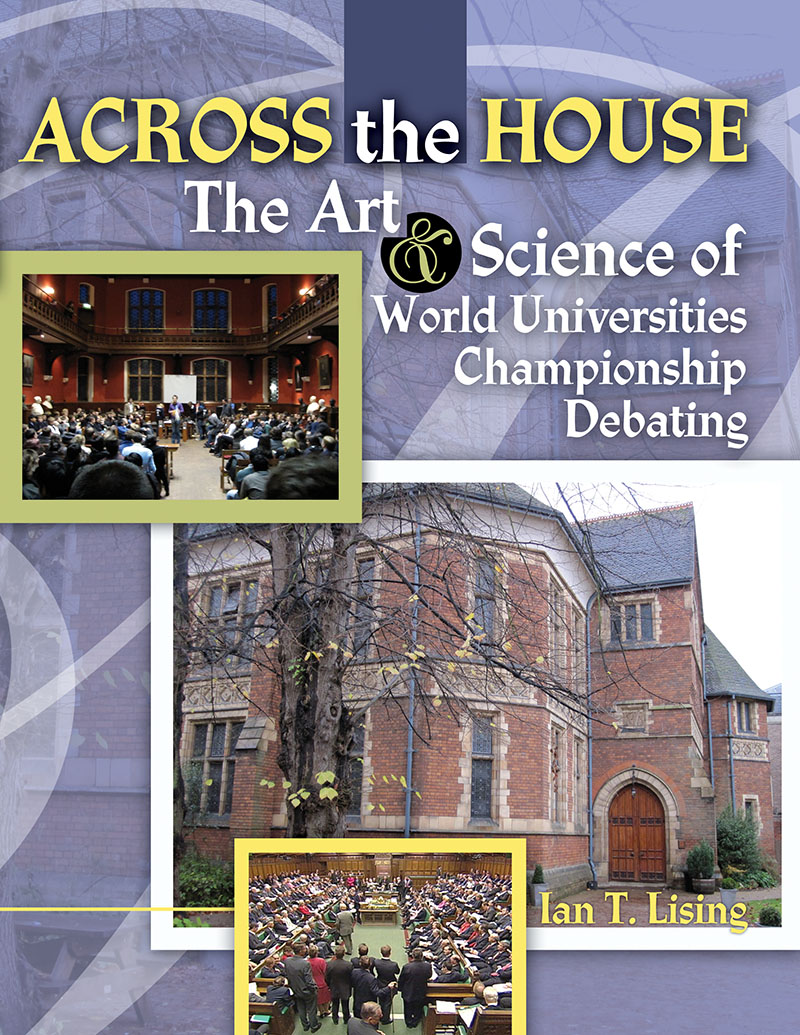
Across the House: The Art and Science of World Universities Championship Debating
Edition: 0
Copyright: 2010
Pages: 154
Edition: 0
Copyright: 2010
Pages: 154
Choose Your Format
$112.31 USD
Ebook
$56.16 USD
Across the House: The Art and Science of World Universities Championship Debating examines the theory, structure, and practice of competitive argumentation, focusing on how effective debates are developed, presented, and evaluated. The material introduces the foundations of debate, including argument construction, persuasive reasoning, the roles of speakers, and the responsibilities of both participants and adjudicators.
The course explores the components of successful debating, including matter (content and arguments), manner (delivery, clarity, and audience engagement), and method (organization, strategy, and responses). It also addresses debate etiquette, judging standards, and official rules used in international university debate competitions, emphasizing critical thinking, communication skills, and structured reasoning.
eBook Version
You will receive access to this electronic text via email after using the shopping cart above to complete your purchase.
Foreword
About the Author
Acknowledgments
CHAPTER 1 Introduction
CHAPTER 2 The Debate
Part I
CHAPTER 3 Matter
CHAPTER 4 Motions
CHAPTER 5 The Opening Government
CHAPTER 6 The Opening Opposition
CHAPTER 7 The Closing Government
CHAPTER 8 The Closing Opposition
Part II
CHAPTER 9 Manner
CHAPTER 10 Achieving Clarity
CHAPTER 11 Entertaining the Audience
CHAPTER 12 Debate Etiquette
Part III
CHAPTER 13 Method
CHAPTER 14 Internal Method
CHAPTER 15 External Method
Part IV
OFFICIAL RULES AND GUIDES
World Universities Debating Championship Rules
Guide to Chairing and Adjudicating a Worlds Debate
Guide to Bidding, Planning, and Running a World Universities Debating Championship
Ian Lising received his B.A. in Political Science from the Ateneo de Manila University in the Philippines. He received his M.A. in Education from the University of La Verne. He is a six-time Grand Finals Adjudicator at the World University Debating Championships. He served as the World Debate Council Chair from 2002–2008. He was honored with the World Debate Council Order of Distinction and named World Council Member Emeritus in 2008. At the University of La Verne, he teaches argumentation and debate, results-oriented interviewing, public controversy and criticism, and rhetorical theory