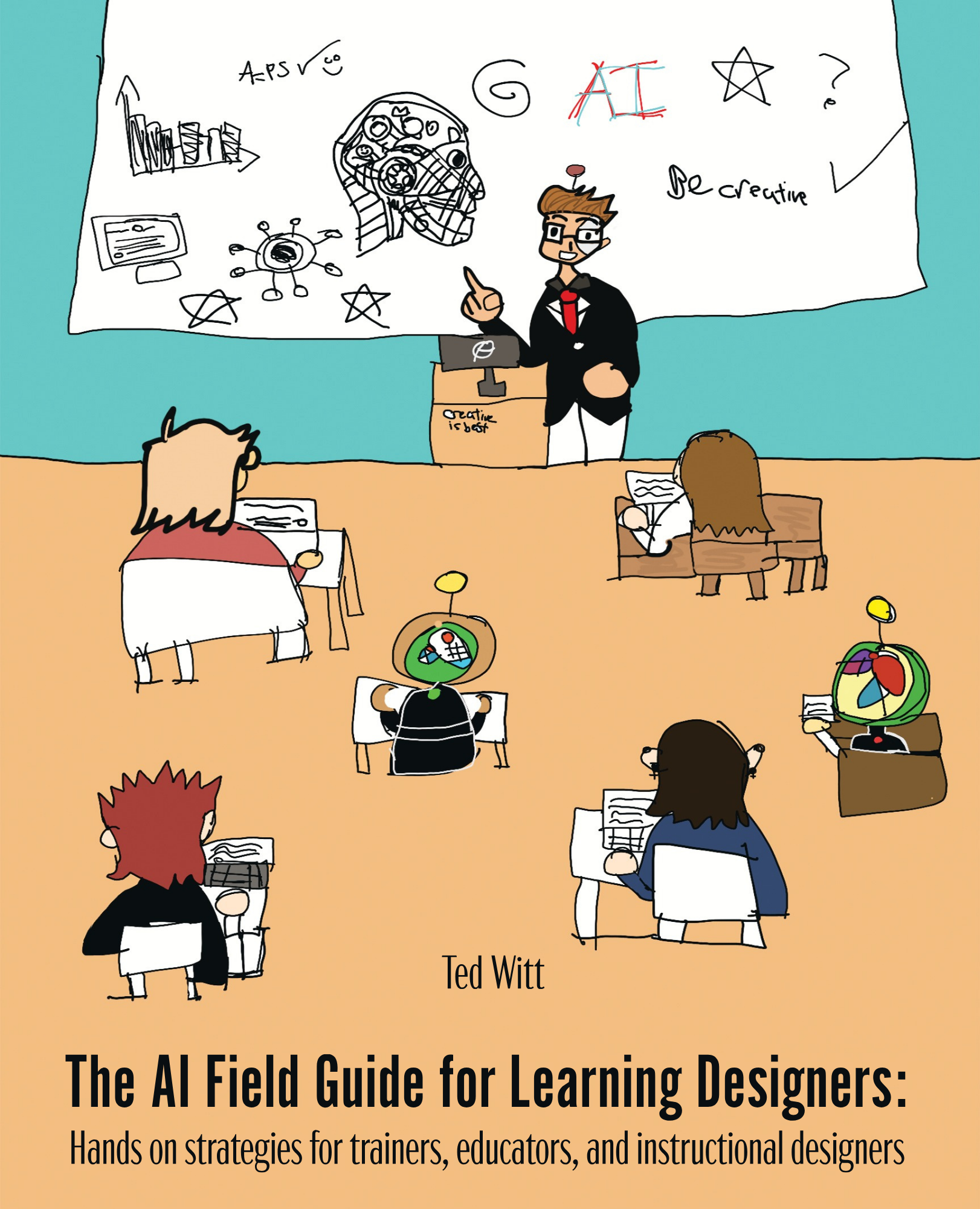
The AI Field Guide for Learning Designers: Hands-on Strategies for Education, Training, and Instructional Design
Edition: 1
Copyright: 2026
Pages: 225
Choose Your Format
Ebook
$82.50 USD
AI for learning designers isn’t coming — it’s already here.
The AI Field Guide for Learning Designers is your practical, hands-on guide to collaborating with AI in your day-to-day design practice. Whether you work in higher ed, K–12 education, corporate learning, or freelance environments, this book meets you where you are — juggling deadlines, navigating ethical questions, and designing smarter, more effective learning experiences.
With a designer’s mindset and a teacher’s voice, author Ted Witt shares real prompts, practical frameworks, and teachable moments from classrooms, project builds, and messy drafts.
From analysis and content development to evaluation and feedback, this book will help you Design Through AI — not just around it. Inside, you’ll find templates, prompt engineering guides, case studies, and practical feedback strategies to support every stage of the instructional design process.
Because the future of learning isn’t just human or machine. It’s both. And it’s time we design like it.
Framed by TED: Technology, Education, Design
Part I – T: Technology
Tools, Prompts, and the Rise of AI in Learning Design
Chapter 1: Welcome to the AI-Powered Design Era
• Why AI matters for instructional designers
• How the design process is evolving
• Use: Intro narrative, landscape summary, author’s note
Chapter 2: What AI Can (and Can’t) Do
• Strengths, limits, and common myths
• Best-fit use cases for instructional designers
• Use: Mythbusting table, student concerns dataset, TED Tip: “AI isn’t magic, but it is a magician’s assistant”
Chapter 3: Prompting as a Design Skill
• Prompting patterns for common instructional design tasks (writing, scripting, summarizing, outlining)
• Tips for teaching prompting to others
• Use: Revised discussion prompt with “knobs and dials” practice activity (sample chapter)
Chapter 4: The AI Toolkit: Text, Media, and Workflow Tools
• Overview and comparison of tools by type (text, video, image, audio, slides)
• Contextual use in higher ed, corporate, and K–12 environments
• Use: Tool matrix, sample course artifacts, Canvas-based design references
Part II – E: Education
Learning Science, Ethics, and the Human Element
Chapter 5: Pedagogy Reimagined — Human–AI Partnerships
• Human + AI co-teaching for personalization, motivation, equity
• Partnership models & pattern library for belonging and curiosity
• Use: persona prompts, adaptive-quiz sprint, belonging-booster activities
Chapter 6: Assessment Reimagined — AI-Powered Evidence & Feedback
• AI-driven assessments for speed, validity, and actionable analytics
• Design matrix, authentic tasks, integrity tech, life-cycle workflows
• Use: rapid-rubric generator, feedback bot, risk-radar dashboard
Chapter 7: Ethics & Equity by Design
• Embed transparency, privacy, fairness, and accessibility in AI learning
• Four-Pillar framework with regulatory grid and safeguard checklists
• Use: bias-hunt mini-lab, privacy-redaction sprint, accessibility audit, risk register
Part III – D: Design
Prototypes, Collaboration, and Real-World Scenarios
Chapter 8: AI in Action: From Idea to Prototype
• Rapid prototyping with storyboards, moodboards, branching scripts
• Co-design workflows for agile learning development
• Use: Project Management, gamification projects, scenario-building exercises,
Chapter 9: Collaborating with AI (and with Humans)
• Working with SMEs, project managers, and stakeholders using AI
• Prompting for interview prep, summaries, and coaching support
• Use: SME coaching examples, stakeholder engagement prompts, real-world design planning
Chapter 10: Translating Across Contexts and Building a Portfolio
• Adapting designs across higher ed, corporate, and nonprofit sectors
• Showcasing AI-enhanced workflows in your portfolio
• Use: Student showcase portfolio walkthroughs, job-focused prompt designs
Ted Witt is an instructional designer, data nerd, and instructor in the Instructional Design & Learning Technology (IDLT) master’s program at the University of Wisconsin–Whitewater, where he helped launch the Production Certificate focused on hands-on Storyline, Rise 360, and project management. He also teaches systems analysis and design, human computer interaction, and sports analytics.
Ted has spent years helping educators, trainers, and IDs turn messy real-world constraints into clear, engaging learning experiences. He is an early and vocal advocate for ethical, practical use of Artificial Intelligence in education and workplace learning. He is known for his workshop-friendly frameworks, field-guide metaphors, dry humor, and live demonstrations that rarely go as planned. We learn best from the mess!
A little bit witty,
Very thoughtful,
Systematically practical,
With a slightly mischievous twinkle under the professionalism.
"Witty, technical, and wildly practical. The TED voice makes complex ideas feel obvious—and immediately usable.”
Dr. Elizabeth King, Associate Professor
“Clear ‘ship-it’ energy throughout ready-to-run prompts, workflows, and deliverables you can use today.”
Joya Davidson, Instructional Design Graduate Student)
“Ethics aren’t an afterthought. Guardrails, bias checks, and transparent provenance make responsible AI feel doable.”
Pat Hurlbut, Instructional Designer
AI for learning designers isn’t coming — it’s already here.
The AI Field Guide for Learning Designers is your practical, hands-on guide to collaborating with AI in your day-to-day design practice. Whether you work in higher ed, K–12 education, corporate learning, or freelance environments, this book meets you where you are — juggling deadlines, navigating ethical questions, and designing smarter, more effective learning experiences.
With a designer’s mindset and a teacher’s voice, author Ted Witt shares real prompts, practical frameworks, and teachable moments from classrooms, project builds, and messy drafts.
From analysis and content development to evaluation and feedback, this book will help you Design Through AI — not just around it. Inside, you’ll find templates, prompt engineering guides, case studies, and practical feedback strategies to support every stage of the instructional design process.
Because the future of learning isn’t just human or machine. It’s both. And it’s time we design like it.
Framed by TED: Technology, Education, Design
Part I – T: Technology
Tools, Prompts, and the Rise of AI in Learning Design
Chapter 1: Welcome to the AI-Powered Design Era
• Why AI matters for instructional designers
• How the design process is evolving
• Use: Intro narrative, landscape summary, author’s note
Chapter 2: What AI Can (and Can’t) Do
• Strengths, limits, and common myths
• Best-fit use cases for instructional designers
• Use: Mythbusting table, student concerns dataset, TED Tip: “AI isn’t magic, but it is a magician’s assistant”
Chapter 3: Prompting as a Design Skill
• Prompting patterns for common instructional design tasks (writing, scripting, summarizing, outlining)
• Tips for teaching prompting to others
• Use: Revised discussion prompt with “knobs and dials” practice activity (sample chapter)
Chapter 4: The AI Toolkit: Text, Media, and Workflow Tools
• Overview and comparison of tools by type (text, video, image, audio, slides)
• Contextual use in higher ed, corporate, and K–12 environments
• Use: Tool matrix, sample course artifacts, Canvas-based design references
Part II – E: Education
Learning Science, Ethics, and the Human Element
Chapter 5: Pedagogy Reimagined — Human–AI Partnerships
• Human + AI co-teaching for personalization, motivation, equity
• Partnership models & pattern library for belonging and curiosity
• Use: persona prompts, adaptive-quiz sprint, belonging-booster activities
Chapter 6: Assessment Reimagined — AI-Powered Evidence & Feedback
• AI-driven assessments for speed, validity, and actionable analytics
• Design matrix, authentic tasks, integrity tech, life-cycle workflows
• Use: rapid-rubric generator, feedback bot, risk-radar dashboard
Chapter 7: Ethics & Equity by Design
• Embed transparency, privacy, fairness, and accessibility in AI learning
• Four-Pillar framework with regulatory grid and safeguard checklists
• Use: bias-hunt mini-lab, privacy-redaction sprint, accessibility audit, risk register
Part III – D: Design
Prototypes, Collaboration, and Real-World Scenarios
Chapter 8: AI in Action: From Idea to Prototype
• Rapid prototyping with storyboards, moodboards, branching scripts
• Co-design workflows for agile learning development
• Use: Project Management, gamification projects, scenario-building exercises,
Chapter 9: Collaborating with AI (and with Humans)
• Working with SMEs, project managers, and stakeholders using AI
• Prompting for interview prep, summaries, and coaching support
• Use: SME coaching examples, stakeholder engagement prompts, real-world design planning
Chapter 10: Translating Across Contexts and Building a Portfolio
• Adapting designs across higher ed, corporate, and nonprofit sectors
• Showcasing AI-enhanced workflows in your portfolio
• Use: Student showcase portfolio walkthroughs, job-focused prompt designs
Ted Witt is an instructional designer, data nerd, and instructor in the Instructional Design & Learning Technology (IDLT) master’s program at the University of Wisconsin–Whitewater, where he helped launch the Production Certificate focused on hands-on Storyline, Rise 360, and project management. He also teaches systems analysis and design, human computer interaction, and sports analytics.
Ted has spent years helping educators, trainers, and IDs turn messy real-world constraints into clear, engaging learning experiences. He is an early and vocal advocate for ethical, practical use of Artificial Intelligence in education and workplace learning. He is known for his workshop-friendly frameworks, field-guide metaphors, dry humor, and live demonstrations that rarely go as planned. We learn best from the mess!
A little bit witty,
Very thoughtful,
Systematically practical,
With a slightly mischievous twinkle under the professionalism.
"Witty, technical, and wildly practical. The TED voice makes complex ideas feel obvious—and immediately usable.”
Dr. Elizabeth King, Associate Professor
“Clear ‘ship-it’ energy throughout ready-to-run prompts, workflows, and deliverables you can use today.”
Joya Davidson, Instructional Design Graduate Student)
“Ethics aren’t an afterthought. Guardrails, bias checks, and transparent provenance make responsible AI feel doable.”
Pat Hurlbut, Instructional Designer