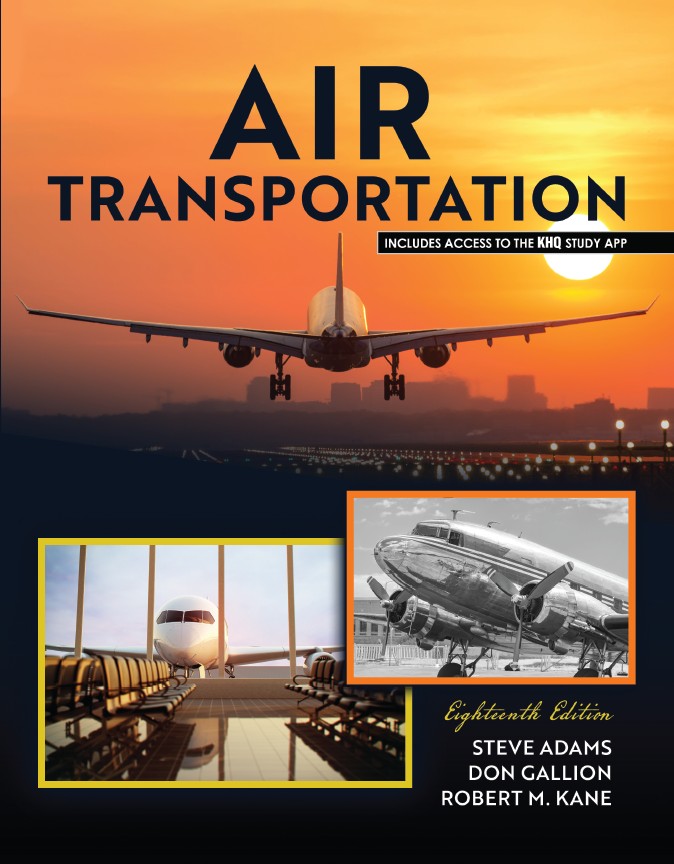
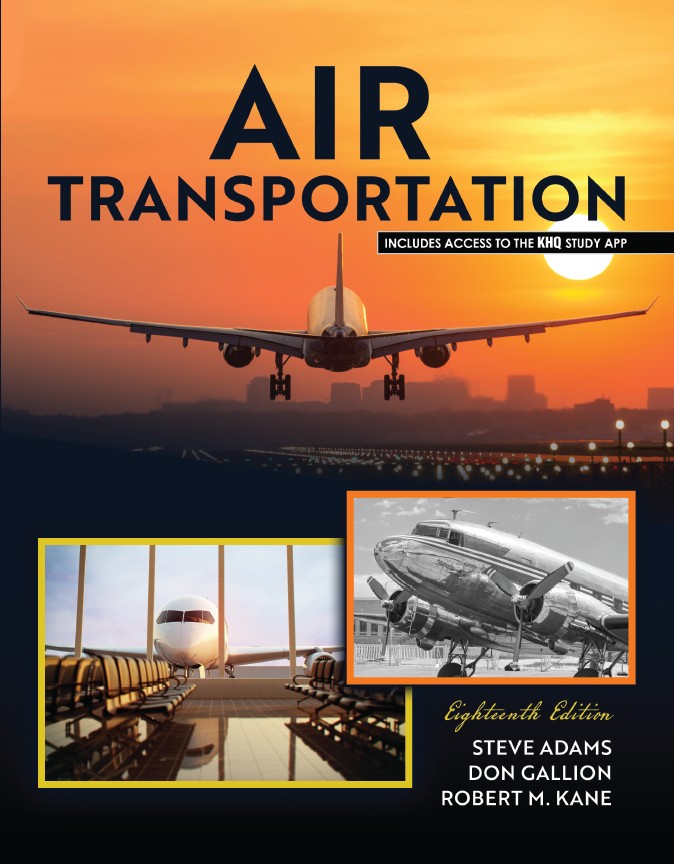
Air Transportation

Edition: 18

Copyright: 2025

Choose Your Format

Ebook Package

$68.00 USD

ISBN 9798385177455

Details Ebook w/KHQ 180 days

For forty-five years and sixteen editions, Air Transportation was the passion of Bob Kane. Now, Professors Steve Adams and Don Gallion have picked up and carried Kane’s work into a new streamlined edition that takes a more holistic approach to air transportation. 

The 18th edition broadens the scope to focus on the operation of the industry and the interdependence of its components. We hope you find it to be an easy-to-read overview of the fundamentals of air transportation, including:

  • Regulatory processes
  • Aircraft, airports, and airmen
  • Careers in aviation
  • Airspace and air traffic control
  • Aviation safety and security
  • Aircraft manufacturers and airlines
  • Influence of aviation on the economy, people and culture, and the environment

The impact of aviation has been felt in all fields of human endeavors. Open up to examine the building blocks of this incredible industry that has so much changed the history of human civilization.

Chapter 1: Development of Air Transportation
Development of the Lighter-than-Airship
Development of the Airplane
The Birth of the Aviation Industry
The Beginning of Commercial Air Transportation

Chapter 2: The Air Carrier Industry and Federal Regulation 
History of Federal Regulation
Regulatory Agencies
The Regulatory Process

Chapter 3: International Aviation 
General History of International Aviation
International Deregulation
International Air Transportation Organizations

Chapter 4: Aircraft and Airmen 
Aircraft
Airmen

Chapter 5: Careers in Aviation
The “Big Three”: Pilots, Mechanics, Flight Attendants
Air Traffic Controllers
Other Careers
Emerging Professions
The Aviation Professional

Chapter 6: Air Traffic Control 
Introduction
Airspace Designation
Special Use Airspace
Other Airspace
ATC System and Next Gen
Navigation
International

Chapter 7: Aviation Safety 
Safety Regulation
Safety Certificates
Reinspection
The National Transportation Safety Board (NTSB)
Aviation Accident Investigation
Aviation Accident and Safety Performance

Chapter 8: Aviation Security
Hijacking or “Armed Interference”
Explosives as a Weapon for Terror, Crime, or Suicide
Solutions to Hijacking and Bombings in Civil Aviation
Airport Security Program Today
General Aviation
The Future

Chapter 9: Airports: The United States and International 
Airports in the United States
History of Airports
Airport Components
Terminal Buildings—History and Evolution
Airport Legislation and Federal Funding
Airport Organization & Administration
Airports Council International

Chapter 10: Aircraft Manufacturers
The Martin Company
The Boeing Company
The Lockheed Martin Corporation
The Douglas Corporation
The McDonnell Corporation
The McDonnell Douglas Corporation (MDC)
Airbus Industries
Manufacturer Consolidation

Chapter 11 Air Carriers
Early Air Carriers
Air Carrier Classification
Major U.S. Airlines
Evolution of U.S. Airlines
Airlines for America (A4A)

Chapter 12: Airline Administration
Air Carrier Management and Organization
Characteristics of Air Carriers
Air Carrier Organization
Air Carrier Product
Principles of Air Carrier Management
Air Carrier Marketing
Air Carrier Financial Management

Chapter 13: Influence of Aviation 
Economic Benefits
The Social Impact of Aviation
Aviation and the Environment
 

Robert Kane

Bob Kane got his start in aviation in the Army Air Force in World War II, and saw action in the Southwest Pacific Theater. After leaving active duty in 1946, he ultimately landed at the University of Miami and earned both a BBA degree and then an MBA in 1953. He stayed at Miami until 1964 as a professor in the Manage-ment Department where he established the aviation administration program of study that was the first of its kind in the nation. In 1964 Bob joined the Miami-Dade Community College as Professor and Chairman of Aerospace-Aviation Department that he founded. There he created various courses of study that became the foundation at other colleges and universities throughout the country and published 16 editions of Air Transportation from 1967 to 2012. Bob passed away in 2015.

Steve Adams

Steve Adams grew up in an airline family and spent much of his formative years in airplanes and airports around the world. He attended the University of Notre Dame on an NROTC scholarship and earned his Naval Flight Officer “wings of gold” in 1985. After a career that included numerous aviation operations assignments, flying from four different aircraft carriers, and training flight instructors, Steve retired in 2006 as a navy commander and immediately transitioned to professor of aviation science at Florida State College at Jacksonville. He has a master of education from the University of North Florida and a federal aviation admin-istration (FAA) advanced ground instructor (AGI) certificate.

DONALD KINNARD GALLION

Don Gallion Jr. has been in aviation since the late 1970s as a student, an FAR 135 pilot and manager, an enroute air traffic controller and supervisor, and a technical instructor and professor of aviation. He earned a bachelor of science degree in aeronautical science (Cum Laude) from Embry-Riddle Aeronautical University, and a master of arts degree from the University of North Carolina at Greensboro. He holds a commercial pilot certificate with instrument, single-engine land, and multiengine land ratings and an FAA advanced and instrument ground instructor rating. He is rated in two different FAA enroute centers and was a professor of aviation and air traffic control at Florida State College at Jacksonville from 2010 until his retirement in 2021. He and his wife are retired and living in the Blue Ridge Mountains of Virginia. Their two sons are both airline aircraft maintenance technicians.
 

For forty-five years and sixteen editions, Air Transportation was the passion of Bob Kane. Now, Professors Steve Adams and Don Gallion have picked up and carried Kane’s work into a new streamlined edition that takes a more holistic approach to air transportation. 

The 18th edition broadens the scope to focus on the operation of the industry and the interdependence of its components. We hope you find it to be an easy-to-read overview of the fundamentals of air transportation, including:

  • Regulatory processes
  • Aircraft, airports, and airmen
  • Careers in aviation
  • Airspace and air traffic control
  • Aviation safety and security
  • Aircraft manufacturers and airlines
  • Influence of aviation on the economy, people and culture, and the environment

The impact of aviation has been felt in all fields of human endeavors. Open up to examine the building blocks of this incredible industry that has so much changed the history of human civilization.

Chapter 1: Development of Air Transportation
Development of the Lighter-than-Airship
Development of the Airplane
The Birth of the Aviation Industry
The Beginning of Commercial Air Transportation

Chapter 2: The Air Carrier Industry and Federal Regulation 
History of Federal Regulation
Regulatory Agencies
The Regulatory Process

Chapter 3: International Aviation 
General History of International Aviation
International Deregulation
International Air Transportation Organizations

Chapter 4: Aircraft and Airmen 
Aircraft
Airmen

Chapter 5: Careers in Aviation
The “Big Three”: Pilots, Mechanics, Flight Attendants
Air Traffic Controllers
Other Careers
Emerging Professions
The Aviation Professional

Chapter 6: Air Traffic Control 
Introduction
Airspace Designation
Special Use Airspace
Other Airspace
ATC System and Next Gen
Navigation
International

Chapter 7: Aviation Safety 
Safety Regulation
Safety Certificates
Reinspection
The National Transportation Safety Board (NTSB)
Aviation Accident Investigation
Aviation Accident and Safety Performance

Chapter 8: Aviation Security
Hijacking or “Armed Interference”
Explosives as a Weapon for Terror, Crime, or Suicide
Solutions to Hijacking and Bombings in Civil Aviation
Airport Security Program Today
General Aviation
The Future

Chapter 9: Airports: The United States and International 
Airports in the United States
History of Airports
Airport Components
Terminal Buildings—History and Evolution
Airport Legislation and Federal Funding
Airport Organization & Administration
Airports Council International

Chapter 10: Aircraft Manufacturers
The Martin Company
The Boeing Company
The Lockheed Martin Corporation
The Douglas Corporation
The McDonnell Corporation
The McDonnell Douglas Corporation (MDC)
Airbus Industries
Manufacturer Consolidation

Chapter 11 Air Carriers
Early Air Carriers
Air Carrier Classification
Major U.S. Airlines
Evolution of U.S. Airlines
Airlines for America (A4A)

Chapter 12: Airline Administration
Air Carrier Management and Organization
Characteristics of Air Carriers
Air Carrier Organization
Air Carrier Product
Principles of Air Carrier Management
Air Carrier Marketing
Air Carrier Financial Management

Chapter 13: Influence of Aviation 
Economic Benefits
The Social Impact of Aviation
Aviation and the Environment
 

Robert Kane

Bob Kane got his start in aviation in the Army Air Force in World War II, and saw action in the Southwest Pacific Theater. After leaving active duty in 1946, he ultimately landed at the University of Miami and earned both a BBA degree and then an MBA in 1953. He stayed at Miami until 1964 as a professor in the Manage-ment Department where he established the aviation administration program of study that was the first of its kind in the nation. In 1964 Bob joined the Miami-Dade Community College as Professor and Chairman of Aerospace-Aviation Department that he founded. There he created various courses of study that became the foundation at other colleges and universities throughout the country and published 16 editions of Air Transportation from 1967 to 2012. Bob passed away in 2015.

Steve Adams

Steve Adams grew up in an airline family and spent much of his formative years in airplanes and airports around the world. He attended the University of Notre Dame on an NROTC scholarship and earned his Naval Flight Officer “wings of gold” in 1985. After a career that included numerous aviation operations assignments, flying from four different aircraft carriers, and training flight instructors, Steve retired in 2006 as a navy commander and immediately transitioned to professor of aviation science at Florida State College at Jacksonville. He has a master of education from the University of North Florida and a federal aviation admin-istration (FAA) advanced ground instructor (AGI) certificate.

DONALD KINNARD GALLION

Don Gallion Jr. has been in aviation since the late 1970s as a student, an FAR 135 pilot and manager, an enroute air traffic controller and supervisor, and a technical instructor and professor of aviation. He earned a bachelor of science degree in aeronautical science (Cum Laude) from Embry-Riddle Aeronautical University, and a master of arts degree from the University of North Carolina at Greensboro. He holds a commercial pilot certificate with instrument, single-engine land, and multiengine land ratings and an FAA advanced and instrument ground instructor rating. He is rated in two different FAA enroute centers and was a professor of aviation and air traffic control at Florida State College at Jacksonville from 2010 until his retirement in 2021. He and his wife are retired and living in the Blue Ridge Mountains of Virginia. Their two sons are both airline aircraft maintenance technicians.