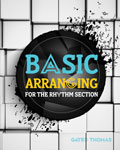
Basic Arranging for the Rhythm Section
Edition: 1
Copyright: 2016
Pages: 118
Edition: 1
Copyright: 2016
Pages: 118
Choose Your Format
$61.16 USD
Ebook
$30.59 USD
This section focuses on the principles and techniques of arranging for contemporary rhythm sections. It covers song and arrangement form, groove construction, drum writing and notation, rhythmic concepts, and stylistic approaches to rock- and jazz-based grooves. Students explore writing effective parts for drums, bass, guitar, keyboards, and other comping instruments while developing an understanding of player perspective, voicing, register, and ensemble interaction. Additional topics include transposing instruments, low interval limits, electronic concepts, and strategies for achieving clarity, balance, projection, and blend among multiple rhythm section voices.
Chapter 1: “Song Form” and “Arrangement Form”
Chapter 2: Groove Writing I: Basic Concepts
Chapter 3: Drums
Chapter 4: Drum Set Notation
Chapter 5: Notation Concepts for Rhythm Sections
Chapter 6: Thinking Like a Drummer
Chapter 7: Groove Writing II—Rock-Derived Styles: Cells and Fills
Chapter 8: Groove Writing III—Jazz-Derived Styles: Line and Contour
Chapter 9: Concert Pitch and Transposing Instruments
Chapter 10: Bass
Chapter 11: Groove Writing IV: Writing for Comping Instruments
Chapter 12: Guitar
Chapter 13: Keyboards
Chapter 14: Low Interval Limits (“LIL”)
Chapter 15: Basic Electronic Concepts
Chapter 16: Avoiding “Family Fights”: Multiple Comping Instruments
Chapter 17: Comping Instruments: Projection, Balance, and Blend
Chapter 18: Things to Do with that Sixth Voice
Gates Thomas is an Associate Professor in Berklee College of Music’s Contemporary Writing and Production (CWP) department. A vocalist, keyboardist, guitarist, violinist, and conductor, Thomas has performed with Choral Chameleon, Rosemary Clooney, Paula Cole, Bill Conti, Christian Fabian, Matt Garrison, Abe Laboriel Jr., the New American Orchestra of Chicago, and Sadao Watanabe. His recording credits include collaborations with Gary Burton, Jim Hall, m-pact, and John Scofield.