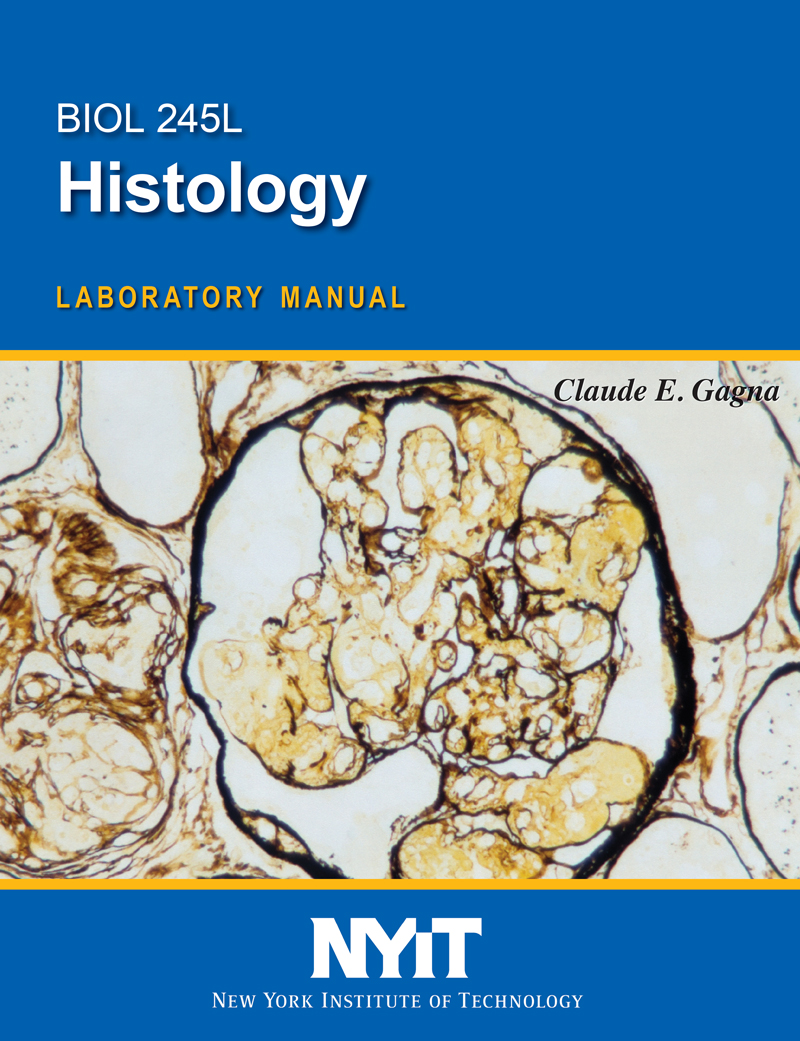
BIOL 245L: Histology
Author(s): Claude E Gagna
Edition: 1
Copyright: 2022
Pages: 102
Basic Laboratory Instructions
- Atlas, Textbook and Laboratory Manual
- Laptop Computer (Optional)
- Light Microscope and Histology Slide Box
- Safety First!
- Visually Inspect the Histology Slide
- Abbreviations on the Slides' Labels
- Begin Observations with the Lowest Magnification
- Microscopic Resolution
- Illumination Must Be Adjusted for Selected Lens
- Oil Immersion at High Magnifications
- Identification and Interpretation of Tissues
- Drawings of Tissue Sections
- Clean Lenses and Slides After Applying Oil Immersion
- Notes: Homework Assignment
- Return Light Microscope and Histology Slide Box
- Weekly Reports: "Funciontal & Clinical Correlations"
- Cover Page for Weekly Laboratory Reports
- Exams: Midterm and Final Laboratory Practicals
- Example of How to Label Tissue Drawings
- Hand in Your Histology Laboratory Manual
List of Histology Slides
List of Pathology Slides
Start of Weekly Histology Laboratory
Introduction (Week #1)
Staining Micrscope Slides (Week #2)
Epithelium (Week #2)
Connective Tissue (Week # 3)
Cartilage, Bone and Blood (Week # 3)
Muscle (Week # 4)
Nerve tissue (Week # 4)
Circulatory System (Week # 5)
Lymphoid Tissue and Integument (Week # 6)
Review for Midterm Practical (Week #7)
Midterm Practical (Week #8)
Digestive and Glands (Week # 9)
Respiratory and Urogenital System (Week # 9)
Endocrine System (Week # 10)
Reproductive System (Week # 10)
Special Senses (Week # 10)
Pathology Slides (Week # 11)
Discussion of Pathologies (Week #11)
Text & Atlas Pathology Resources (Week #11)
Homework Assignment: Pathology (Week #11)
Last Homework Assignment: Overview of Course (Week #11)
Review for Final Practical (Week #12)
Final Practical (Week #13)
Claude Gagna is a professor in the Department of Biological and Chemical Sciences. He is the course director of Anatomical Sciences (e.g., Histology, Anatomy, Physiology, Embryology, and Pathophysiology) and a senior educator in lecture and labs. Gagna is a Molecular Biologist, DNA Nanotechnologist, and Human Anatomist who holds patents, and has published conference proceedings/abstracts, book chapters, review articles, case studies, methodologies, and original research articles. His continuing goal is to add to the knowledgebase of DNA and RNA structure and function in normal and diseased tissues, and cell death (terminal differentiation: denucleation, i.e., lens and epidermis), while developing novel “omics” technologies (e.g., “Genomesorganizomics” and “Structural Spatial Transcriptomics“), and new nucleic acid-based nanotech devices (e.g., next generation DNA and RNA microarrays). The “Canonical, and Multistranded, Alternative and Transitional Helical (C-MATH) Nucleic Acid Microarrays” will enhance the characterization of gene function and help produce drugs/biologics that inhibit gene expression. Gagna characterizes intact, non-denatured canonical B-DNA, and unusual nucleic acids, such as alternative Z-DNA, and multistranded nucleic acids, e.g., triplex DNA, G4-quadruplex DNA and i-motif quadruplex DNA. He also engages high school and undergraduate students in related STEM-based research projects, such as DNA bioinformatics and micro-CT scanning to characterize the eye globes of different species.
As a senior Biologist, Professor Gagna involves undergraduate, graduate and medical students, and postdoctoral fellows and residents in research projects, scientific meetings, and publications. He has produced tailor-made laboratory manuals for Histology, Human Gross Anatomy, Comparative Anatomy, Pathophysiology, Human Physiology, Developmental Biology, and Biomedical Research I, II, and III courses. Additionally, he is working in partnership with other faculty at major universities, medical schools, and research institutions. Gagna holds adjunct positions at the Rutgers-NJMS (formerly University of Medicine & Dentistry of NJ) in the Department of Pathology and Laboratory Medicine, and Department of Medicine (Dermatology). He also focuses on clinical disease-based research, i.e., cancer (e.g., melanoma), dermatophytes, cataracts, and xeroderma pigmentosum.
He received his B.S. in Biology from St. Peter’s University, his M.S. in Human Anatomy (minor: Genetic Engineering) from Fairleigh Dickinson University School of Dental Medicine, and his Ph.D. from New York University-Basic Medical Sciences (Department of Human Anatomy, and Department of Biochemistry). He was a postdoctoral fellow at NYU-Basic Medical Sciences and Rutgers-NJMS.
Basic Laboratory Instructions
- Atlas, Textbook and Laboratory Manual
- Laptop Computer (Optional)
- Light Microscope and Histology Slide Box
- Safety First!
- Visually Inspect the Histology Slide
- Abbreviations on the Slides' Labels
- Begin Observations with the Lowest Magnification
- Microscopic Resolution
- Illumination Must Be Adjusted for Selected Lens
- Oil Immersion at High Magnifications
- Identification and Interpretation of Tissues
- Drawings of Tissue Sections
- Clean Lenses and Slides After Applying Oil Immersion
- Notes: Homework Assignment
- Return Light Microscope and Histology Slide Box
- Weekly Reports: "Funciontal & Clinical Correlations"
- Cover Page for Weekly Laboratory Reports
- Exams: Midterm and Final Laboratory Practicals
- Example of How to Label Tissue Drawings
- Hand in Your Histology Laboratory Manual
List of Histology Slides
List of Pathology Slides
Start of Weekly Histology Laboratory
Introduction (Week #1)
Staining Micrscope Slides (Week #2)
Epithelium (Week #2)
Connective Tissue (Week # 3)
Cartilage, Bone and Blood (Week # 3)
Muscle (Week # 4)
Nerve tissue (Week # 4)
Circulatory System (Week # 5)
Lymphoid Tissue and Integument (Week # 6)
Review for Midterm Practical (Week #7)
Midterm Practical (Week #8)
Digestive and Glands (Week # 9)
Respiratory and Urogenital System (Week # 9)
Endocrine System (Week # 10)
Reproductive System (Week # 10)
Special Senses (Week # 10)
Pathology Slides (Week # 11)
Discussion of Pathologies (Week #11)
Text & Atlas Pathology Resources (Week #11)
Homework Assignment: Pathology (Week #11)
Last Homework Assignment: Overview of Course (Week #11)
Review for Final Practical (Week #12)
Final Practical (Week #13)
Claude Gagna is a professor in the Department of Biological and Chemical Sciences. He is the course director of Anatomical Sciences (e.g., Histology, Anatomy, Physiology, Embryology, and Pathophysiology) and a senior educator in lecture and labs. Gagna is a Molecular Biologist, DNA Nanotechnologist, and Human Anatomist who holds patents, and has published conference proceedings/abstracts, book chapters, review articles, case studies, methodologies, and original research articles. His continuing goal is to add to the knowledgebase of DNA and RNA structure and function in normal and diseased tissues, and cell death (terminal differentiation: denucleation, i.e., lens and epidermis), while developing novel “omics” technologies (e.g., “Genomesorganizomics” and “Structural Spatial Transcriptomics“), and new nucleic acid-based nanotech devices (e.g., next generation DNA and RNA microarrays). The “Canonical, and Multistranded, Alternative and Transitional Helical (C-MATH) Nucleic Acid Microarrays” will enhance the characterization of gene function and help produce drugs/biologics that inhibit gene expression. Gagna characterizes intact, non-denatured canonical B-DNA, and unusual nucleic acids, such as alternative Z-DNA, and multistranded nucleic acids, e.g., triplex DNA, G4-quadruplex DNA and i-motif quadruplex DNA. He also engages high school and undergraduate students in related STEM-based research projects, such as DNA bioinformatics and micro-CT scanning to characterize the eye globes of different species.
As a senior Biologist, Professor Gagna involves undergraduate, graduate and medical students, and postdoctoral fellows and residents in research projects, scientific meetings, and publications. He has produced tailor-made laboratory manuals for Histology, Human Gross Anatomy, Comparative Anatomy, Pathophysiology, Human Physiology, Developmental Biology, and Biomedical Research I, II, and III courses. Additionally, he is working in partnership with other faculty at major universities, medical schools, and research institutions. Gagna holds adjunct positions at the Rutgers-NJMS (formerly University of Medicine & Dentistry of NJ) in the Department of Pathology and Laboratory Medicine, and Department of Medicine (Dermatology). He also focuses on clinical disease-based research, i.e., cancer (e.g., melanoma), dermatophytes, cataracts, and xeroderma pigmentosum.
He received his B.S. in Biology from St. Peter’s University, his M.S. in Human Anatomy (minor: Genetic Engineering) from Fairleigh Dickinson University School of Dental Medicine, and his Ph.D. from New York University-Basic Medical Sciences (Department of Human Anatomy, and Department of Biochemistry). He was a postdoctoral fellow at NYU-Basic Medical Sciences and Rutgers-NJMS.