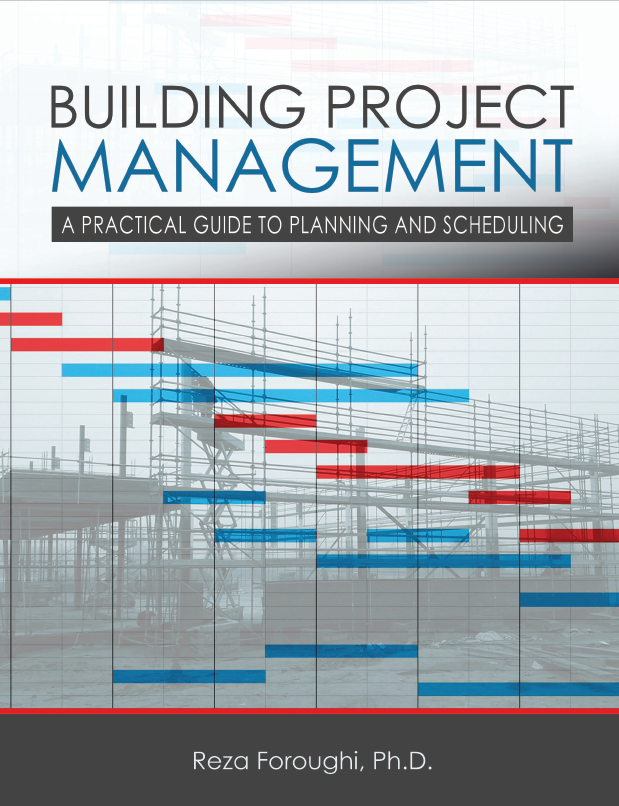
Building Project Management: A Practical Guide to Planning and Scheduling
Edition: 1
Copyright: 2026
Pages: 300
Choose Your Format
Choose Your Platform | Help Me Choose


Ebook
$75.00 USD
This book is designed specifically for courses focused on construction planning and scheduling within construction management, construction engineering, and related programs. Its emphasis is practical and application-driven, focusing on the tools, techniques, and workflows that practitioners routinely use to plan, schedule, monitor, and control building projects. Rather than presenting project management as an abstract managerial function, the material connects core concepts directly to construction sequencing, logic development, resource constraints, and schedule-based coordination, skills that are essential for professional
practice.
The book begins by establishing a foundational understanding of project management within the construction context. Key concepts such as project objectives, organizational structures, and project outcomes are introduced to provide a clear framework for planning and scheduling decisions. This foundation supports the development of effective project plans, ensuring that scope, responsibilities, and objectives are clearly defined before detailed scheduling begins.
Author Testimonial
Author’s Biography
Introduction
CHAPTER 1 Project Management Overview
CHAPTER 2 Pre-Planning & Planning
CHAPTER 3 Scheduling
CHAPTER 4 Software Use
CHAPTER 5 Monitoring and Controlling
CHAPTER 6 Resource Management
CHAPTER 7 Risk Management
CHAPTER 8 Cost and Resource Management
CHAPTER 9 Project Closure
Appendix A
Appendix B
Dr. Reza Foroughi is an Associate Professor in the Department of Sustainable Technology and the Built Environment at Appalachian State University. He holds a Ph.D. in Architectural Engineering from The Pennsylvania State University, with an emphasis on Construction Engineering. Teaching construction engineering has been a central and deeply rewarding part of Dr. Foroughi’s career. He has extensive experience mentoring undergraduate and graduate students and has taught a broad range of core courses in construction and engineering education. His teaching portfolio includes Construction Estimating, Project Planning and Scheduling, Construction Administration, Integrated Project Design and Delivery, Surveying, Soils and Foundations, Construction Management Competition, Internships, Honors Thesis Preparation, Senior Capstone, and Study Abroad courses. Through these courses, he emphasizes integrative thinking, professional responsibility, and real-world application. Dr. Foroughi has also spent more than a decade working in the construction industry, an extensive professional background that informs his teaching, research, and writing. This experience enables him to bridge theory and practice and address the complex realities of contemporary construction projects. His research and scholarly contributions, published in leading peer-reviewed journals, focus on construction engineering, architectural technology, and the built environment. Together, his industry expertise and academic work reflect a strong commitment to advancing both professional practice and education, with a particular emphasis on translating real-world industry challenges into meaningful educational and scholarly insight.