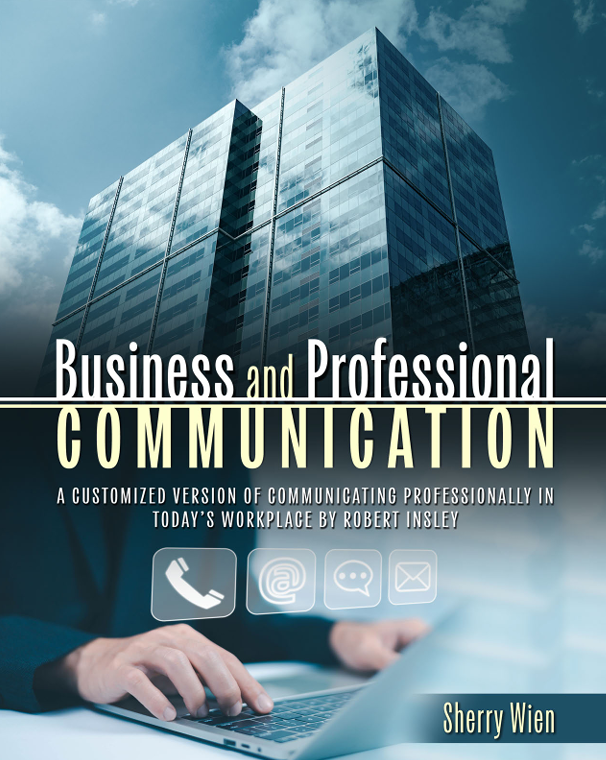
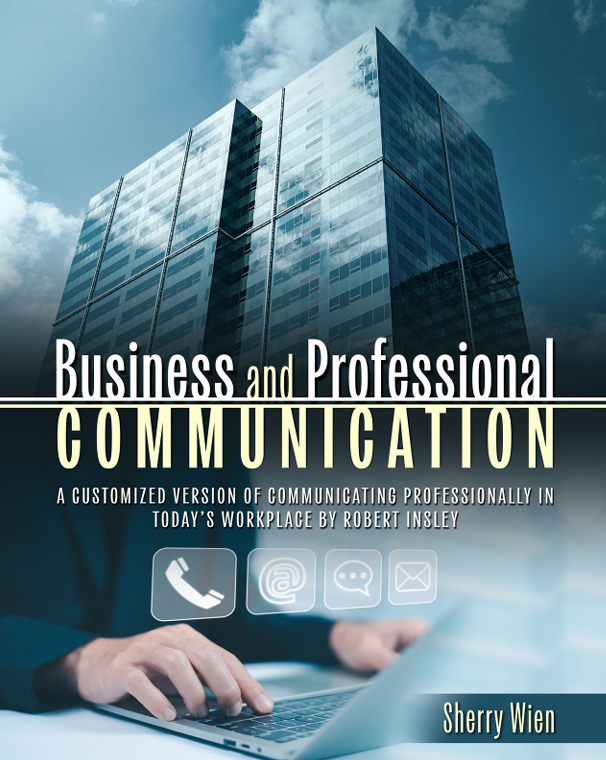
Business and Professional Communication: A Customized Version of Communicating Professionally in Today's Workplace by Robert Insley

Author(s): Sherry Wien

Edition: 1

Copyright: 2026

Pages: 143

Choose Your Format

Ebook

$65.00 USD

ISBN 9798319739032

Details Electronic Delivery EBOOK 180 days

Business and Professional Communication provides practical guidance on professional communication and career success. It covers effective communication, listening, resumes and cover letters, interviewing, workplace emails and digital communication, teamwork and meetings, and professional presentations. Throughout, it emphasizes clear communication, professionalism, audience awareness, ethical communication, collaboration, and effective workplace practices.

Chapter 1 Understanding Communication

I. Communication Defined
II. Suggestions for Effective Communication
   A. Appreciate How Challenging It Is to Communicate Effectively
   B. Analyze Your Audience
   C. Be Congenial
   D. Be Ethical
   E. Choose the Appropriate Medium for the Situation
   F. Practice Team Communication Skills
   G. Practice Intercultural Communication Skills
   H. Practice Interpersonal Skills
III. Virtual Communication
IV. Professionalism

Chapter 2 Listening

I. Role of Listening in Organizations
II. How Listening Affects Organizations
   A. Employee Morale
   B. Misunderstandings
   C. Team Success
   D. Relationships with External Stakeholders
   E. Hiring Decisions
   F. Communicating with People from Other Cultures
III. How Listening Affects Individual Careers
   A. Learn More
   B. Improve Odds in the Job Search Process
   C. More Successful on the Job
   D. Better Prepared to Succeed in Upper-Level Management Positions
IV. Technology Makes Listening Less Effective
V. Hearing and Listening
   A. Hearing and Listening—what’s the Difference?
VI. Barriers to Effective Listening
   A. Negative Attitude Toward Listening
   B. Failure to Improve at Listening
   C. Failure to Give Full Attention to the Person Speaking
   D. Failure to Listen for Emotions and Nonverbal Cues
   E. Failure to Listen for Facts and Details
   F. Conflicting Nonverbal Cues
   G. Closed Mindedness
   H. Urge to Interrupt or Debate
   I. Failure to Control Emotions
   J. Failure to Control Selective Listening
   K. Allowing Status to Interfere
   L. Allowing Environmental Distractions to Interfere
   M. Failure to Put the Speaker At Ease
   N. Message Organization Barriers
   O. Allowing Content-Related Barriers to Interfere
   P. Allowing Speaker-Related Barriers to Interfere
VII. Listening Techniques
   A. Develop and Maintain a Positive Attitude Toward Listening
   B. Give Your Full Attention to the Person Speaking
   C. Listen for Emotions, Nonverbal Cues, Facts, and Details
   D. Capitalize on the Speaking/Listening Rate Differential
   E. Be Open-Minded
   F. Control Your Emotional Triggers
   G. Empathize with the Speaker
   H. Remove Environmental Distractions
   I. Avoid Interrupting
   J. Do Not Allow Status to Interfere
   K. Do Not Eavesdrop
   L. Avoid Content-Related Barriers
   M. Avoid Speaker-Related Barriers

Chapter 3 Resumes and Cover Letters

I. Skills Employers Want
II. Personal Attributes Employers Want
III. Resumes
   A. Develop Multiple Resumes
   B. Purposes for Resumes
   C. Resume Types
   D. Resume Components
IV. Cover Letters
   A. Purposes for Cover Letters
   B. Cover Letters Not Always Required but Preferred
   C. Importance of Reader-Centered Tone
   D. Cover Letter Strategy and Structure
   E. Persuasive Elements of Cover Letters
   F. Format Considerations

Chapter 4 Interviewing

I. Interviewing Goals for the Job Candidate
II. Interviewing Goals for the Recruiter
III. Types of Interviews
IV. Interviewing Techniques
   A. Anticipate a Short Small Talk Session Before the Interview
   B. Anticipate Major Types of Questions That May Be Asked
   C. Anticipate Commonly-Asked Questions
   D. Anticipate Unusual/Odd Questions
   E. Anticipate Illegal and Unethical Questions
   F. Anticipate Being Asked About Weaknesses and Failures
   G. Develop Questions to Ask the Recruiter
   H. Anticipate Testing During the Interview Process
V. Phases of an Interview
VI. Suggestions for Interviewing
   A. Know The Recruiter’s Name
   B. Eye Contact
   C. Smile
   D. Handshake
   E. Sitting
   F. Facial Expressions
   G. Be Enthusiastic
   H. Be Well-Spoken
   I. Avoid Distracting Nervous Mannerisms
   J. Avoid Criticizing
   K. Think Before Answering
   L. Respond Honestly
   M. Focus on Persuading the Recruiter
   N. Focus on What You Can Do for the Organization
   O. Share Your Knowledge of the Job, Organization, and Industry
   P. Ask Questions
   Q. Avoid Asking About Benefits and Salary Until the Job Offer
   R. End the Interview Effectively
VII. Thank You Notes
VIII. Check Back with the Recruiter

Chapter 5 Emails, Texts, Instant Messages, and Social Media Posts

I. Emails
   A. Choose If You Should Email
   B. Know Email Policies and Potential Liability Issues
   C. Get Familiar with Organizational Email Culture
   D. Writing Effective Email Messages
   E. Email Components
   F. Edit and Revise the Message
   G. Proofread the Message
II. Texts
   A. Business Uses of Texting
   B. Writing Effective Text Messages
III. Instant Messages
   A. Benefits of IMs in Business
   B. How to Use IM
   C. Writing Effective Instant Messages
IV. Social Media Posts
   A. Role of Social Media in Organizations
   B. Social Media Challenges

Chapter 6 Teams and Meetings

I. Teams
   A. Role of Teams in Organizations
   B. Key Factors That Affect Team Development
   C. Effective Communication in Teams
II. Meetings
   A. Role of Meetings in Organizations
   B. Team Leaders
   C. Meeting Agendas

Chapter 7 Presentations

I. Preparing Information
   A. Understand the Purpose of Your Presentation
   B. Know Your Objective
   C. Know Your Audience
   D. Know What Information to Share
   E. Research Information
   F. Organize Information
   G. Structure an Outline
   H. Use Notes Effectively
II. Visual Aids
   A. Know What Information Needs Visual Aids
   B. Types of Visual Aids
   C. Design Your Visual Aids
   D. Visit Your Presentation Site
   E. Rehearse Your Presentation
III. Delivery
   A. Display Appropriate Body Language
   B. Avoid Distracting Nonverbal Behaviors
   C. Use Your Voice Effectively
   D. Use Visual Aids Effectively

Sherry Wien

Sherry Wien, Ph.D. is an Associate Professor in the Department of Communication at Monmouth University. Her research focuses on workplace interpersonal relationships, organizational socialization, mentoring, organizational assessment, and adjunct faculty issues in higher education. 

Business and Professional Communication provides practical guidance on professional communication and career success. It covers effective communication, listening, resumes and cover letters, interviewing, workplace emails and digital communication, teamwork and meetings, and professional presentations. Throughout, it emphasizes clear communication, professionalism, audience awareness, ethical communication, collaboration, and effective workplace practices.

Chapter 1 Understanding Communication

I. Communication Defined
II. Suggestions for Effective Communication
   A. Appreciate How Challenging It Is to Communicate Effectively
   B. Analyze Your Audience
   C. Be Congenial
   D. Be Ethical
   E. Choose the Appropriate Medium for the Situation
   F. Practice Team Communication Skills
   G. Practice Intercultural Communication Skills
   H. Practice Interpersonal Skills
III. Virtual Communication
IV. Professionalism

Chapter 2 Listening

I. Role of Listening in Organizations
II. How Listening Affects Organizations
   A. Employee Morale
   B. Misunderstandings
   C. Team Success
   D. Relationships with External Stakeholders
   E. Hiring Decisions
   F. Communicating with People from Other Cultures
III. How Listening Affects Individual Careers
   A. Learn More
   B. Improve Odds in the Job Search Process
   C. More Successful on the Job
   D. Better Prepared to Succeed in Upper-Level Management Positions
IV. Technology Makes Listening Less Effective
V. Hearing and Listening
   A. Hearing and Listening—what’s the Difference?
VI. Barriers to Effective Listening
   A. Negative Attitude Toward Listening
   B. Failure to Improve at Listening
   C. Failure to Give Full Attention to the Person Speaking
   D. Failure to Listen for Emotions and Nonverbal Cues
   E. Failure to Listen for Facts and Details
   F. Conflicting Nonverbal Cues
   G. Closed Mindedness
   H. Urge to Interrupt or Debate
   I. Failure to Control Emotions
   J. Failure to Control Selective Listening
   K. Allowing Status to Interfere
   L. Allowing Environmental Distractions to Interfere
   M. Failure to Put the Speaker At Ease
   N. Message Organization Barriers
   O. Allowing Content-Related Barriers to Interfere
   P. Allowing Speaker-Related Barriers to Interfere
VII. Listening Techniques
   A. Develop and Maintain a Positive Attitude Toward Listening
   B. Give Your Full Attention to the Person Speaking
   C. Listen for Emotions, Nonverbal Cues, Facts, and Details
   D. Capitalize on the Speaking/Listening Rate Differential
   E. Be Open-Minded
   F. Control Your Emotional Triggers
   G. Empathize with the Speaker
   H. Remove Environmental Distractions
   I. Avoid Interrupting
   J. Do Not Allow Status to Interfere
   K. Do Not Eavesdrop
   L. Avoid Content-Related Barriers
   M. Avoid Speaker-Related Barriers

Chapter 3 Resumes and Cover Letters

I. Skills Employers Want
II. Personal Attributes Employers Want
III. Resumes
   A. Develop Multiple Resumes
   B. Purposes for Resumes
   C. Resume Types
   D. Resume Components
IV. Cover Letters
   A. Purposes for Cover Letters
   B. Cover Letters Not Always Required but Preferred
   C. Importance of Reader-Centered Tone
   D. Cover Letter Strategy and Structure
   E. Persuasive Elements of Cover Letters
   F. Format Considerations

Chapter 4 Interviewing

I. Interviewing Goals for the Job Candidate
II. Interviewing Goals for the Recruiter
III. Types of Interviews
IV. Interviewing Techniques
   A. Anticipate a Short Small Talk Session Before the Interview
   B. Anticipate Major Types of Questions That May Be Asked
   C. Anticipate Commonly-Asked Questions
   D. Anticipate Unusual/Odd Questions
   E. Anticipate Illegal and Unethical Questions
   F. Anticipate Being Asked About Weaknesses and Failures
   G. Develop Questions to Ask the Recruiter
   H. Anticipate Testing During the Interview Process
V. Phases of an Interview
VI. Suggestions for Interviewing
   A. Know The Recruiter’s Name
   B. Eye Contact
   C. Smile
   D. Handshake
   E. Sitting
   F. Facial Expressions
   G. Be Enthusiastic
   H. Be Well-Spoken
   I. Avoid Distracting Nervous Mannerisms
   J. Avoid Criticizing
   K. Think Before Answering
   L. Respond Honestly
   M. Focus on Persuading the Recruiter
   N. Focus on What You Can Do for the Organization
   O. Share Your Knowledge of the Job, Organization, and Industry
   P. Ask Questions
   Q. Avoid Asking About Benefits and Salary Until the Job Offer
   R. End the Interview Effectively
VII. Thank You Notes
VIII. Check Back with the Recruiter

Chapter 5 Emails, Texts, Instant Messages, and Social Media Posts

I. Emails
   A. Choose If You Should Email
   B. Know Email Policies and Potential Liability Issues
   C. Get Familiar with Organizational Email Culture
   D. Writing Effective Email Messages
   E. Email Components
   F. Edit and Revise the Message
   G. Proofread the Message
II. Texts
   A. Business Uses of Texting
   B. Writing Effective Text Messages
III. Instant Messages
   A. Benefits of IMs in Business
   B. How to Use IM
   C. Writing Effective Instant Messages
IV. Social Media Posts
   A. Role of Social Media in Organizations
   B. Social Media Challenges

Chapter 6 Teams and Meetings

I. Teams
   A. Role of Teams in Organizations
   B. Key Factors That Affect Team Development
   C. Effective Communication in Teams
II. Meetings
   A. Role of Meetings in Organizations
   B. Team Leaders
   C. Meeting Agendas

Chapter 7 Presentations

I. Preparing Information
   A. Understand the Purpose of Your Presentation
   B. Know Your Objective
   C. Know Your Audience
   D. Know What Information to Share
   E. Research Information
   F. Organize Information
   G. Structure an Outline
   H. Use Notes Effectively
II. Visual Aids
   A. Know What Information Needs Visual Aids
   B. Types of Visual Aids
   C. Design Your Visual Aids
   D. Visit Your Presentation Site
   E. Rehearse Your Presentation
III. Delivery
   A. Display Appropriate Body Language
   B. Avoid Distracting Nonverbal Behaviors
   C. Use Your Voice Effectively
   D. Use Visual Aids Effectively

Sherry Wien

Sherry Wien, Ph.D. is an Associate Professor in the Department of Communication at Monmouth University. Her research focuses on workplace interpersonal relationships, organizational socialization, mentoring, organizational assessment, and adjunct faculty issues in higher education.