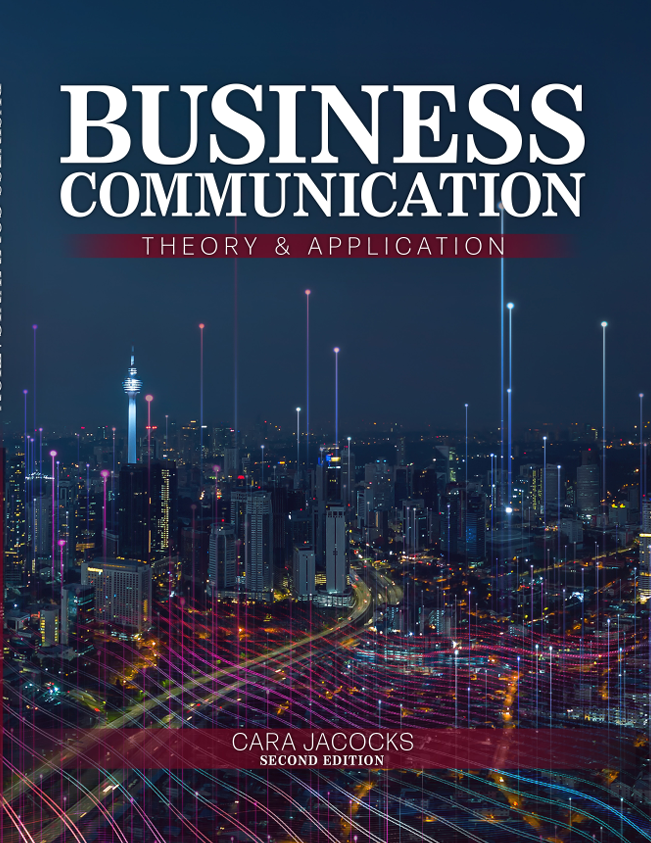
Business Communication: Theory & Application

Author(s): Cara Jacocks

Edition: 2

Copyright: 2026

Choose Your Format

Choose Your Platform | Help Me Choose

Ebook Package

$68.00 USD

ISBN 9798319740151

Details eBook w/Ancillary Site 180 days

Website


This product is currently not available.

This text is titled Business Communication: Theory & Application as it provides a healthy balance of business and organizational communication theory and research as well as practical application.  You will notice some chapters are more theory-driven (Chapters 2 and 3) and other chapters offer suggestions, best practices, and even additional resources in the form of visual communication templates and examples (Chapters 8, 10, & 11).  Through both theory and application this text is intended to instruct readers on how to engage as competent communicators in the workplace and that is exactly where Chapter 1 begins by providing overarching definitions and models of communication and communication competence.  Regardless of what kind of business communication context you are interacting within, the end goal is to be effective, appropriate, and ethical with your communication practices.  Each chapter within this textbook is designed to teach you this concept within a variety of contexts that include: 

  • Various forms of organizational authority, structure, and systems (and related communication flows)
  • Interpersonal communication at work
  • Diverse workspaces
  • Nonverbal communication at work
  • Workplace conflict
  • Listening in the workplace
  • Technology-mediated communication in the workplace
  • Small group communication in work contexts
  • Rhetorical communication (both written and spoken), and
  • Interviewing contexts at work

Chapter 1 An Introduction to Business Communication

Chapter 2 Organizational Structure, Communication, & Ethics

Chapter 3 Interpersonal Communication in the Workplace

Chapter 4 Diversity, Communication, and Work

Chapter 5 Nonverbal Communication in the Workplace

Chapter 6 Conflict and Communication at Work

Chapter 7 Effective Listening in Workplace

Chapter 8 Technology-Mediated Communication and Work

Chapter 9 Small Group Communication

Chapter 10 Rhetorical Communication in the Workplace

Chapter 11 Interviewing Basics and the Employment Interview

Cara Jacocks

My journey as a communication specialist began as an undergraduate enrolled in the Department of Communication at Texas A&M University where I stood in a classroom (probably similar to one of your own campus classrooms) and delivered informative and persuasive speeches to an audience of my peers. After taking more advanced (upper-level) communication courses and eventually graduating with a BA in Speech Communication, I continued to work in the media and telecommunications industry as a pro duction assistant at KBTX (Bryan, TX) and then KTVT (Dallas/Fort Worth, TX). I spent the vast majority of my news/television career working behind the scenes (running cameras, floor directing, teleprompting, script-writing) covering 9/11 and Ground Zero stories that permeated the daily news of that era. Eventually I decided to return to higher education and earn a Master of Arts in Communication from Abilene Christian University. As a graduate student I instructed undergraduates on the art and science of rhetorical communication through the basic speech course at ACU, and my passion for teaching and researching professional communication topics began. After completing my master’s degree, I headed back to College Station, TX and began studying organizational communication in TAMU’s Department of Communication where I earned my PhD. 

Over the last two decades I have instructed business communication, organizational communication, business and professional speaking, and a variety of related topics at several campuses including the University of Dallas, TCU, SMU, UT-Dallas, and UT-Arlington. Throughout these experiences I have relied on a great number of instructional materials including textbooks by published authors and supplementary resources of my own creation. It took me over twenty years, but I finally decided it was time to put the teaching materials and lessons of my own design to good use, by writing a textbook that is instructional, insightful, accessible, and affordable.

This text is titled Business Communication: Theory & Application as it provides a healthy balance of business and organizational communication theory and research as well as practical application.  You will notice some chapters are more theory-driven (Chapters 2 and 3) and other chapters offer suggestions, best practices, and even additional resources in the form of visual communication templates and examples (Chapters 8, 10, & 11).  Through both theory and application this text is intended to instruct readers on how to engage as competent communicators in the workplace and that is exactly where Chapter 1 begins by providing overarching definitions and models of communication and communication competence.  Regardless of what kind of business communication context you are interacting within, the end goal is to be effective, appropriate, and ethical with your communication practices.  Each chapter within this textbook is designed to teach you this concept within a variety of contexts that include: 

  • Various forms of organizational authority, structure, and systems (and related communication flows)
  • Interpersonal communication at work
  • Diverse workspaces
  • Nonverbal communication at work
  • Workplace conflict
  • Listening in the workplace
  • Technology-mediated communication in the workplace
  • Small group communication in work contexts
  • Rhetorical communication (both written and spoken), and
  • Interviewing contexts at work

Chapter 1 An Introduction to Business Communication

Chapter 2 Organizational Structure, Communication, & Ethics

Chapter 3 Interpersonal Communication in the Workplace

Chapter 4 Diversity, Communication, and Work

Chapter 5 Nonverbal Communication in the Workplace

Chapter 6 Conflict and Communication at Work

Chapter 7 Effective Listening in Workplace

Chapter 8 Technology-Mediated Communication and Work

Chapter 9 Small Group Communication

Chapter 10 Rhetorical Communication in the Workplace

Chapter 11 Interviewing Basics and the Employment Interview

Cara Jacocks

My journey as a communication specialist began as an undergraduate enrolled in the Department of Communication at Texas A&M University where I stood in a classroom (probably similar to one of your own campus classrooms) and delivered informative and persuasive speeches to an audience of my peers. After taking more advanced (upper-level) communication courses and eventually graduating with a BA in Speech Communication, I continued to work in the media and telecommunications industry as a pro duction assistant at KBTX (Bryan, TX) and then KTVT (Dallas/Fort Worth, TX). I spent the vast majority of my news/television career working behind the scenes (running cameras, floor directing, teleprompting, script-writing) covering 9/11 and Ground Zero stories that permeated the daily news of that era. Eventually I decided to return to higher education and earn a Master of Arts in Communication from Abilene Christian University. As a graduate student I instructed undergraduates on the art and science of rhetorical communication through the basic speech course at ACU, and my passion for teaching and researching professional communication topics began. After completing my master’s degree, I headed back to College Station, TX and began studying organizational communication in TAMU’s Department of Communication where I earned my PhD. 

Over the last two decades I have instructed business communication, organizational communication, business and professional speaking, and a variety of related topics at several campuses including the University of Dallas, TCU, SMU, UT-Dallas, and UT-Arlington. Throughout these experiences I have relied on a great number of instructional materials including textbooks by published authors and supplementary resources of my own creation. It took me over twenty years, but I finally decided it was time to put the teaching materials and lessons of my own design to good use, by writing a textbook that is instructional, insightful, accessible, and affordable.
