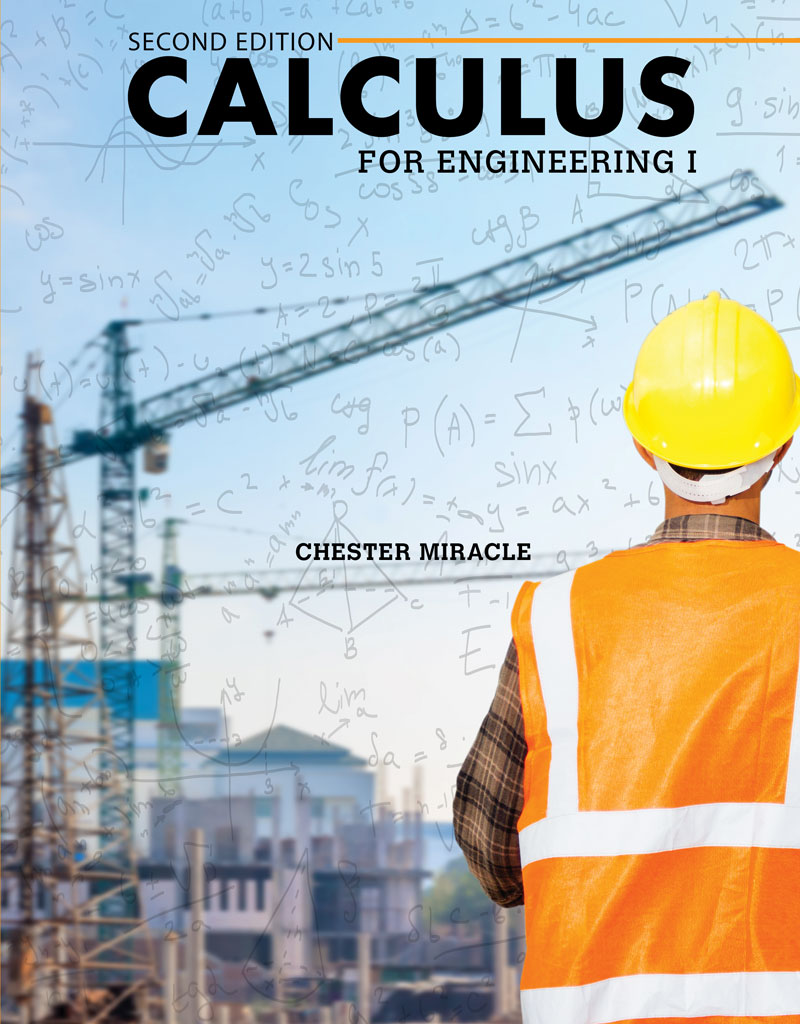
Calculus for Engineering I

Author(s): Chester Miracle

Choose Your Format

This text provides a comprehensive introduction to single-variable calculus, beginning with foundational concepts such as limits, tangent lines, and the definition of the derivative. It develops core differentiation techniques, including rules for polynomial, trigonometric, exponential, and composite functions, as well as applications involving implicit differentiation, inverse functions, and related rates. The text also emphasizes real-world interpretations of derivatives, such as velocity, acceleration, and rates of change, alongside methods for analyzing functions using increasing/decreasing behavior, concavity, and optimization.

The second half of the book transitions into integral calculus, introducing antiderivatives, substitution methods, and the definite integral as a tool for measuring area and accumulated change. It explores the Fundamental Theorem of Calculus and applies integration to problems involving area, volume of solids of revolution, work, and fluid pumping. Additional topics such as L’Hospital’s Rule, the Mean Value Theorem, and linearization connect differential and integral concepts, providing a unified understanding of calculus and its applications in mathematics and the sciences.

Chapter 1 6310 Limits for Derivatives

Chapter 2 6311 Review of Lines

Chapter 3 6312 The Tangent Problem

Chapter 4 6314 The Velocity Problem

Chapter 5 6315 The Definition of Derivative

Chapter 6 6316 The Power Formula

Chapter 7 6323 the Quotient Rule

Chapter 8 6325 Derivatives of Trigonometric Functions

Chapter 9 6327 Composite Functions

Chapter 10 6329 Chain Rule

Chapter 11 6335 Implicit Functions

Chapter 12 6337 Differentiating Implicit Functions

Chapter 13 6339 Derivatives of Inverse Functions

Chapter 14 6341 Velocity and Other Rates of Change

Chapter 15 6343 High Derivatives

Chapter 16 6347 Hyperbolic Functions

Chapter 17 6349 Differentials

Chapter 18 6351 Related Rates

Chapter 19 6353 Increasing and Decreasing for Functions

Chapter 20 6355 First Derivative Test

Chapter 21 6357 Concavity

Chapter 22 6359 Second Derivative Test

Chapter 23 6360 Maximum and Minimum at Bounding Points

Chapter 24 6362 Finding Local Maxima and Local Minima

Chapter 25 6365 Optimization

Chapter 26 6367 Review of Graphing

Chapter 27 6369 L’Hospital’s Rule

Chapter 28 6371 The Mean Value Theorem

Chapter 29 6376 Linearization

Chapter 30 6375 Introduction to Antiderivatives

Chapter 31 6379 Reverse Newton’s Method

Chapter 32 6381 Introducing the Chain Rule

Chapter 33 6383 The Substitution Rule

Chapter 34 6385 More Substitution Rule

Chapter 35 6387 The Area Problem

Chapter 36 6389 The Distance Problem

Chapter 37 6391 Definition of the Definite Integral

Chapter 38 6395 The Fundamental Theorem of Calculus

Chapter 39 6397 Area and Velocity

Chapter 40 6399 Area

Chapter 41 6402 Velocity

Chapter 42 6403 Volume by Disks

Chapter 43 6405 Volume by Cylindrical Shells

Chapter 44 6407 Hard Volumes of Revolution

Chapter 45 6411 Work

Chapter 46 6413 Pumping Water

Chapter 47 6417 Mean Value theorem for Integrals

Chester Miracle

Chester Miracle is Associate Professor Emeritus in the School of Mathematics. His academic career focused on mathematics education and harmonic analysis, with scholarly interests that connect mathematical theory and instructional practice. 

This text provides a comprehensive introduction to single-variable calculus, beginning with foundational concepts such as limits, tangent lines, and the definition of the derivative. It develops core differentiation techniques, including rules for polynomial, trigonometric, exponential, and composite functions, as well as applications involving implicit differentiation, inverse functions, and related rates. The text also emphasizes real-world interpretations of derivatives, such as velocity, acceleration, and rates of change, alongside methods for analyzing functions using increasing/decreasing behavior, concavity, and optimization.

The second half of the book transitions into integral calculus, introducing antiderivatives, substitution methods, and the definite integral as a tool for measuring area and accumulated change. It explores the Fundamental Theorem of Calculus and applies integration to problems involving area, volume of solids of revolution, work, and fluid pumping. Additional topics such as L’Hospital’s Rule, the Mean Value Theorem, and linearization connect differential and integral concepts, providing a unified understanding of calculus and its applications in mathematics and the sciences.

Chapter 1 6310 Limits for Derivatives

Chapter 2 6311 Review of Lines

Chapter 3 6312 The Tangent Problem

Chapter 4 6314 The Velocity Problem

Chapter 5 6315 The Definition of Derivative

Chapter 6 6316 The Power Formula

Chapter 7 6323 the Quotient Rule

Chapter 8 6325 Derivatives of Trigonometric Functions

Chapter 9 6327 Composite Functions

Chapter 10 6329 Chain Rule

Chapter 11 6335 Implicit Functions

Chapter 12 6337 Differentiating Implicit Functions

Chapter 13 6339 Derivatives of Inverse Functions

Chapter 14 6341 Velocity and Other Rates of Change

Chapter 15 6343 High Derivatives

Chapter 16 6347 Hyperbolic Functions

Chapter 17 6349 Differentials

Chapter 18 6351 Related Rates

Chapter 19 6353 Increasing and Decreasing for Functions

Chapter 20 6355 First Derivative Test

Chapter 21 6357 Concavity

Chapter 22 6359 Second Derivative Test

Chapter 23 6360 Maximum and Minimum at Bounding Points

Chapter 24 6362 Finding Local Maxima and Local Minima

Chapter 25 6365 Optimization

Chapter 26 6367 Review of Graphing

Chapter 27 6369 L’Hospital’s Rule

Chapter 28 6371 The Mean Value Theorem

Chapter 29 6376 Linearization

Chapter 30 6375 Introduction to Antiderivatives

Chapter 31 6379 Reverse Newton’s Method

Chapter 32 6381 Introducing the Chain Rule

Chapter 33 6383 The Substitution Rule

Chapter 34 6385 More Substitution Rule

Chapter 35 6387 The Area Problem

Chapter 36 6389 The Distance Problem

Chapter 37 6391 Definition of the Definite Integral

Chapter 38 6395 The Fundamental Theorem of Calculus

Chapter 39 6397 Area and Velocity

Chapter 40 6399 Area

Chapter 41 6402 Velocity

Chapter 42 6403 Volume by Disks

Chapter 43 6405 Volume by Cylindrical Shells

Chapter 44 6407 Hard Volumes of Revolution

Chapter 45 6411 Work

Chapter 46 6413 Pumping Water

Chapter 47 6417 Mean Value theorem for Integrals

Chester Miracle

Chester Miracle is Associate Professor Emeritus in the School of Mathematics. His academic career focused on mathematics education and harmonic analysis, with scholarly interests that connect mathematical theory and instructional practice.