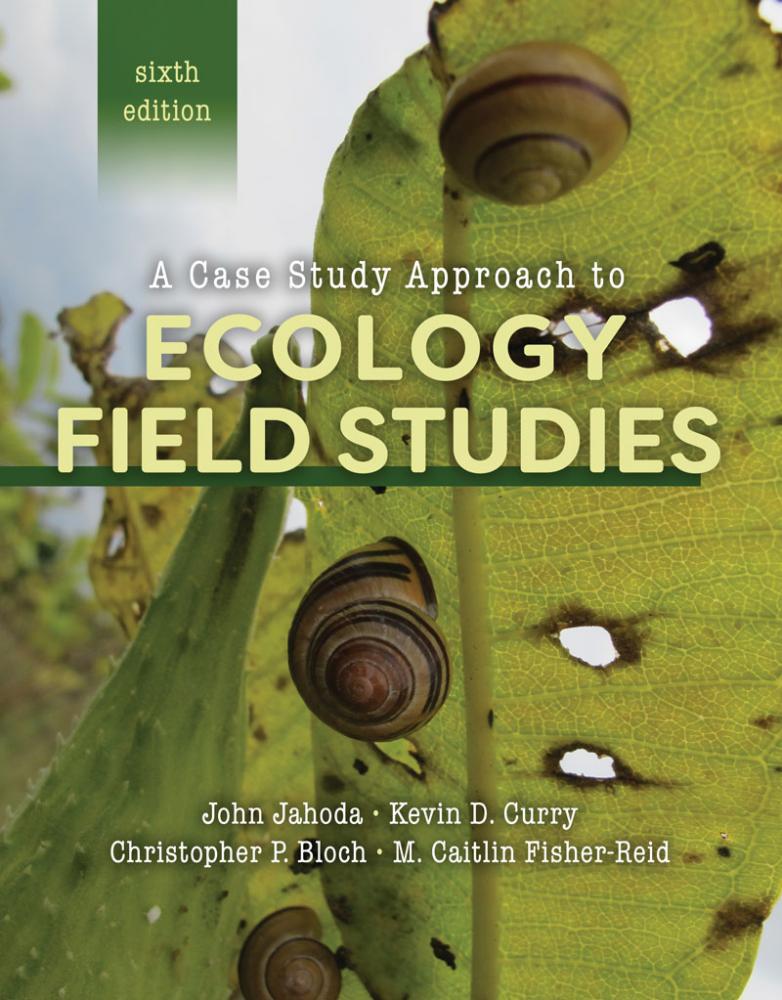
A Case Study Approach to Ecology Field Studies
Edition: 6
Copyright: 2020
Pages: 104
Edition: 6
Copyright: 2020
Pages: 104
Choose Your Format
$52.27 USD
Ebook
$26.15 USD
This laboratory manual is designed to support a laboratory and field experience in a one-semester course in general ecology. The case study approach is taken to introduce the student to ecological field studies, the handling of data, and the process of science. The entire scientific process is modeled in a series of case studies, including observation, formation of hypotheses, data collection, data analysis, and presentation of results in the format of a scientific research paper.
The overall goal in this course is to learn as much as possible about the principles of ecology. The laboratory portion of the course models science as a process of discovery. Students work as research teams in a series of ecological case studies designed to model scientific investigations and procedures.
Chapter 1 Introduction
Chapter 2 Introduction to Statistics and Data Analysis
Chapter 3 Global Positioning Systems (GPS)
Chapter 4 Terrestrial Macroinvertebrates: Predators, Habitat Cues, and Biodiversity
Chapter 5 The Intertidal Invasion: A Field Study of Invasive Species and Intertidal Zonation
Chapter 6 Guidelines for Laboratory Reports
Chapter 7 Human Demography Field Study
Chapter 8 The Woodlot Project: A Field Study of Tree Competition
Chapter 9 Additional Considerations on Statistics and Data
Dr. Kevin Curry is Professor Emeritus of Biological Sciences. He earned a B.A. in Biology from Central College, an M.S. in Fisheries from the University of Arizona, and a Ph.D. in Aquatic Ecology from Purdue University. His teaching and research focus on stream ecology, fish biology, and aquatic insects, with an emphasis on freshwater ecosystems, environmental indicators, and the impacts of human activities on aquatic habitats.
Dr. Christopher Bloch is Professor of Biological Sciences at Bridgewater State University. He earned a B.S. and M.S. in Biology from Old Dominion University and a Ph.D. in Biology from Texas Tech University. His teaching and research focus on ecology, biometry, population biology, and community ecology, with an emphasis on how natural and human-caused disturbances influence species populations, biodiversity, and ecosystem structure.