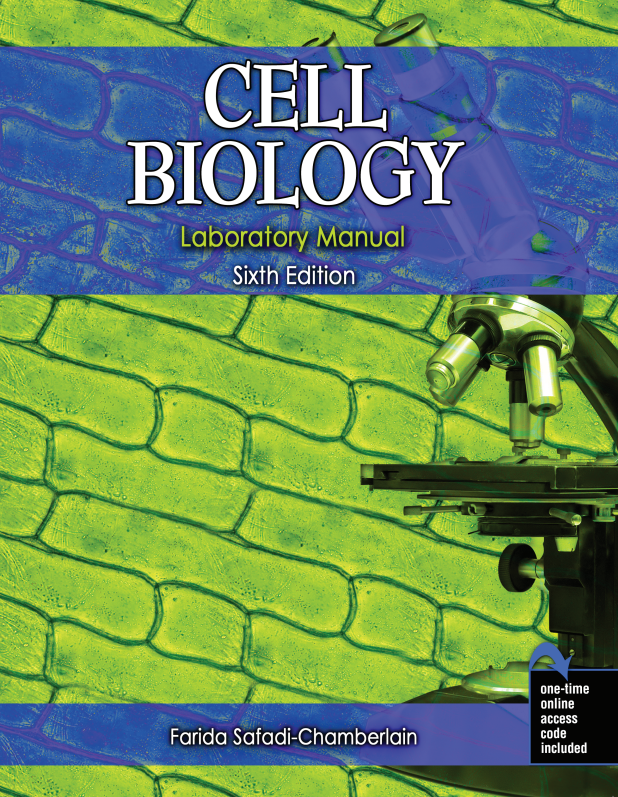
Cell Biology Lab Manual
Edition: 6
Copyright: 2024
Edition: 6
Copyright: 2024
Pages: 264
Choose Your Format
Print Package
$56.00 USD
Website
$50.40 USD
You will be using chemical solutions in this laboratory and throughout your careers in science. It is, thus, very important to learn the basic expressions of concentrations, calculate the conversion of one expression of concentration into another, and learn how to dilute a concentrated solution into a desired concentration. It is of special importance to understand the units of experimental values and their multiples and subdivisions.
Acknowledgements
Lab Session 1 Concentrations of Solutions, Accuracy, and Precision of Data Acquisition
Part 1: Concentrations of Solutions
Part 2: Accuracy, and Precision of Data Acquisition; Volume Measuring Devices
Lab Session 2 The Microscope Part 1: Types and Proper Use
Lab Session 3 The Microscope Part 2: Cells of Living Organisms
Lab Session 4 Enzymes I: Spectrophotometry and Partial Puri cation or Tyrosinase Enzyme from Potato Tubers
Lab Session 5 Enzymes II: Effect of the Environment on Enzyme Activity
Lab Session 6 Enzymes III Kinetic Analysis of the Tyrosinase Enzyme: KM and VMAX
Lab Session 7 Characterization of Proteins
Part 1: Protein Separation by Gel Electrophoresis
Part 2: Determining Protein Concentration: Bradford Assay
Lab Session 8 The Study of Cellular Functions
Part 1: Cell Organelle Isolation
Part 2: Isolation of Mitochondria from Spinach Leaves Respiration
Lab Session 9 The Study of Cellular Functions
Part 3: Isolation of Chloroplasts from Spinach Leaves: Photosynthesis - Hill Reaction
Lab Session 10 Enzyme Linked Immunosorbent Assay (ELISA)
Addendum: Enzyme Linked Immunosorbent Assay
Lab Session 11 Fluorescence Microscopy Immunostaining
Lab Session 12 The Hemocytometer: Determining Density and Viability of Cells in Suspension
Lab Session 13 Protein Structure Analysis Using Online Tools

Associate Professor at Colorado State University
You will be using chemical solutions in this laboratory and throughout your careers in science. It is, thus, very important to learn the basic expressions of concentrations, calculate the conversion of one expression of concentration into another, and learn how to dilute a concentrated solution into a desired concentration. It is of special importance to understand the units of experimental values and their multiples and subdivisions.
Acknowledgements
Lab Session 1 Concentrations of Solutions, Accuracy, and Precision of Data Acquisition
Part 1: Concentrations of Solutions
Part 2: Accuracy, and Precision of Data Acquisition; Volume Measuring Devices
Lab Session 2 The Microscope Part 1: Types and Proper Use
Lab Session 3 The Microscope Part 2: Cells of Living Organisms
Lab Session 4 Enzymes I: Spectrophotometry and Partial Puri cation or Tyrosinase Enzyme from Potato Tubers
Lab Session 5 Enzymes II: Effect of the Environment on Enzyme Activity
Lab Session 6 Enzymes III Kinetic Analysis of the Tyrosinase Enzyme: KM and VMAX
Lab Session 7 Characterization of Proteins
Part 1: Protein Separation by Gel Electrophoresis
Part 2: Determining Protein Concentration: Bradford Assay
Lab Session 8 The Study of Cellular Functions
Part 1: Cell Organelle Isolation
Part 2: Isolation of Mitochondria from Spinach Leaves Respiration
Lab Session 9 The Study of Cellular Functions
Part 3: Isolation of Chloroplasts from Spinach Leaves: Photosynthesis - Hill Reaction
Lab Session 10 Enzyme Linked Immunosorbent Assay (ELISA)
Addendum: Enzyme Linked Immunosorbent Assay
Lab Session 11 Fluorescence Microscopy Immunostaining
Lab Session 12 The Hemocytometer: Determining Density and Viability of Cells in Suspension
Lab Session 13 Protein Structure Analysis Using Online Tools
Associate Professor at Colorado State University