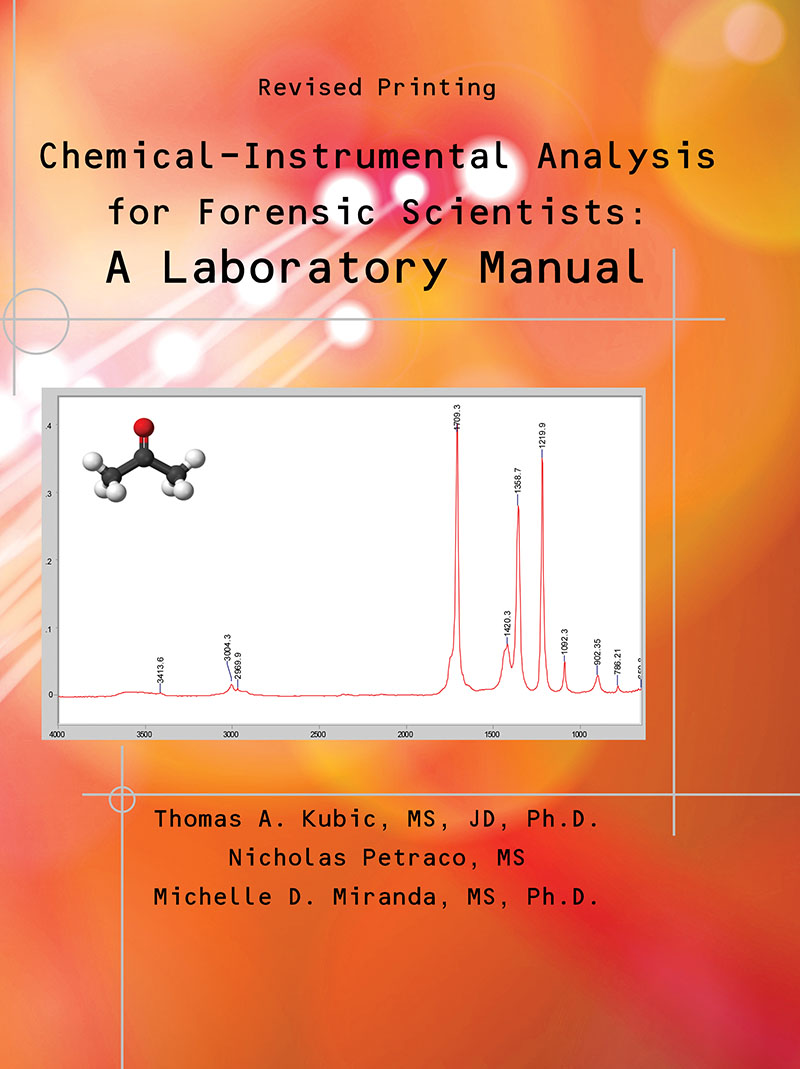
Chemical-Instrumental Analysis for Forensic Scientists: A Laboratory Manual
Edition: 2
Copyright: 2025
Pages: 268
Edition: 2
Copyright: 2025
Pages: 268
Choose Your Format
$79.00 USD
Ebook
$63.00 USD
This laboratory manual is a Second Edition containing over twenty five chemical instrumentation laboratory exercises designed for undergraduate and graduate chemical instrumentation courses of study. It is over 150 pages in length with added appendices containing information on materials, calibrations, error analysis, electronic data processing, sample questions for student education and removable exercise report pages. It is designed to be used in either a one or two semester program. It can accompany and supplement any quality college text book dealing with the theory, operation and usefulness of electronics based chemical instrumentation for the qualitative and quantitative determination of chemical species.
The exercises vary from the rudimentary dealing with simple solvent mixture identification by gas chromatography, different classic sample preparation methods for infrared spectrometry and how solvents, sample containers and instrument data collection parameters affect the UV-Visible spectra that are collected on a sample by a student. Exercises with more advanced methodology such as X-ray diffraction and florescence, atomic absorption, gas chromatography-mass spectrometry (GC-MS) Raman, high performance liquid chromatography and polarimetry are also offered. Both qualitative and quantitative experiments are included as well as short theoretical discussions of the topics covered.
Originally developed for the two semester course of study in Forensic Chemical Instrumentation at John Jay College part of City University of New York it has been used successfully for over 10 years in the College’s curricula.
Although, a majority of the exercises deal with items of forensic interest such as the determination of ethanol content by gas chromatography, ignitable liquid residues by GC-MS, and drug (non-controlled substances) identification by Fourier Transform Infrared and Raman vibrational spectromitries, many are fundamental in nature and apply to most classes of chemicals. The proper calibration of instruments, careful notebook entries, as well as the correct interpretation of data is stressed in this manual.
The three authors have a combined crime laboratory experience of over 80 years with court expert testimony experience and of over 50 years of criminalistics and analytical chemistry teaching experience at the university level.
Preface
Acknowledgements
Table of Contents
General Instructions
Laboratory Notebook
Grading
Checkouts
Results
Special Projects
Laboratory Conduct
Laboratory Operation
Additional Laboratory Regulations
LABORATORY EXPERIMENTS
UV/Visible Spectrophotometry I [UV Parameters]
UV/Visible Spectrophotometry II [UV Qual]
UV/Visible Spectrophotometry III [UV Quant]
Spectrophotometric Measurement [Conway Microdiffusion]
Infrared Spectroscopy I [IR Sample Prep]
Infrared Spectroscopy II [IR Qual]
Infrared Spectroscopy III [Polymer Films]
Infrared Spectroscopy IV [ATR-IR]
Introduction to Raman Spectroscopy
X-ray Diffraction I
X-ray Diffraction II
X-ray Diffraction III
X-ray Diffraction IV
X-ray Fluorescence/Energy Dispersive Spectrometry
Atomic Absorption Spectroscopy I
Atomic Absorption Spectroscopy II
Spectrofluorometry
Introduction to Polarimetry
Gas Chromatography I [GC Solvents]
Gas Chromatography II [GC Ethanol]
Gas Chromatography III [GC Arson]
Introduction to Mass Spectrometry
Gas Chromatography/Mass Spectrometry I [GC/MS Arson-Simulated]
Gas Chromatography/Mass Spectrometry II [GC/MS Arson]
Gas Chromatography/Mass Spectrometry III [GC/MS Quant]
High Performance Liquid Chromatography I [HPLC Qual]
High Performance Liquid Chromatography II [HPLC Quant]