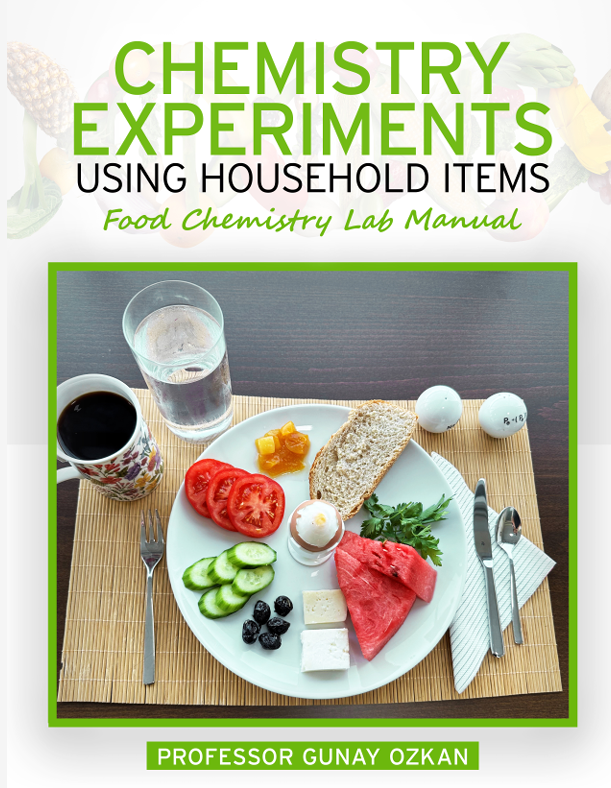
Chemistry Experiments using Household Items: Food Chemistry Lab Manual
Edition: 1
Copyright: 2025
Choose Your Format
Ebook Package
$89.40 USD
The Chemistry Experiments Using Household Items: Food Chemistry Lab Manual introduces students to the fundamental principles of chemistry through safe, hands-on experiments that use common household materials and food products. Designed to make chemistry accessible and engaging, the manual explores essential topics such as measurement, graphing, boiling and freezing points, density, and the chemical properties of everyday foods. By connecting scientific concepts to familiar materials, students gain a practical understanding of chemistry and its role in daily life.
Throughout the manual, students investigate the chemistry behind common foods and household items through laboratory activities including popcorn preparation, margarine composition, yogurt production, fat analysis in ground beef, starch testing, and natural acid-base indicators. Each experiment emphasizes scientific observation, data collection, graphing, calculations, and laboratory safety while encouraging critical thinking and problem-solving. By integrating foundational chemistry concepts with real-world applications, the manual helps students develop laboratory skills and a greater appreciation for the chemistry found in everyday experiences.
Experiment 1 Measurements 1
Experiment 2 Preparing and Reading a Graph 15
Experiment 3 Determination of Boiling and Freezing Point of Water 21
Experiment 4 Density I 29
Experiment 5 Density II 39
Experiment 6 Chemistry of Making Popcorn in a Microwave 49
Experiment 7 What Makes Margarine Regular, Light, or Extra Light? 55
Experiment 8 Chemistry of Yogurt Making 67
Experiment 9 Calculation of Percent (%) and Density of Fat in Ground Beef 77
Experiment 10 Iodine Test for Starch in Foods 83
Experiment 11 Nature's Indicator 93
Gunay Ozkan obtained a Bachelor of Science in Chemistry and her first Master's degree in Türkiye. Upon relocating to the United States, she pursued a second Master's degree in Organic Chemistry in Washington D.C. and subsequently dedicated over thirty years to the community college system across multiple states. During this distinguished career, Gunay was awarded three prestigious grants to collaborate with K-12 educators, focusing on innovative methods to teach hands-on chemistry using everyday household items. This inspired her to develop an advanced online Food Chemistry course, complete with comprehensive laboratory components.