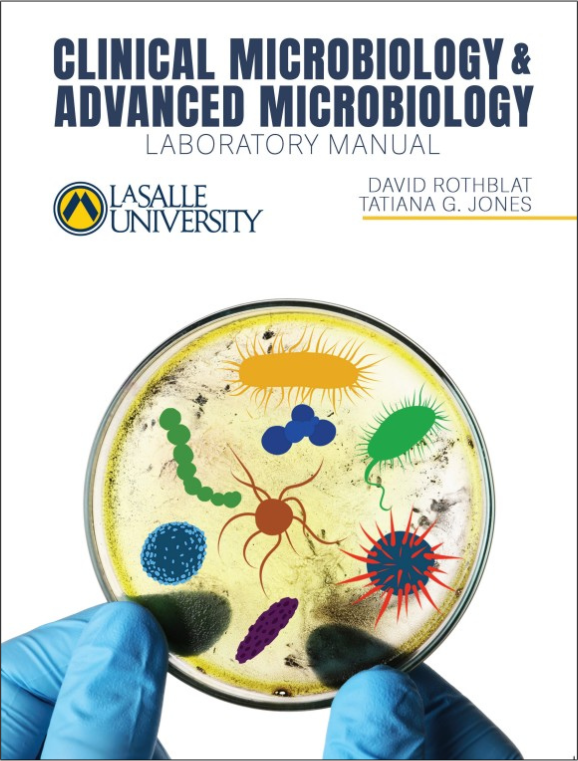
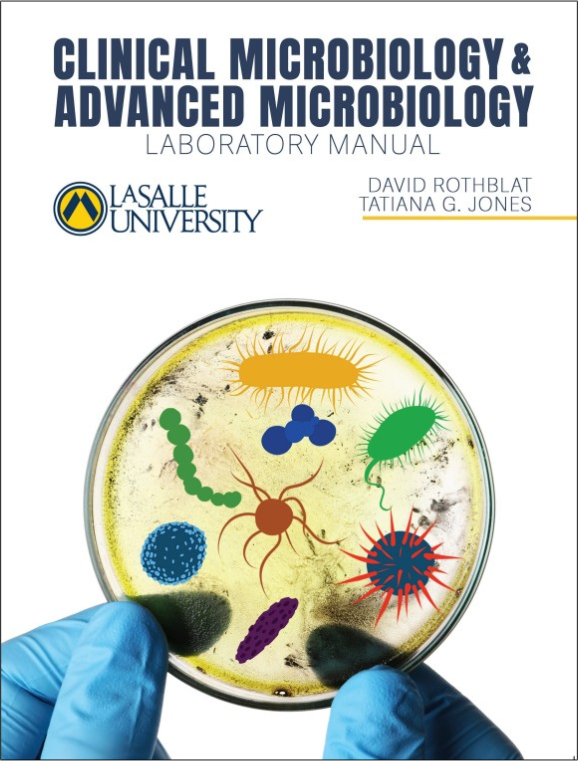
Clinical Microbiology & Advanced Microbiology Laboratory Manual
Edition: 1
Copyright: 2026
Pages: 316
Edition: 1
Copyright: 2026
Pages: 316
Choose Your Format
Choose Your Platform | Help Me Choose


$90.00 USD
Ebook
$45.00 USD
Preface
Introduction
Laboratory Safety
General Information
Microbiology Lab Safety Contract
Laboratory Waste Disposal
PART I CLINICAL MICROBIOLOGY LABORATORY
SECTION I.1 Laboratory Safety and Metric System
I.1.1. Laboratory Safety
I.1.2. Metric System Denominators, Units, Fraction, and Multiplication
I.1.3. Exercise: Measurements in Clinical Microbiology
I.1.4. Exercise: Hand Washing
LABORATORY REPORT I.1. Diseases Caused by Bacteria, Measurements in Clinical Microbiology, Hand Washing
SECTION I.2 Growing Bacteria
I.2.1. Introduction to Microbes
I.2.2. Exercise: Where are the Microbes?
Reflection Questions
Week 2: Making Your Observations
LABORATORY REPORT I.2 Growing Bacteria
SECTION I.3 Aseptic Transfer
I.3.1. Aseptic Transfer Techniques
I.3.2. Exercise: Agar Art
I.3.3. Exercise: Aseptic Transfer
LABORATORY REPORT I.3.1. Agar Art Observations
LABORATORY REPORT I.3.2. Aseptic Transfer (Plates and Slants)
SECTION I.4 Isolating Bacteria
I.4.1. Streak Isolation
I.4.2. Serial Dilutions Concept
I.4.3. Counting Colony-Forming Units—Counting Bacteria
I.4.4. Exercise: Four-Phase Streak
I.4.5. Exercise: Serial Dilutions and Colony Forming Units Calculation
LABORATORY REPORT I.4. Streak Isolation, Serial Dilutions, Plate Count, and CFUS Calculation
SECTION I.5 Microscopy
1.5.1. Using Your Microscope
I.5.2. Exercise: Using Your Microscope
LABORATORY REPORT I.5. Using Your Microscope
SECTION I.6 Gram Staining
I.6.1. Introduction to the Gram Staining
I.6.2. Bacterial Smear Preparation
I.6.3. Exercise: Gram Staining
LABORATORY REPORT #7
SECTION I.7 Selective and Differential Media and Biochemical Differential Tests
I.7.1. Basic Principles of Selective and Differential Media
I.7.2. Mannitol Salt Agar
I.7.3. Eosin–Methylene Blue Agar
I.7.4. Sheep Blood Agar
I.7.5. Urea Hydrolysis Test
I.7.6. Citrate Utilization Test
I.7.7. Catalase Test
I.7.8. Sulfur Reduction, Indole Production, Motility Test
I.7.9. Exercise: Selective and Differential Media and Biochemical Differential Tests
LABORATORY REPORT I.7.1. Selective and Differential Media and Biochemical Differential Tests
LABORATORY REPORT I.7.2. Differentiating Bacteria (Based on Case Study)
SECTION I.8 Microbiology and Food
I.8.1. Introduction
I.8.2. Exercise: Microbiology of Food
LABORATORY REPORT I.8. Microbiology of Food
SECTION I.9 The Unknown Bacteria Identification Project
I.9.1. Introduction to the Unknown Bacteria Identification Project
I.9.2. Guidelines for Completing the Unknown Bacteria Identification Project
I.9.3. Procedure for Completing the Unknown Bacteria Identification Project
LABORATORY REPORT 1.9. Unknown Bacteria Identification
PART II ADVANCED MICROBIOLOGY LABORATORY
SECTION II.1 Introduction to Microbiology Laboratory and Laboratory Safety and Metric System
II.1.1. Introduction to Microbiology Laboratory and Laboratory Safety
II.1.2. Metric System Denominators, Units, Fractions, and Multiplication
II.1.3. Conversion of Metric Measurements to Imperial and Imperial to Metric
II.1.4. Exercise: Hand Washing
LABORATORY REPORT II.1. Safety and Waste Disposal, Metric System, and Hand Washing
SECTION II.2 Aseptic Transfer
II.2.1. Aseptic Transfer Techniques
II.2.2. Streak Isolation
II.2.3. Serial Dilutions Concept
II.2.4. Counting Colony Forming Units
II.2.5. Exercise: Aseptic Transfer and Streak Isolation
II.2.6. Exercise: Serial Dilutions and Colony Forming Units (CFUS)
Plate Count and Calculation
LABORATORY REPORT II.2. Aseptic Transfer Techniques, Streak Isolation, Serial Dilutions, Plate Count, and CFUS Calculation
SECTION II.3 Bacterial Colonies and Culture Characterization
II.3.1. Bacterial Colonies Morphology
II.3.2. Bacterial Culture Characteristics
II.3.3. Exercise: Bacterial Colonies and Culture Characterization Using Agar Art
LABORATORY REPORT II.3. Bacterial Colony Characterization Using Agar Art
SECTION II.4 Microscopy
II.4.1. Introduction to Light Microscope
II.4.2. Working with Oil-Immersion Microscopy
II.4.3. Field of View Calculation
II.4.4. Preparation of Bacterial Smear for Microscopy
II.4.5. Exercise: Observing Bacteria Through Oil-Immersion Microscopy
II.4.6. Exercise: Preparing Bacterial Smear for Microscopy and Observing Using Oil-Immersion Microscopy
LABORATORY REPORT II.4.1. Basics of Microscopy and FOV Calculation
LABORATORY REPORT II.4.2. Bacterial Smear Preparation from Liquid and Solid Cultures and Observation Using Oil-Immersion Microscopy
SECTION II.5 Bacterial Smear Staining Techniques
II.5.1. Basic Principles of Staining
II.5.2. Classification of Staining
II.5.3. Simple Staining
II.5.4. Gram Staining
II.5.5. Acid-Fast Staining
II.5.6. Capsule Staining
II.5.7. Endospore Staining
II.5.8. Exercise. Staining Bacterial Smears: Gram Staining, Capsule Staining, and Endospore Staining
LABORATORY REPORT II.5. Staining Techniques: Gram Staining, Capsule Staining, and Endospore Staining
SECTION II.6 Bacterial Culture Media
II.6.1. Types of Bacterial Culture Media
II.6.2. Media Preparation
II.6.3. Growth Pattern in Broth
II.6.4. Growth Pattern on Agar Slant
II.6.5. Growth Pattern on Deep Stab Agar
II.6.6. Growth Pattern on Agar Plate (Petri Dish)
II.6.7. Exercise: Evaluation of Bacterial Respiratory Pattern Using Liquid Media and Thioglycolate Broth
LABORATORY REPORT II.6. Bacterial Respiratory Pattern and Oxygen Requirement
SECTION II.7 Selective and Differential Media
II.7.1. Basic Principles of Selective and Differential Media
II.7.2. Phenylethyl Alcohol Agar
II.7.3. Mannitol Salt Agar
II.7.4. Eosin–Methylene Blue Agar
II.7.5. MacConkey Agar
II.7.6. Sheep Blood Agar
II.7.7. Exercise: Selective and Differential Media
LABORATORY REPORT II.7. Selective and Differential Media
SECTION II.8 Biochemical Differential Tests
II.8.1. Phenol Red Test
II.8.2. Methyl Red/Voges–Proskauer (MR-VP) Test
II.8.3. Urea Hydrolysis Test
II.8.4. Citrate Utilization Test
II.8.5. Catalase Test
II.8.6. Nitrate Reduction Test
II.8.7. Sulfur Reduction, Indole Production, Motility Test
II.8.8. Triple Sugar Iron Agar
II.8.9. Exercise: Biochemical Differential Tests
LABORATORY REPORT II.8. Biochemical Differential Tests
SECTION II.9 Bacterial Gene Recombination
II.9.1. Types of Bacterial Gene Recombination
II.9.2. Introduction to E. Coli pGLO Transformation
II.9.3. Calculation of Transformation Efficiency
II.9.4. Exercise: pGLO Transformation
LABORATORY REPORT II.9. pGLO Transformation
SECTION II.10 The Unknown Bacteria Identification Project
II.10.1. Introduction to the Unknown Bacteria Identification Project
II.10.2. Guidelines for the Unknown Bacteria Identification Project
II.10.3. Exercise: Procedure for Completion of the Unknown Bacteria Identification Project
LABORATORY REPORT II.10. Unknown Bacteria Identification
Appendix
Media Recipes
Preparation of Broth-Based (Liquid) and Agar-Based (Solid) Media For General Use
Selective and Differential Media
Media for Differential Tests