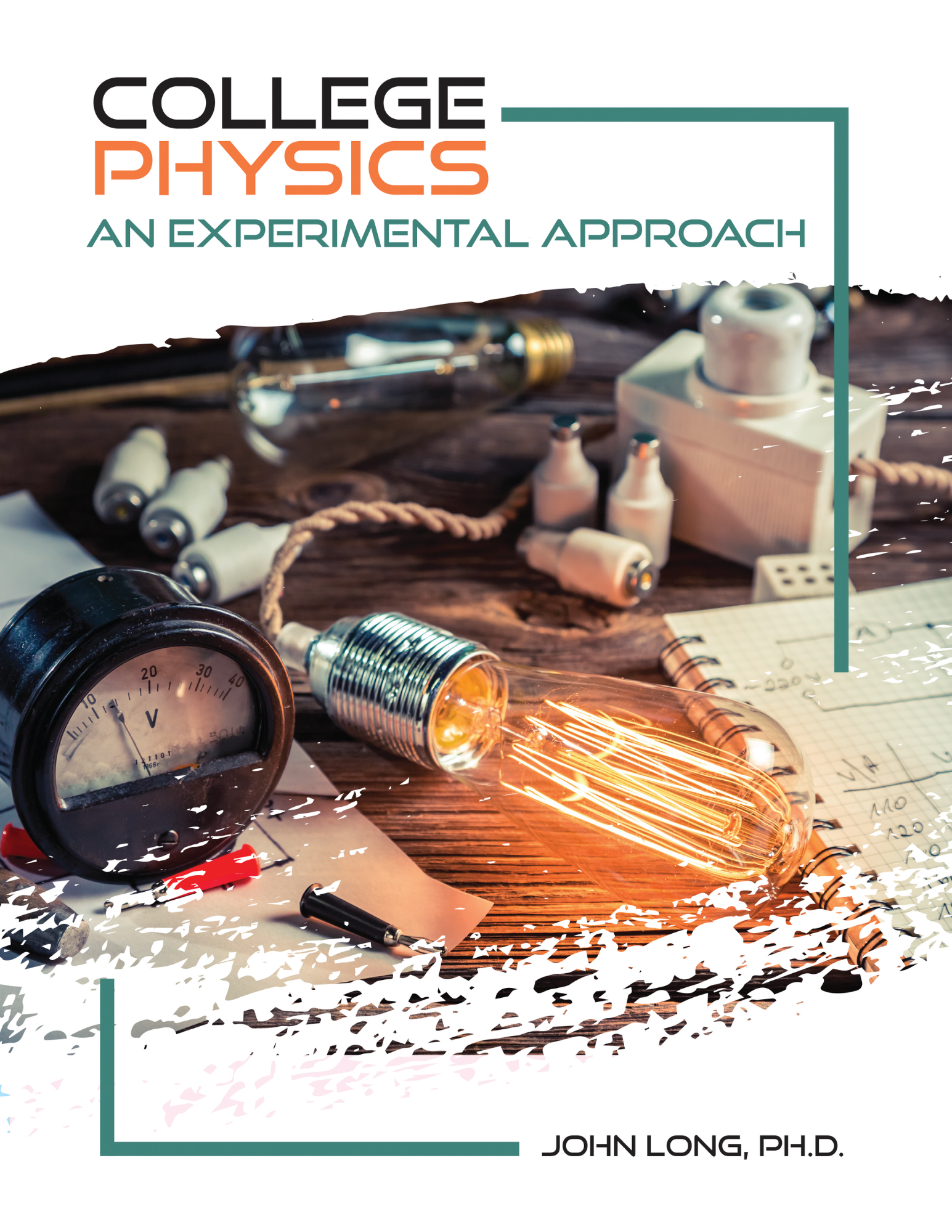
College Physics: An Experimental Approach
Edition: 1
Copyright: 2026
Pages: 176
Choose Your Format
$40.00 USD
Laboratory experiments are a fundamental part of any science course. An experimental approach to physics strengthens critical thinking by compelling students to connect the theoretical models to real-world behavior. In addition, they promote collaboration as students must work with their peers.
College Physics - An Experimental Approach is a comprehensive set of experiments designed for a full year, algebra-based physics sequence. There are 22 experiments covering topics in motion, force and energy, momentum, equilibrium, thermodynamics, fluids, optics, electrostatics, electricity, and modern physics. Each experiment includes a thorough summary of the background material needed to connect the theoretical with the experimental. In addition, most experiments include challenging problems for the students to work on in groups.

Dr. John Long is an Associate Professor of Environmental Physics and Chair of the Department of Science and Mathematics at Northern State University. He has over 30 years of experience teaching STEM subjects. His area of expertise is the mathematical and physical aspects of the environment. Dr. Long earned a BS degree in Applied Mathematics from the State University of New York, an MS degree in Environmental & Ecological Statistics and a Ph.D. in Ecology and Environmental Sciences, both from Montana State University.
Laboratory experiments are a fundamental part of any science course. An experimental approach to physics strengthens critical thinking by compelling students to connect the theoretical models to real-world behavior. In addition, they promote collaboration as students must work with their peers.
College Physics - An Experimental Approach is a comprehensive set of experiments designed for a full year, algebra-based physics sequence. There are 22 experiments covering topics in motion, force and energy, momentum, equilibrium, thermodynamics, fluids, optics, electrostatics, electricity, and modern physics. Each experiment includes a thorough summary of the background material needed to connect the theoretical with the experimental. In addition, most experiments include challenging problems for the students to work on in groups.
Dr. John Long is an Associate Professor of Environmental Physics and Chair of the Department of Science and Mathematics at Northern State University. He has over 30 years of experience teaching STEM subjects. His area of expertise is the mathematical and physical aspects of the environment. Dr. Long earned a BS degree in Applied Mathematics from the State University of New York, an MS degree in Environmental & Ecological Statistics and a Ph.D. in Ecology and Environmental Sciences, both from Montana State University.