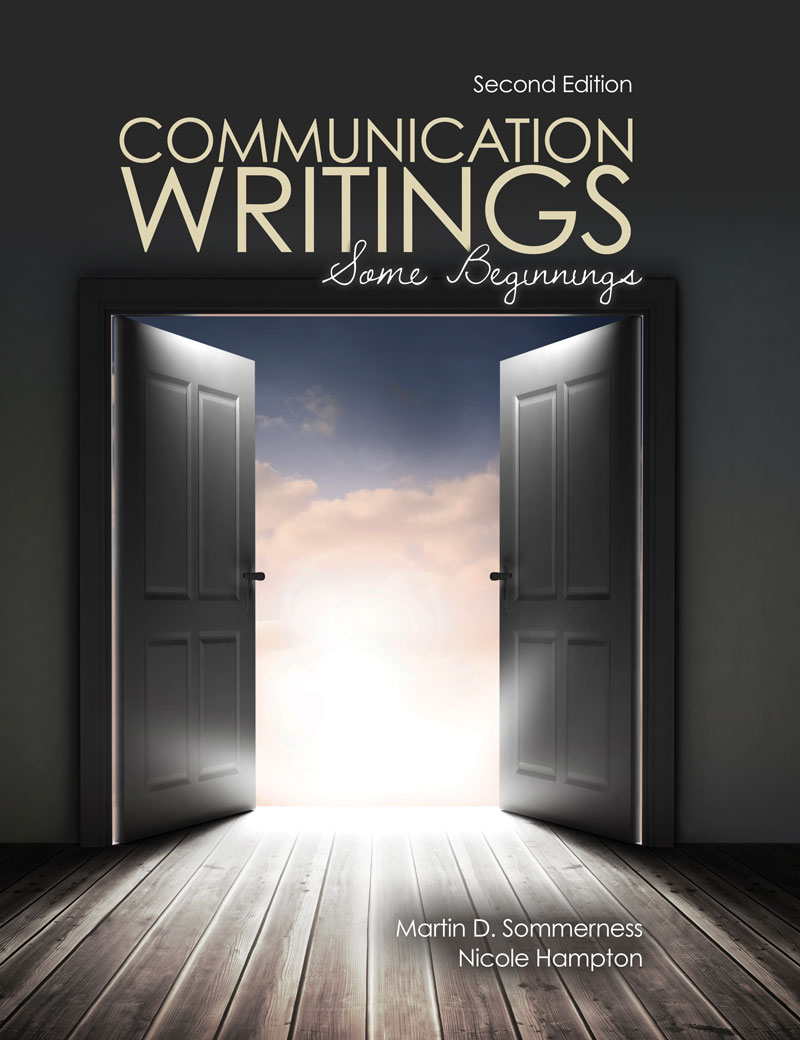

Communication Writings: Some Beginnings
Edition: 2
Copyright: 2017
Pages: 182
Edition: 2
Copyright: 2017
Pages: 182
Choose Your Format
$80.23 USD
Ebook
$40.11 USD
The Communication Writings: Some Beginnings textbook introduces students to the fundamentals of effective written communication in academic, professional, and media environments. Covering topics such as communication theory, grammar, AP style, editing, research, social media, multimedia communication, and broadcast news writing, the book provides a practical foundation for developing strong writing and critical thinking skills. Through engaging discussions and real-world examples, students learn the importance of precision, clarity, ethics, and audience awareness in producing effective communication across a variety of formats.
Throughout the book, readers strengthen their writing abilities by exploring the writing process, paragraph development, grammar, diction, plagiarism, research methods, and professional communication standards. The text also emphasizes career readiness through discussions of personal strengths, digital communication, and emerging media while encouraging students to apply industry-standard practices to their own work. By combining communication theory with hands-on writing instruction, the book prepares students for success in journalism, public relations, strategic communication, media, and other communication-related professions.
Chapter 1: Communication Writing—An Introduction
Chapter 2: The Clifton StrengthsFinder 2.0 and You
Chapter 3: Why You Are Not a "Communications" Major and Other Terminology Traps of "Drop the 's,'" Will ya?" An Example of the Importance of Precision in Verbal Expression
Chapter 4: "Your Grammar Wears Combat Boots!" "Well! My Grammar Can Beat Up Your Grammar"
Chapter 5: An Introduction to AP Style: "It's Your Business to Make it Clear for Them"
Chapter 6: Editing Strategic Writing
Chapter 7: Plagiarism
Chapter 8: Social Media and the Millennial Generation
Chapter 9: Creating Effective Multimedia Communications
Chapter 10: Introduction to Broadcast News Writing
Chapter 11: Diction, Syntax, Poetry, and Canned Meat
Chapter 12: Clicking Enter: Shaping Paragraphs
Chapter 13: "A"cing AP Style
Chapter 14: Conducting Research
Chapter 15: Annotated Bibliography
Chapter 16: A Brief Intern-rruption
Chapter 17: Where Do We Go From Here?
B.S. in Communication, Michigan State University (1977)
M.A. in Communication, Michigan State University (1979)
J.D. in Law, Wayne State University (1981)

Nicole Hampton is a Senior Lecturer in the Department of Educational Specialties within the College of Education at Northern Arizona University (NAU), where she has served as a faculty member for over two decades. She is the CTE (Career and Technical Education) Area Coordinator at NAU, responsible for course design and delivery at both undergraduate and graduate levels, student advising and mentoring, program assessment, and administration of CTE degrees. Her work includes curriculum mapping, program articulation with the Arizona community college system, and developing program outcomes.
The Communication Writings: Some Beginnings textbook introduces students to the fundamentals of effective written communication in academic, professional, and media environments. Covering topics such as communication theory, grammar, AP style, editing, research, social media, multimedia communication, and broadcast news writing, the book provides a practical foundation for developing strong writing and critical thinking skills. Through engaging discussions and real-world examples, students learn the importance of precision, clarity, ethics, and audience awareness in producing effective communication across a variety of formats.
Throughout the book, readers strengthen their writing abilities by exploring the writing process, paragraph development, grammar, diction, plagiarism, research methods, and professional communication standards. The text also emphasizes career readiness through discussions of personal strengths, digital communication, and emerging media while encouraging students to apply industry-standard practices to their own work. By combining communication theory with hands-on writing instruction, the book prepares students for success in journalism, public relations, strategic communication, media, and other communication-related professions.
Chapter 1: Communication Writing—An Introduction
Chapter 2: The Clifton StrengthsFinder 2.0 and You
Chapter 3: Why You Are Not a "Communications" Major and Other Terminology Traps of "Drop the 's,'" Will ya?" An Example of the Importance of Precision in Verbal Expression
Chapter 4: "Your Grammar Wears Combat Boots!" "Well! My Grammar Can Beat Up Your Grammar"
Chapter 5: An Introduction to AP Style: "It's Your Business to Make it Clear for Them"
Chapter 6: Editing Strategic Writing
Chapter 7: Plagiarism
Chapter 8: Social Media and the Millennial Generation
Chapter 9: Creating Effective Multimedia Communications
Chapter 10: Introduction to Broadcast News Writing
Chapter 11: Diction, Syntax, Poetry, and Canned Meat
Chapter 12: Clicking Enter: Shaping Paragraphs
Chapter 13: "A"cing AP Style
Chapter 14: Conducting Research
Chapter 15: Annotated Bibliography
Chapter 16: A Brief Intern-rruption
Chapter 17: Where Do We Go From Here?
B.S. in Communication, Michigan State University (1977)
M.A. in Communication, Michigan State University (1979)
J.D. in Law, Wayne State University (1981)
Nicole Hampton is a Senior Lecturer in the Department of Educational Specialties within the College of Education at Northern Arizona University (NAU), where she has served as a faculty member for over two decades. She is the CTE (Career and Technical Education) Area Coordinator at NAU, responsible for course design and delivery at both undergraduate and graduate levels, student advising and mentoring, program assessment, and administration of CTE degrees. Her work includes curriculum mapping, program articulation with the Arizona community college system, and developing program outcomes.