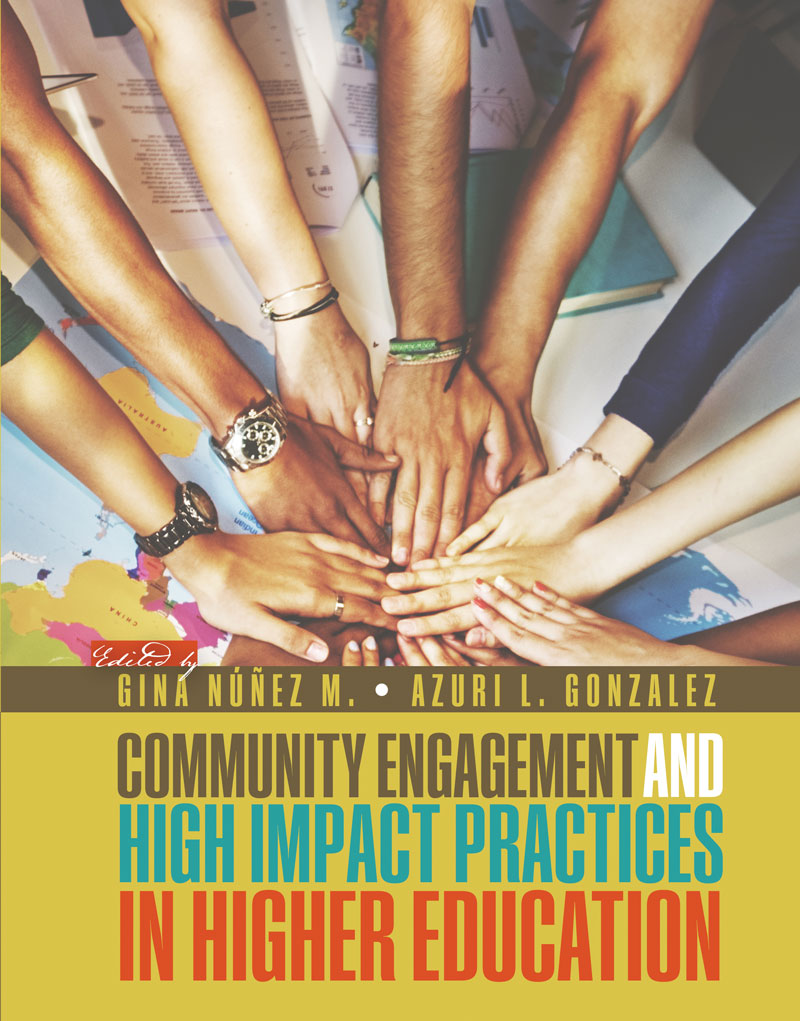
Community Engagement and High Impact Practices in Higher Education
Edition: 1
Copyright: 2018
Pages: 264
Choose Your Format
Ebook
$38.89 USD
Community Engagement and High Impact Practices in Higher Education provides students with valuable skills and experiences that contribute to their academic and professional success; these experiences are heightened when paired with meaningful community engagement.
This book is a compilation of elaborate examples of community engagement by faculty, students, community members and professionals that have integrated various methods in their courses to achieve higher levels of impact. In each scenario, faculty, students and community partners discuss the strategies, successes and challenges of working to address specific social needs identified in their community. They have all methodically engaged students to acquire complex theory and knowledge while serving concrete social and environmental needs.
Contributions to this book were made from a place-based educational context where participating students come from the very community they serve and the faculty who support them have a keen understanding of the regional community. The represented engaged institution and faculty members have worked on developing long-standing relationships with community partners and entities, and together co-teach and learn with students.
Anthropology
1. Anthropology and Service Learning: Building Bridges Across Generations to Challenge the Social Stigmas of Aging
Gina Núñez, David Josue Lopez, and Corina Marrufo
Communications
2. Service-Learning as a Collaborative Assignment: Possibilities and Practices
Sarah De Los Santos Upton
3. Entering Students Practicing Social Justice and Activism through Research, Service Learning and Documentary Film Making
DeAnna Kay Varela
Education
4. Collaboration Creation of an Air Quality Curriculum That Promotes Community Based Learning
Elaine Hampton, Cynthia Ontiveros, Amy Canales, Monica Chavez, Manuel Piña Jr., W.L. Hargrove, Wen-Whai Li, Susan Brown, Bora Simmons, and Jennifer M. Lujan
5. Using a Service-Learning Project to Overcome the Fear of Arthropods and Instill an Awareness of the Sixth Mass Extinction in Future Teachers and Elementary Children
Ron Wagler
Engineering
6. Community Engagement in Civil Engineering Senior Capstone Design
Ivonne Santiago
English
7. Leveraging Assets Through Appreciative Interviews in Classrooms and Communities
Lucía Durá
8. The Value of Internships in a College Education
Isabel Baca
9. Critical Incident Interviews: Cultivating Dialogue Across Difference
Jennifer Clifton
Health Science
10. Community and Academic Public Health Perspectives in Pharmacy Education: Linking the Learning Out comes of Service-Learning and Community-Based Participatory Research
Eufemia (Pema) B. Garcia, and Jeri J. Sias
11. Using Capstone Course Fieldwork to Serve the Older Adult Community
Sandor Dorgo
Nonprofit and Border Studies
12. Building Latinx Solidarity Through Global Learning Communities in the 21st Century
Irma Victoria Montelongo and Isabel Martinez
13. Scaling Up: Mini-Internships in Nonprofit Management
Kathleen Staudt
Philosophy
14. Wondering with Others: Philosophy for Children and Place-Based Community Engagement
Amy Reed-Sandoval
Dr. Guillermina G. Núñez-Mchiri is associate professor of anthropology and director of women and
gender studies at UTEP. She teaches courses in Ethnographic Research Methods; Death, Dying, and
Bereavement; Anthropology of Food, Culture, and Society; Interdisciplinary feminist theory and
methods; and Death, Dying, and Bereavement. Her classes incorporate high-impact practices involving
service-learning, undergraduate research, internships, and engagement opportunities through
community partnerships. Dr. Núñez received her Ph.D. in Cultural Anthropology from the University of
California Riverside in 2006, her MA in Latin American studies in 1998, and her BA in International
Business with a specialty in Spanish and Portuguese in 1994 from San Diego State University. She has a
partnership with the City of El Paso’s Park and Recreation Department working with older adult athletes
who are challenging the social stigmas of aging through active living and competitive athletics. Dr.
Núñez is an applied anthropologist with specialization in ethnography and the U.S.–Mexico border
region. She has published on a number of topics related to colonias, immigration and human rights,
housing and social justice, Latina identity, Latinas in STEM fields, immigrant youth and education, and the
applications of Ethnography and Service-learning in higher education. In 2012, she received the 2012
University of Texas Regents Outstanding Teaching Award for her contributions to transforming higher
education at the state level.
Azuri Gonzalez served The University of Texas at El Paso and the Center for Civic Engagement (CCE)
for 15 years and as director for the past 9 years. Through her work at the CCE, she has been instrumental
in the institutionalization of community engagement at UTEP and led the institution’s first Carnegie’s
Community Engagement Classification (2010). She has taught first-year entering student program university
courses, focusing on student engagement and service-learning, as well as co-taught a Women’s Studies
course on nonprofits, social entrepreneurship, and volunteerism and an educational leadership course on
community advocacy. She has also served on a number of boards including the YWCA USA, the YWCA El
Paso del Norte Region, the Women’s Fund of El Paso, and the Nonprofit Enterprise Center. She has
presented her work at various venues including Campus Compact 30th Anniversary Conference, the
Engaged Scholarship Consortium, American Association of College’s and University Conference, and
served as a panelist for the Texas One Light Conference. She appreciates her academic roots in political
science at UTEP, where she earned both her bachelor’s and master’s degrees. She is currently pursuing her
education doctorate, with a research focus on community engagement in higher education.