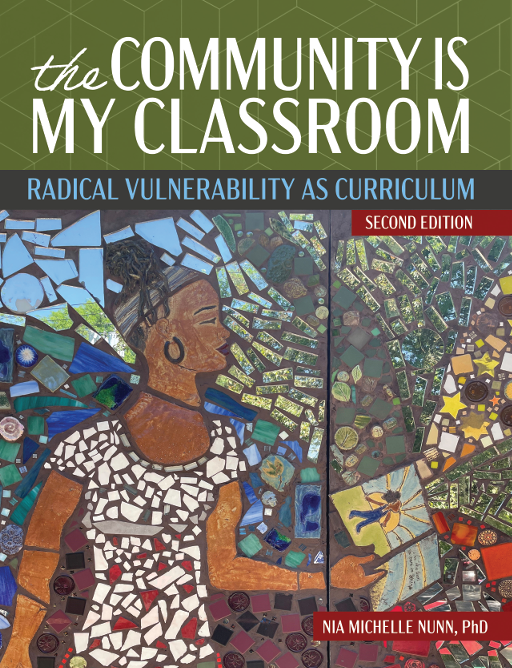
The Community is My Classroom: Radical Vulnerability as Curriculum
Edition: 2
Copyright: 2025
Pages: 184
Edition: 2
Copyright: 2025
Pages: 184
Choose Your Format
Ebook
$44.00 USD
$56.00 USD
The Community is My Classroom: Radical Vulnerability as Curriculum offers a deeply reflective and praxis-driven exploration of teaching educational psychology through a radically vulnerable, Black feminist, and critically conscious lens. Part I centers the classroom as a relational and transformative space, beginning with how instructors intentionally curate culture through narrative, openness, and shared humanity. Through racial consciousness, autoethnographic writing, role-play, and innovative pedagogical strategies, the text reimagines traditional educational psychology by inviting students to engage theory through self-analysis, critical reflection, and cooperative learning. Rather than positioning canonical theorists as neutral or fixed, the book models how students can become discerning thinkers who interrogate knowledge, power, and identity while developing intellectual confidence and emotional literacy.
Parts II and III expand this pedagogical framework beyond the classroom, grounding it in Black feminist pedagogy, community-based programming, and global Black consciousness. Through the evolution of Black feminist courses, Black girl–centered liberation work, intergenerational arts education, and place-based histories of radical Black educators, the book illustrates how teaching, learning, and healing are inseparable. Case studies—from local community spaces to international study experiences in London—demonstrate how radical vulnerability can foster collective liberation across contexts. The concluding chapter synthesizes these approaches, offering readers practical guidance, adaptable assignments, and encouragement to teach, lead, and learn with courage, care, and unapologetic intentionality.
PART I: A Radically Vulnerable Approach to Teaching Educational Psychology
Chapter 1 Who are you bringing into this space? Theorizing Radical Vulnerability- The first four days and two weeks of how I curate the culture of my college classrooms is unique. This includes my narrative as well as the vignettes, assignments, resources/activities, and highlights of students' voices and initial responses to this radically vulnerable approach.
Chapter 2 Why does everything have to be so Black? Racial Consciousness 101 in the Classroom- The second chapter offers insight on how I have been introducing the concept of race through a Black consciousness lens in my educational psychology courses and how I invite everyone to listen, feel, write, and even role-play. The evidence and pattern of a radical vulnerability journey is in their responses especially to their “Dear Dr. Nia” autoethnographic letters to me.
Chapter 3 How Were You Made? Critical Educational Psychology in the Classroom. The third chapter illustrates how I teach and incorporate the educational psychology traditional canon of theorists through innovative self analyses, gaming, and cooperative learning in the second half of the semester. Given the racial consciousness work and journey of criticality that students engage in prior to this part of the course, students learn to be critical thinkers and consumers as we discuss the pros and cons of each theoretical approach.
PART II: Black Feminist Pedagogy & Programming
Chapter 4 Protests, a Pandemic, & Protecting One’s Peace: Evolution of Black Feminist Thought & Black Feminist Alchemy. The fourth chapter tells the journey of how and why I created the Black Feminist courses Black Feminist Thought and Black Feminist Alchemy. It will also illustrate voices from four different cohorts of students that took the course and/or influenced the journey.
Chapter 5 Honor Specificity, Unapologetically: Black Girl Alchemy as Philosophy & Curriculum of Liberation. This chapter will share years of Black girl centered community work and collaborations, including mural projects, author visits, performances, field trips, and retreats.
PART III: Local & Global Black Consciousness Literacy
Chapter 6 Homeplace: Ithaca’s Radical Black Educators Past & Present. This chapter will illustrate historical recollections & contemporary views on a community space called the Southside Community Center, as well as stories and data on several Black educators who helped provide blueprints for me and various educators.
Chapter 7 Stop, Think, Choose Peace: The Community Unity Music Education Program Technique. This chapter gives more details on the 20 year old performing arts program that I inherited from my father. In it, I will illustrate the backstory and lessons across this creative community curriculum.
Chapter 10 Liberated in London: An Emerging Global Black Consciousness. This chapter is a case study and autoethnographic analysis of my adventures to London. Including three trips with students who had taken both my Black Femme (BFT, BFA) and my Educational Psychology courses, exploring Black culture and Black feminist works we called our experience Liberated in London.
CONCLUSION What? So What? Now What?: Replicability, Generalizability, & A Conclusion. This culminating chapter offers a summary and review of how teachers and leaders can incorporate these practical approaches and assignments in a variety of ways and settings. It’s filled with encouraging last words to send the reader off with confidence about teaching, learning, and leading in a radically vulnerable way.