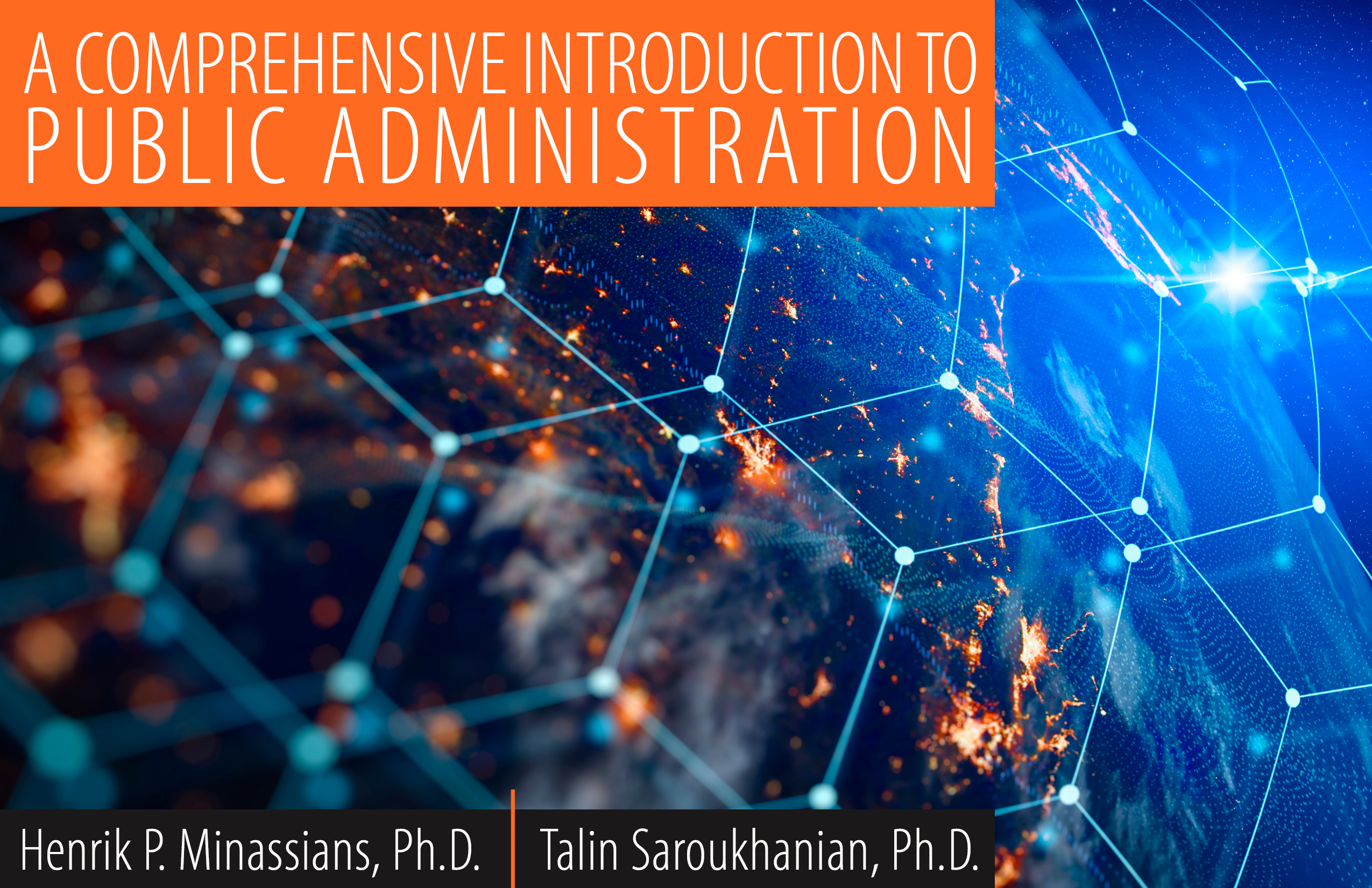
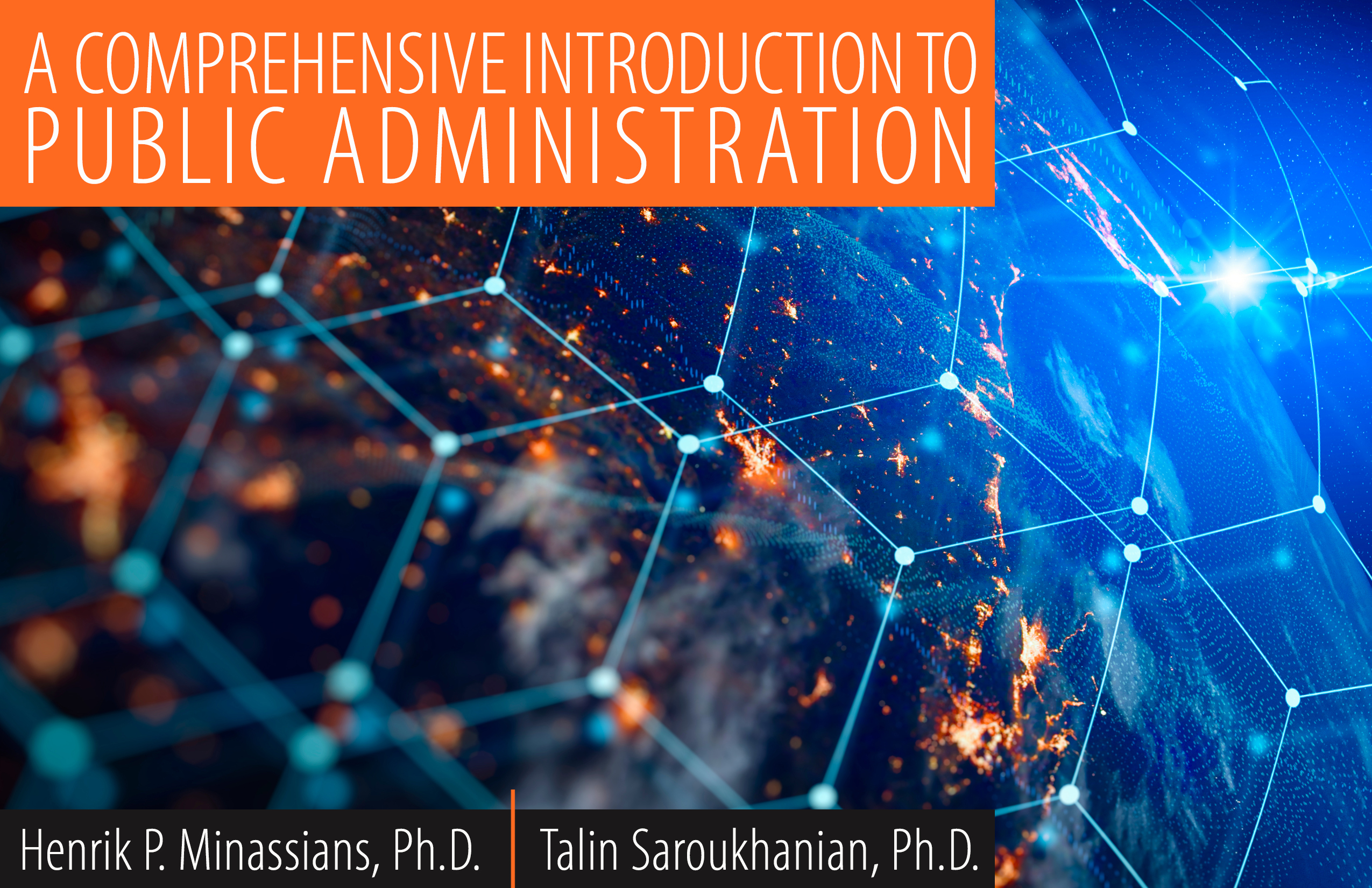
A Comprehensive Introduction to Public Administration

Edition: 1

Copyright: 2025

Choose Your Format

Website

$85.00 USD

ISBN 9798385143405

Details KHPContent 180 days

Why This Book and Why Now

We have written this book as a starting point in the field of public administration, addressing what has been missing from existing textbooks. Most public administration texts tend to be dense, less pedagogically engaging, and rely on dated, static cases. After teaching for over 40 combined years, we set out to identify both classic and contemporary articles and texts that reflect the evolving field and emerging trends in public administration.

 Standard textbooks often include classic cases but may present outdated content or lack structured pedagogical design. One of our key goals was to bridge the gap between theoretical frameworks and the case studies that are staples of many textbooks.

 This textbook combines original content, curated readings, and editorial framing. Each chapter includes introductory material, followed by case studies, exam questions, and interactive content. What sets this book apart is its pedagogically guided learning resources. Designed for an electronic platform, it blends the benefits of a traditional textbook with those of a reader—an approach rarely seen in public administration texts. This format aligns with digital-first, e-learning environments, offering flexibility for instructors and enhanced engagement for students.

 Our deliberate pedagogical design supports a variety of learning styles with simulations, case studies, web resources, discussion questions, and multiple-choice exercises. These features cater to visual, auditory, and experiential learners at both undergraduate and graduate levels—audiences often underserved by traditional texts.

 Although this book is titled a comprehensive introduction, it goes beyond surface-level overviews. It provides theoretical foundations, historical context, and contemporary applications, offering students tools to understand performance movements, e-governance, and artificial intelligence in the public sector. Dedicated chapters on emerging topics—such as AI, digital governance, and New Public Governance—reflect an up-to-date understanding of the field that is not yet mainstream in other introductory texts.

 Curated section reading lists include both foundational and cutting-edge scholarships. For example, the concept of “racialized organizational theory” by Ray, Herd, and Moynihan (2023), combined with coverage of AI governance, public sector machine learning, and public-private partnerships within the New Public Governance framework, showcases our commitment to scholarly relevance and innovation.

 This book redefines the introductory textbook through a modular, interactive, multimedia-friendly format that balances classical theory with current topics. It offers rich, curated content framed by expert authors for structured learning—a strategically differentiated, modern, student-centered alternative to traditional public administration textbooks.

 What Is in This Book

 This book begins with an overview of public administration as both a practical and academic field responsible for managing and implementing policies across all branches of government. While often associated with the executive branch, public administration also spans judicial and legislative domains. It is inherently multidisciplinary, drawing from political science, economics, sociology, history, law, and management. As both an academic discipline and a professional practice, it demands specialized training, ethical standards, and a strong sense of public service.

 The Introduction to Public Administration section explores early administrative systems in Babylonia, Egypt, Rome, and China before turning to the U.S., tracing the field’s evolution from the Guardian Period to the rise of New Public Governance.

 The section on Bureaucracy introduces conceptual frameworks, theoretical foundations, and real-world challenges in managing public bureaucracies, especially in the United States. It examines Weberian rational-legal models and comparative theories by Sager and Rosser, concluding with a contrast between the ideal of bureaucracy—rational, merit-based, neutral—and its practical realities of inefficiency and politicization. The chapter integrates foundational theorists (Weber, Wilson, Hegel) with modern critiques (Schuck) for a comprehensive understanding of public bureaucracy’s role and reform needs.

 The section on Human Resource Management (HRM) traces the origins of the field—formerly known as Public Personnel Administration—which encompasses hiring, training, performance management, and compliance with legal and budgetary requirements. It examines how political shifts, budget pressures, and administrative reforms from the Nixon to Trump administrations have shaped public HRM. The section illustrates the evolution from minimal constitutional attention to a complex, performance-driven system.

 In the section on Budgeting in the United States, the authors present budgeting as both a financial and political tool used to allocate resources, express policy priorities, and ensure accountability. Tracing its roots from the Magna Carta (1215) to post-WWII planning, it summarizes budgeting types—line-item, zero-based, program, and performance budgeting. One chapter uses post-2008 examples, such as the City of San Bernardino’s bankruptcy, to show how U.S. public budgeting has evolved into a system shaped by political priorities, administrative capacity, and economic realities.

The section on Organizational Theory and Human Behavior explores how organizations function structurally and how human behavior influences and is influenced by organizations. It analyzes how mission, tasks, goals, and purpose shape organizational culture, drawing on sociology, psychology, management, and public administration. This section covers classical, neo-classical, systems, contingency, institutional, and network theories, emphasizing that organizations are living social systems. Effective management requires understanding structure, motivation, and human dynamics.

The section on Public Policy discusses how government decides what to do—and not to do—and how public agencies operate, make decisions, and respond to emerging issues. It examines agenda setting, policy subsystems, issue networks, the Advocacy Coalition Framework, and Punctuated Equilibrium. The role of public administrators and street-level bureaucrats is highlighted, emphasizing their discretionary power. Public policy is dynamic, shaped on the ground by workers and influenced by networks, values, and politics.

In Federalism, Separation of Powers, and Intergovernmental Relations section the authors examine the role of federalism, separation of powers, and intergovernmental relations in modern U.S. governance. This section traces federalism’s evolution—dual, cooperative, creative, new, and fragmented/uncooperative federalism—and illustrates separation of powers with key cases like McCulloch v. Maryland (1819) and U.S. v. Nixon (1974). U.S. governance is a dynamic balance of power-sharing and tension, which fosters liberty and flexibility but also fragmentation and policy inconsistency.

The section on Ethics and Accountability begins with a fundamental question: Should civil servants unquestioningly follow elected officials’ orders, or act with independent ethical judgment? Drawing on the debate between Herman Finer and Carl Friedrich, the authors explore this dilemma. Using James Svara’s Ethics Triangle, they bridge responsibility and accountability, offering a practical tool for ethical decision-making in government.

In New Public Governance (NPG), the authors define a modern approach to public administration that emphasizes collaboration across public, private, and nonprofit sectors, with enhanced citizen engagement. NPG responds to the limitations of Classical Public Administration (CPA) and New Public Management (NPM) in tackling complex governance issues. The chapter examines wicked problems, network governance, trust-based relationships, and the role of government as facilitator. NPG exists alongside CPA and NPM in a hybrid model, offering participatory and flexible governance with challenges in coordination, accountability, and equity.

The final section on E-Government and Artificial Intelligence (AI) explores the evolution, challenges, and implications of e-government and AI. The focus is on efficiency, transparency, citizen engagement, and public value creation. The section also raises concerns about access, data privacy, legacy systems, political and legal constraints, and the limitations of AI in providing the human touch. E-government and AI hold transformative potential, but success requires ethical, inclusive, and thoughtful implementation. 

A Comprehensive Introduction to Public Administration grew out of the courses we have taught and developed over the years. Our objective is to complement an introductory discussion of public administration and theory with supplementary materials that deepen understanding and enhance students’ analytical skills. Finally, we wish to thank the Kendall Hunt editorial board and staff for their patience and guidance throughout this process.

Henrik Minassians

Dr. Henrik P. Minassians is a Professor of Urban Studies and Planning at California State University, Northridge (CSUN), where he also serves as the Director of the Master of Public Administration (MPA) program and Academic Director of the ReLAY (ReConnecting Los Angeles Youth) Institute. With a Ph.D. in Political Science from the Nelson A. Rockefeller College of Public Affairs and Policy at SUNY Albany, Dr. Minassians specializes in public administration, urban policy, governance networks, and performance management.

Over the past two decades, Dr. Minassians has held numerous academic and administrative leadership roles, including Director of Public Sector Programs and Director of Regional and National Partnerships at CSUN’s Tseng College. His career includes prior research appointments at the Rockefeller Institute of Government and extensive engagement with local and regional government agencies on topics such as policy implementation, youth development, public budgeting, and inter-organizational collaboration.

A prolific researcher and author, Dr. Minassians has published over 30 peer-reviewed articles and book chapters on governing networks, accountability in public institutions, and hybrid organizational structures. His recent work includes applied research on opportunity youth, collaborative governance, and public-private partnerships in education and workforce systems.

Dr. Minassians is also a seasoned educator, having taught across a wide array of undergraduate and graduate courses in public administration, urban planning, and policy analysis. He has served on local and international research committees, collaborated with public agencies across Southern California, and secured substantial external funding from organizations such as the Conrad Hilton Foundation and the City of Los Angeles.

His scholarship, leadership, and service are rooted in a commitment to bridging theory and practice to improve public service delivery and advance equitable, community-centered governance.

Talin Saroukhanian

Dr. Talin Saroukhanian is a political scientist, educator, and author whose work bridges the worlds of public policy, ethics, political institutions, and global development. With over two decades of teaching and research experience, she brings a deeply interdisciplinary perspective to questions of governance, social equity, and institutional design.

Dr. Saroukhanian currently serves as a lecturer in the Department of Political Science at California State University, Northridge (CSUN) where she has taught courses in public policy and administration, comparative politics, political ideologies, and American government since 2004. Her teaching is rooted in a passion for empowering students to think critically about the world around them and engage meaningfully in civic life.

She holds a Ph.D. in Political Science from the Rockefeller College of Public Affairs and Policy at SUNY Albany. Her doctoral research explored the intersection of policy reform, development, and gender with a particular focus on the gendered effects of global economic policies in Sub-Saharan Africa.

As an early adopter of educational technology, Dr. Saroukhanian has led faculty training in online pedagogy, course design, and accessibility. Her contributions to CSUN’s digital learning initiatives earned her a university award in 2010.

Dr. Saroukhanian is the author of The Fundamentals of the Public Policy Process, co-author of the working paper “A Case Study of Public Administration’s Code of Ethics” and “Dissecting a MOOC: Implications for Design and Delivery of MOOCs”, and forthcoming textbook A Comprehensive Introduction to Public Administration (Fall 2025). Her work reflects a commitment to practical ethics, inclusive policymaking, and innovation in teaching.

Why This Book and Why Now

We have written this book as a starting point in the field of public administration, addressing what has been missing from existing textbooks. Most public administration texts tend to be dense, less pedagogically engaging, and rely on dated, static cases. After teaching for over 40 combined years, we set out to identify both classic and contemporary articles and texts that reflect the evolving field and emerging trends in public administration.

 Standard textbooks often include classic cases but may present outdated content or lack structured pedagogical design. One of our key goals was to bridge the gap between theoretical frameworks and the case studies that are staples of many textbooks.

 This textbook combines original content, curated readings, and editorial framing. Each chapter includes introductory material, followed by case studies, exam questions, and interactive content. What sets this book apart is its pedagogically guided learning resources. Designed for an electronic platform, it blends the benefits of a traditional textbook with those of a reader—an approach rarely seen in public administration texts. This format aligns with digital-first, e-learning environments, offering flexibility for instructors and enhanced engagement for students.

 Our deliberate pedagogical design supports a variety of learning styles with simulations, case studies, web resources, discussion questions, and multiple-choice exercises. These features cater to visual, auditory, and experiential learners at both undergraduate and graduate levels—audiences often underserved by traditional texts.

 Although this book is titled a comprehensive introduction, it goes beyond surface-level overviews. It provides theoretical foundations, historical context, and contemporary applications, offering students tools to understand performance movements, e-governance, and artificial intelligence in the public sector. Dedicated chapters on emerging topics—such as AI, digital governance, and New Public Governance—reflect an up-to-date understanding of the field that is not yet mainstream in other introductory texts.

 Curated section reading lists include both foundational and cutting-edge scholarships. For example, the concept of “racialized organizational theory” by Ray, Herd, and Moynihan (2023), combined with coverage of AI governance, public sector machine learning, and public-private partnerships within the New Public Governance framework, showcases our commitment to scholarly relevance and innovation.

 This book redefines the introductory textbook through a modular, interactive, multimedia-friendly format that balances classical theory with current topics. It offers rich, curated content framed by expert authors for structured learning—a strategically differentiated, modern, student-centered alternative to traditional public administration textbooks.

 What Is in This Book

 This book begins with an overview of public administration as both a practical and academic field responsible for managing and implementing policies across all branches of government. While often associated with the executive branch, public administration also spans judicial and legislative domains. It is inherently multidisciplinary, drawing from political science, economics, sociology, history, law, and management. As both an academic discipline and a professional practice, it demands specialized training, ethical standards, and a strong sense of public service.

 The Introduction to Public Administration section explores early administrative systems in Babylonia, Egypt, Rome, and China before turning to the U.S., tracing the field’s evolution from the Guardian Period to the rise of New Public Governance.

 The section on Bureaucracy introduces conceptual frameworks, theoretical foundations, and real-world challenges in managing public bureaucracies, especially in the United States. It examines Weberian rational-legal models and comparative theories by Sager and Rosser, concluding with a contrast between the ideal of bureaucracy—rational, merit-based, neutral—and its practical realities of inefficiency and politicization. The chapter integrates foundational theorists (Weber, Wilson, Hegel) with modern critiques (Schuck) for a comprehensive understanding of public bureaucracy’s role and reform needs.

 The section on Human Resource Management (HRM) traces the origins of the field—formerly known as Public Personnel Administration—which encompasses hiring, training, performance management, and compliance with legal and budgetary requirements. It examines how political shifts, budget pressures, and administrative reforms from the Nixon to Trump administrations have shaped public HRM. The section illustrates the evolution from minimal constitutional attention to a complex, performance-driven system.

 In the section on Budgeting in the United States, the authors present budgeting as both a financial and political tool used to allocate resources, express policy priorities, and ensure accountability. Tracing its roots from the Magna Carta (1215) to post-WWII planning, it summarizes budgeting types—line-item, zero-based, program, and performance budgeting. One chapter uses post-2008 examples, such as the City of San Bernardino’s bankruptcy, to show how U.S. public budgeting has evolved into a system shaped by political priorities, administrative capacity, and economic realities.

The section on Organizational Theory and Human Behavior explores how organizations function structurally and how human behavior influences and is influenced by organizations. It analyzes how mission, tasks, goals, and purpose shape organizational culture, drawing on sociology, psychology, management, and public administration. This section covers classical, neo-classical, systems, contingency, institutional, and network theories, emphasizing that organizations are living social systems. Effective management requires understanding structure, motivation, and human dynamics.

The section on Public Policy discusses how government decides what to do—and not to do—and how public agencies operate, make decisions, and respond to emerging issues. It examines agenda setting, policy subsystems, issue networks, the Advocacy Coalition Framework, and Punctuated Equilibrium. The role of public administrators and street-level bureaucrats is highlighted, emphasizing their discretionary power. Public policy is dynamic, shaped on the ground by workers and influenced by networks, values, and politics.

In Federalism, Separation of Powers, and Intergovernmental Relations section the authors examine the role of federalism, separation of powers, and intergovernmental relations in modern U.S. governance. This section traces federalism’s evolution—dual, cooperative, creative, new, and fragmented/uncooperative federalism—and illustrates separation of powers with key cases like McCulloch v. Maryland (1819) and U.S. v. Nixon (1974). U.S. governance is a dynamic balance of power-sharing and tension, which fosters liberty and flexibility but also fragmentation and policy inconsistency.

The section on Ethics and Accountability begins with a fundamental question: Should civil servants unquestioningly follow elected officials’ orders, or act with independent ethical judgment? Drawing on the debate between Herman Finer and Carl Friedrich, the authors explore this dilemma. Using James Svara’s Ethics Triangle, they bridge responsibility and accountability, offering a practical tool for ethical decision-making in government.

In New Public Governance (NPG), the authors define a modern approach to public administration that emphasizes collaboration across public, private, and nonprofit sectors, with enhanced citizen engagement. NPG responds to the limitations of Classical Public Administration (CPA) and New Public Management (NPM) in tackling complex governance issues. The chapter examines wicked problems, network governance, trust-based relationships, and the role of government as facilitator. NPG exists alongside CPA and NPM in a hybrid model, offering participatory and flexible governance with challenges in coordination, accountability, and equity.

The final section on E-Government and Artificial Intelligence (AI) explores the evolution, challenges, and implications of e-government and AI. The focus is on efficiency, transparency, citizen engagement, and public value creation. The section also raises concerns about access, data privacy, legacy systems, political and legal constraints, and the limitations of AI in providing the human touch. E-government and AI hold transformative potential, but success requires ethical, inclusive, and thoughtful implementation. 

A Comprehensive Introduction to Public Administration grew out of the courses we have taught and developed over the years. Our objective is to complement an introductory discussion of public administration and theory with supplementary materials that deepen understanding and enhance students’ analytical skills. Finally, we wish to thank the Kendall Hunt editorial board and staff for their patience and guidance throughout this process.

Henrik Minassians

Dr. Henrik P. Minassians is a Professor of Urban Studies and Planning at California State University, Northridge (CSUN), where he also serves as the Director of the Master of Public Administration (MPA) program and Academic Director of the ReLAY (ReConnecting Los Angeles Youth) Institute. With a Ph.D. in Political Science from the Nelson A. Rockefeller College of Public Affairs and Policy at SUNY Albany, Dr. Minassians specializes in public administration, urban policy, governance networks, and performance management.

Over the past two decades, Dr. Minassians has held numerous academic and administrative leadership roles, including Director of Public Sector Programs and Director of Regional and National Partnerships at CSUN’s Tseng College. His career includes prior research appointments at the Rockefeller Institute of Government and extensive engagement with local and regional government agencies on topics such as policy implementation, youth development, public budgeting, and inter-organizational collaboration.

A prolific researcher and author, Dr. Minassians has published over 30 peer-reviewed articles and book chapters on governing networks, accountability in public institutions, and hybrid organizational structures. His recent work includes applied research on opportunity youth, collaborative governance, and public-private partnerships in education and workforce systems.

Dr. Minassians is also a seasoned educator, having taught across a wide array of undergraduate and graduate courses in public administration, urban planning, and policy analysis. He has served on local and international research committees, collaborated with public agencies across Southern California, and secured substantial external funding from organizations such as the Conrad Hilton Foundation and the City of Los Angeles.

His scholarship, leadership, and service are rooted in a commitment to bridging theory and practice to improve public service delivery and advance equitable, community-centered governance.

Talin Saroukhanian

Dr. Talin Saroukhanian is a political scientist, educator, and author whose work bridges the worlds of public policy, ethics, political institutions, and global development. With over two decades of teaching and research experience, she brings a deeply interdisciplinary perspective to questions of governance, social equity, and institutional design.

Dr. Saroukhanian currently serves as a lecturer in the Department of Political Science at California State University, Northridge (CSUN) where she has taught courses in public policy and administration, comparative politics, political ideologies, and American government since 2004. Her teaching is rooted in a passion for empowering students to think critically about the world around them and engage meaningfully in civic life.

She holds a Ph.D. in Political Science from the Rockefeller College of Public Affairs and Policy at SUNY Albany. Her doctoral research explored the intersection of policy reform, development, and gender with a particular focus on the gendered effects of global economic policies in Sub-Saharan Africa.

As an early adopter of educational technology, Dr. Saroukhanian has led faculty training in online pedagogy, course design, and accessibility. Her contributions to CSUN’s digital learning initiatives earned her a university award in 2010.

Dr. Saroukhanian is the author of The Fundamentals of the Public Policy Process, co-author of the working paper “A Case Study of Public Administration’s Code of Ethics” and “Dissecting a MOOC: Implications for Design and Delivery of MOOCs”, and forthcoming textbook A Comprehensive Introduction to Public Administration (Fall 2025). Her work reflects a commitment to practical ethics, inclusive policymaking, and innovation in teaching.