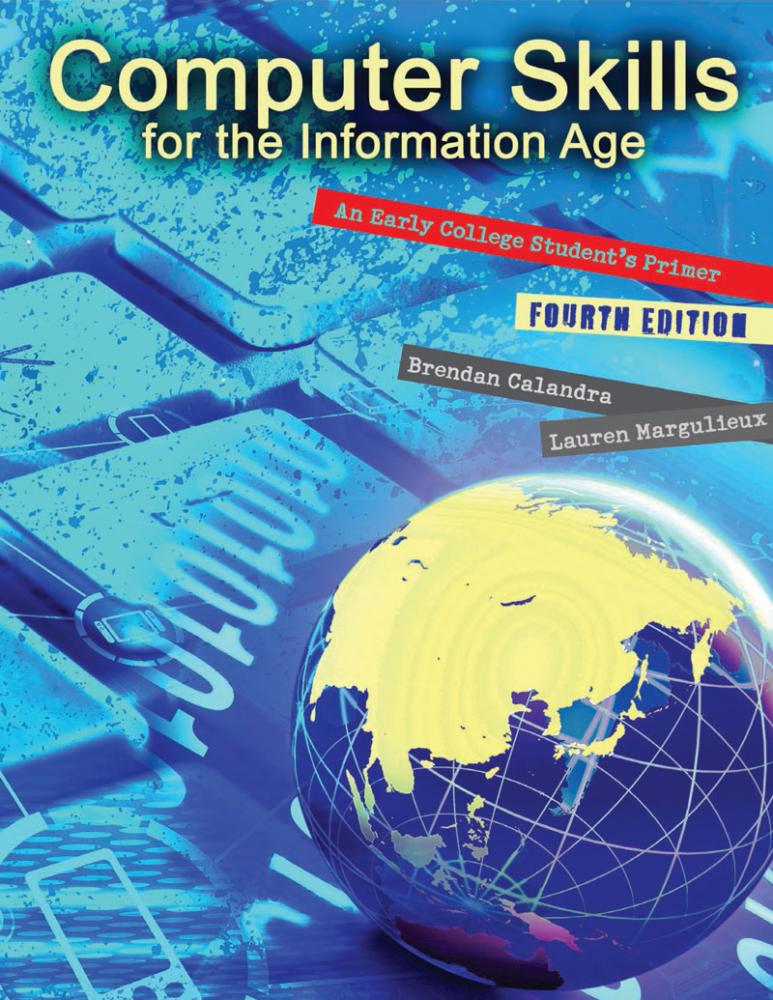
Computer Skills for the Information Age: An Early College Student's Primer
Edition: 4
Copyright: 2020
Pages: 136
Choose Your Format
Choose Your Platform | Help Me Choose


Ebook
$89.95 USD
Computer Skills for the Information Age: An Early College Student’s Primer introduces students on how to be a 21st Century student. It is full of facts, advice, and activities directly relevant to navigating a technology-enhanced college experience.
A competitive, information age college graduate should at minimum be able to:
- use online resources to learn new skills;
- get the most out of online courses;
- effectively communicate and collaborate online;
- find, evaluate, and use valid information online;
- maintain security of personal and professional accounts and content;
- use productivity software like word processing programs, spreadsheets, and media presentation tools;
- create and manage digital content.
Unit Layout
Each unit of this book is divided into four major sections:
- Unit objectives that describe what you should learn as a result of working through the unit;
- Unit content;
- Assignments that help you practice what you learned in each unit; and
- Glossary of relevant terms: Each term listed in the glossary will be in bold font in the unit.
Introduction
Unit 1 How to Be Successful Online Student
Unit 2 Communicating and Collaborating Online
Unit 3 Creating a Mobile Personal Learning Environment
Unit 4 Information Literacy
Unit 5 Cyberethics
Unit 6 Cybersecurity
Unit 7 Creating Professional Documents
Unit 8 Working with Data Using Spreadsheets
Unit 9 Creating and Delivering Effective Presentations
Unit 10 Web Design and Development Basics
Unit 11 An Introduction to Code

Lauren Margulieux, assistant professor in the College of Education & Human Development’s Department of Learning Sciences, studies educational technology and online learning, particularly for science, technology, engineering and mathematics education. She focuses on designing instructions in a way that supports online students who do not necessarily have immediate access to an instructor or professor to ask questions or overcome problem-solving impasses. Margulieux’s other area of research explores factors that affect the success of hybrid, blended, flipped and inverted courses
Computer Skills for the Information Age: An Early College Student’s Primer introduces students on how to be a 21st Century student. It is full of facts, advice, and activities directly relevant to navigating a technology-enhanced college experience.
A competitive, information age college graduate should at minimum be able to:
- use online resources to learn new skills;
- get the most out of online courses;
- effectively communicate and collaborate online;
- find, evaluate, and use valid information online;
- maintain security of personal and professional accounts and content;
- use productivity software like word processing programs, spreadsheets, and media presentation tools;
- create and manage digital content.
Unit Layout
Each unit of this book is divided into four major sections:
- Unit objectives that describe what you should learn as a result of working through the unit;
- Unit content;
- Assignments that help you practice what you learned in each unit; and
- Glossary of relevant terms: Each term listed in the glossary will be in bold font in the unit.
Introduction
Unit 1 How to Be Successful Online Student
Unit 2 Communicating and Collaborating Online
Unit 3 Creating a Mobile Personal Learning Environment
Unit 4 Information Literacy
Unit 5 Cyberethics
Unit 6 Cybersecurity
Unit 7 Creating Professional Documents
Unit 8 Working with Data Using Spreadsheets
Unit 9 Creating and Delivering Effective Presentations
Unit 10 Web Design and Development Basics
Unit 11 An Introduction to Code
Lauren Margulieux, assistant professor in the College of Education & Human Development’s Department of Learning Sciences, studies educational technology and online learning, particularly for science, technology, engineering and mathematics education. She focuses on designing instructions in a way that supports online students who do not necessarily have immediate access to an instructor or professor to ask questions or overcome problem-solving impasses. Margulieux’s other area of research explores factors that affect the success of hybrid, blended, flipped and inverted courses