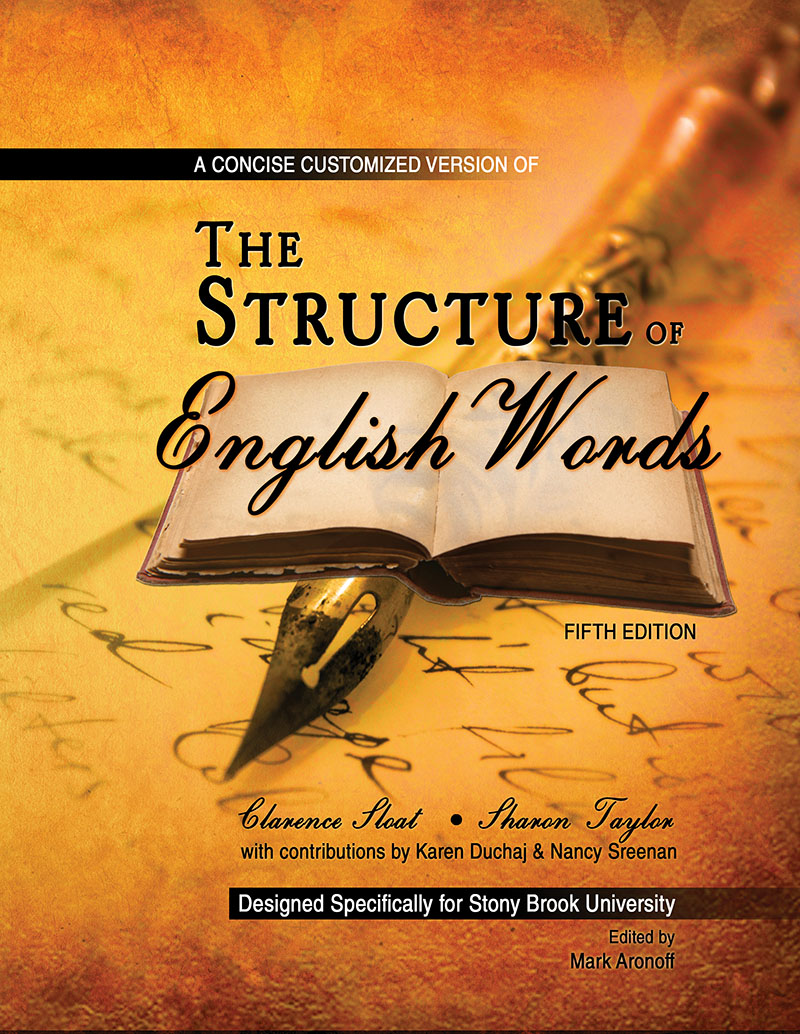
A Concise Custom Version of "The Structure of English Words" Designed Specifically for Stony Brook University
Edition: 5
Copyright: 2015
Pages: 170
Choose Your Format
Choose Your Platform | Help Me Choose


Ebook
$54.69 USD
Preface
About the Authors
About the Contributors
Chapter 1 The English Vocabulary
1.1 Native Vocabulary
1.2 Borrowed Vocabulary
1.3 Learning New Vocabulary
1.4 Unfamiliar Words
1.5 Memorizing Base Forms
1.6 Base Form Sets 1 and 2
Chapter 2 Word Structure
2.1 Morphemes, the Units of Meaning
2.2 Classes of Morphemes
2.3 The Stem
2.4 The Stem Extender
2.5 Multiple Affixes
2.6 Base Form Sets 3 and 4
Chapter 3 English Prefixes and Suffixes
3.1 English Prefixes
3.2 Relational Prefixes
3.3 Negative Prefixes
3.4 Numerical Prefixes
Clarence Sloat received his Ph.D. in Linguistics from the University of Washington in 1966, after which he was Professor of Linguistics and English at the University of Oregon for fifteen years, specializing in Amerindian Linguistics and Phonology. During that time he served as Director of Graduate Studies in the English Department for a year and as Director of Academic Services for the American English Institute for two years. He also served as Chair of the Linguistic Program and Head of the Linguistics Department for a total of twelve years. His awards include: Research Assistantship, National Science Foundation, University of Washington; Advanced Linguistics Fellowship, American Council of Learned Societies; and Younger Humanist Fellowship, National Endowment for the Humanities. His other professional experience includes having served as President and CEO of Pacific Language Associates, a private education firm, for twenty-three years. He has authored and coauthored a number of articles and coauthored Introduction to Phonology in 1978. He is now retired, but still actively publishing articles on subjects involving Native Americans.
Sharon Taylor received her Bachelor of Arts degree (Phi Beta Kappa) in Anthropology in 1973 and her Ph.D. in Linguistics from the University of Oregon in 1980. Her dissertation was on the idiosyncratic properties of English words. From 1979 to 1981, she worked as Coordinator of Academic Services at the University of Oregon’s American English Institute and from 1981 to 2004 as Director of the Intensive English Institute at Lewis-Clark State College where she also taught word analysis to college students, international students, and high school teachers. She co-authored Introduction to Phonology in 1978 and has written a number of articles on teaching word analysis and on the properties of English words. She has also co-authored two handbooks on teaching word analysis in public schools. Although she is now retired, she still gives workshops on teaching word analysis.