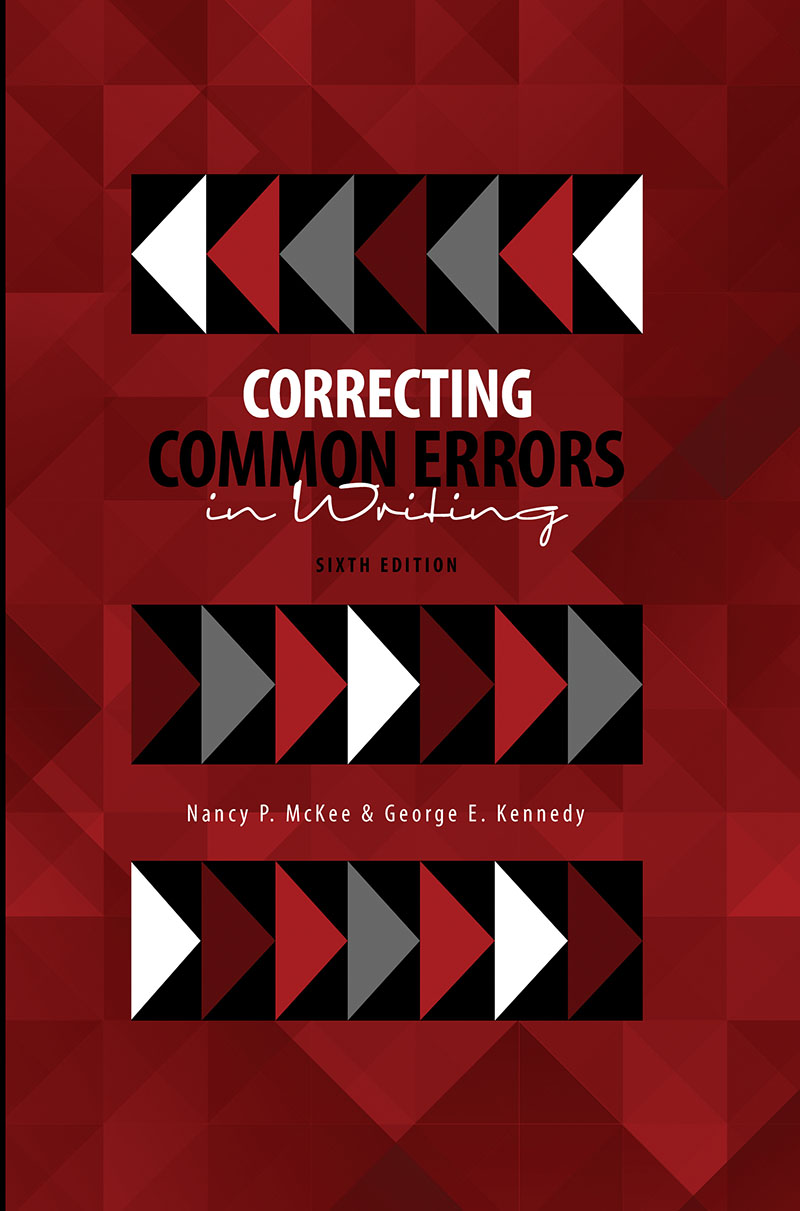
Correcting Common Errors in Writing
Edition: 6
Copyright: 2013
Pages: 300
Edition: 6
Copyright: 2013
Pages: 300
Choose Your Format
Ebook
$38.43 USD
$84.75 USD
Correcting Common Errors in Writing is a practical guide designed to help students improve their writing by identifying and correcting common mistakes in grammar, punctuation, spelling, and usage. Rather than focusing only on rules, the book explains the reasoning behind frequent errors and provides examples that demonstrate how to make writing clearer, more accurate, and more effective. It serves as a useful reference for students, writers, and anyone seeking to strengthen their command of written English.
The book is organized into major sections covering Grammar, Punctuation, Spelling, and Usage. Topics include agreement errors, pronoun usage, sentence structure, verb forms, punctuation choices, commonly confused words, capitalization, and problems with word choice and style. Through explanations, exercises, and answer sections, readers practice recognizing and correcting errors while developing stronger editing skills. The final section on paragraphing and the index provide additional support for applying these skills to academic, professional, and everyday writing.
Preface
Acknowledgments
Introduction
Grammar
Agreement
Fewer vs. Less (aka Count Nouns vs. Mass Nouns)
Number vs. Amount (aka Count Nouns vs. Mass Nouns)
A Great Deal of (aka Count Nouns vs. Mass Nouns)
Pronoun-Antecedent Agreement
Plural Subject, Plural Objects
Subject-Verb Agreement
Pronouns
I or Me, Which Is It?
Myself/Yourself/Herself/Ourselves/Yourselves/Themselves
That/Which/Who/Whom
Who/Whom/Whoever/Whomever
Sentences
Sentence Fragments (Something to Avoid)
Whereas/Although/Though and As Far As
Verbs
–ing Forms
To Hang (and when to use two possible past tense forms: hung and hanged)
Had vs. Would Have and If Clauses
Might vs. May
To Lie (To Recline) vs. To Lay (To Place)
Present Subjunctive and Were vs. Was with If Clauses
Other Common Errors
Between/Among
Confusing Prepositional Phrases: Singulars and Plurals
Consistent Use of Plurals
Than
Exercises
Answers
Punctuation
Apostrophes
Apostrophe Pitfalls
Contraction
Possession
Plural Forms of Years and Other Perfectly Respectable Nouns
Colons
Colons in Complicated Sentences
Colons in Simple Lists
Commas
Comma Splices (Something to Avoid)
Introductory Phrases and Clauses
Commas with Coordinating Conjunctions
Apposition
Commas in a List
Periods
Periods
Quotation Marks
When Do You Use Quotation Marks?
Where Does the End Punctuation Go?
Semicolons
Semicolons in a Complex List
Semicolons Where You Could Use Periods
Exercises
Answers
Spelling
Capitalization
Proper Nouns
Common Nouns
Adjectives That Need to Be Capitalized
Other Common Errors
Accustom/Accustomed
Advice/Advise
Affect/Effect
Aisle/Isle
Allusion/Illusion
A Lot/Allot/A Lot
Alright/All Right
Altogether/All Together
Anymore/Any More
Anyway/Any Way/Anyways
A Part/Apart
Asterik/Asterisk
Awhile/A While
Bare/Bear
Bias/Biased
Can Not/Cannot
Chose/Choose
Coarse/Course
Defiant/Definate/Definite
Do To/Due To
Dominant/Dominate
Ect./Etc.
Every Day/Everyday
Except/Accept
Heighth/Height
It’s/Its
Lead/Lead/Led
Loose/Lose
Momento/Memento
Moral/Morale
Nonetheless/None the Less/Nevertheless/Never the Less
Noticable/Noticeable
Occurrance/Occurrence
Onetime/One Time; Sometime/Some Time
Past/Passed
Populous/Populace
Preform/Perform
Prejudice/Prejudiced
Principal/Principle
Recent/Resent
Recieve/Receive
Recur/Reoccur
Scientist/Scientists
Sight/Site/Cite
Tenant/Tenet
Their/There/They’re
Then/Than
Through Out/Throughout
Through/Thru/Threw
To/Too/Two
Use To/Used To
Vain/Vein/Vane
Verses/Versus
Where/Were
Who’s/Whose
With Regards To/With Regard To
Woman/Women
Would Of/Would Have
Exercises
Answers
Usage
Errors and Choices
False Elegance: Pronouns
False Elegance: Empty Expressions
False Elegance: Unnecessarily Fancy Words
Excessively Casual Tone: Terms of Address vs. Terms of Reference
Nouns Used as Other Parts of Speech
Sentences Ending in Prepositions
Split Infinitives
Being That/Since (or Because)
Bring/Take
Enormity/Enormousness: Mistaken Synonyms
Nouns Ending in –ee
Different Than/Different From
Disinterested/Uninterested
Infer/Imply
To (or For) All Intents/Intensive and Purposes
Moot/Mute
More/More So/Moreso
That Said
Suppose/Supposed
To Try and/To Try To
Weird Plurals
Exercises
Answers
A Final Word
Paragraphing
Index

Kennedy has his PhD from New York University in English and American Literature. He has taught at Washington State University since 1979 in technical and professional communication, composition/rhetoric, and general literature and composition for the Honors College. In recent years, he has taught for WSU Online and has served as the English Department’s Vice Chair and Scheduler.
Correcting Common Errors in Writing is a practical guide designed to help students improve their writing by identifying and correcting common mistakes in grammar, punctuation, spelling, and usage. Rather than focusing only on rules, the book explains the reasoning behind frequent errors and provides examples that demonstrate how to make writing clearer, more accurate, and more effective. It serves as a useful reference for students, writers, and anyone seeking to strengthen their command of written English.
The book is organized into major sections covering Grammar, Punctuation, Spelling, and Usage. Topics include agreement errors, pronoun usage, sentence structure, verb forms, punctuation choices, commonly confused words, capitalization, and problems with word choice and style. Through explanations, exercises, and answer sections, readers practice recognizing and correcting errors while developing stronger editing skills. The final section on paragraphing and the index provide additional support for applying these skills to academic, professional, and everyday writing.
Preface
Acknowledgments
Introduction
Grammar
Agreement
Fewer vs. Less (aka Count Nouns vs. Mass Nouns)
Number vs. Amount (aka Count Nouns vs. Mass Nouns)
A Great Deal of (aka Count Nouns vs. Mass Nouns)
Pronoun-Antecedent Agreement
Plural Subject, Plural Objects
Subject-Verb Agreement
Pronouns
I or Me, Which Is It?
Myself/Yourself/Herself/Ourselves/Yourselves/Themselves
That/Which/Who/Whom
Who/Whom/Whoever/Whomever
Sentences
Sentence Fragments (Something to Avoid)
Whereas/Although/Though and As Far As
Verbs
–ing Forms
To Hang (and when to use two possible past tense forms: hung and hanged)
Had vs. Would Have and If Clauses
Might vs. May
To Lie (To Recline) vs. To Lay (To Place)
Present Subjunctive and Were vs. Was with If Clauses
Other Common Errors
Between/Among
Confusing Prepositional Phrases: Singulars and Plurals
Consistent Use of Plurals
Than
Exercises
Answers
Punctuation
Apostrophes
Apostrophe Pitfalls
Contraction
Possession
Plural Forms of Years and Other Perfectly Respectable Nouns
Colons
Colons in Complicated Sentences
Colons in Simple Lists
Commas
Comma Splices (Something to Avoid)
Introductory Phrases and Clauses
Commas with Coordinating Conjunctions
Apposition
Commas in a List
Periods
Periods
Quotation Marks
When Do You Use Quotation Marks?
Where Does the End Punctuation Go?
Semicolons
Semicolons in a Complex List
Semicolons Where You Could Use Periods
Exercises
Answers
Spelling
Capitalization
Proper Nouns
Common Nouns
Adjectives That Need to Be Capitalized
Other Common Errors
Accustom/Accustomed
Advice/Advise
Affect/Effect
Aisle/Isle
Allusion/Illusion
A Lot/Allot/A Lot
Alright/All Right
Altogether/All Together
Anymore/Any More
Anyway/Any Way/Anyways
A Part/Apart
Asterik/Asterisk
Awhile/A While
Bare/Bear
Bias/Biased
Can Not/Cannot
Chose/Choose
Coarse/Course
Defiant/Definate/Definite
Do To/Due To
Dominant/Dominate
Ect./Etc.
Every Day/Everyday
Except/Accept
Heighth/Height
It’s/Its
Lead/Lead/Led
Loose/Lose
Momento/Memento
Moral/Morale
Nonetheless/None the Less/Nevertheless/Never the Less
Noticable/Noticeable
Occurrance/Occurrence
Onetime/One Time; Sometime/Some Time
Past/Passed
Populous/Populace
Preform/Perform
Prejudice/Prejudiced
Principal/Principle
Recent/Resent
Recieve/Receive
Recur/Reoccur
Scientist/Scientists
Sight/Site/Cite
Tenant/Tenet
Their/There/They’re
Then/Than
Through Out/Throughout
Through/Thru/Threw
To/Too/Two
Use To/Used To
Vain/Vein/Vane
Verses/Versus
Where/Were
Who’s/Whose
With Regards To/With Regard To
Woman/Women
Would Of/Would Have
Exercises
Answers
Usage
Errors and Choices
False Elegance: Pronouns
False Elegance: Empty Expressions
False Elegance: Unnecessarily Fancy Words
Excessively Casual Tone: Terms of Address vs. Terms of Reference
Nouns Used as Other Parts of Speech
Sentences Ending in Prepositions
Split Infinitives
Being That/Since (or Because)
Bring/Take
Enormity/Enormousness: Mistaken Synonyms
Nouns Ending in –ee
Different Than/Different From
Disinterested/Uninterested
Infer/Imply
To (or For) All Intents/Intensive and Purposes
Moot/Mute
More/More So/Moreso
That Said
Suppose/Supposed
To Try and/To Try To
Weird Plurals
Exercises
Answers
A Final Word
Paragraphing
Index
Kennedy has his PhD from New York University in English and American Literature. He has taught at Washington State University since 1979 in technical and professional communication, composition/rhetoric, and general literature and composition for the Honors College. In recent years, he has taught for WSU Online and has served as the English Department’s Vice Chair and Scheduler.