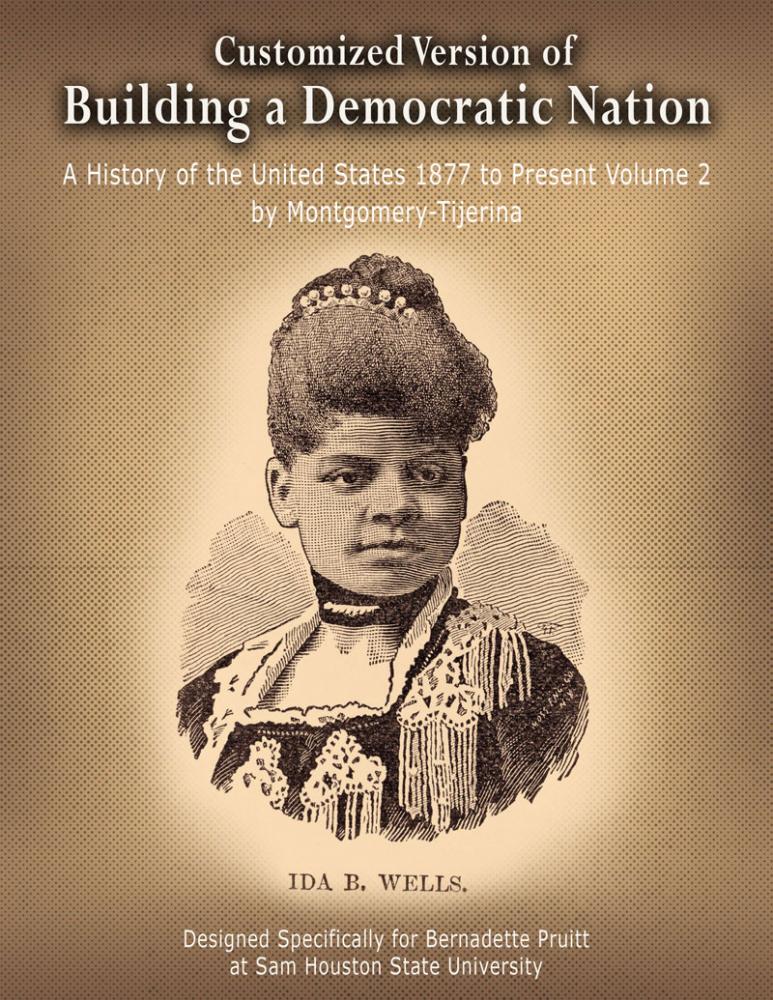
Customized Version of Building a Democratic Nation: A History of the United States 1877 to Present Volume 2 by Montgomery-Tijerina, Designed Specifically for Bernadette Pruitt at Sam Houston State
Edition: 1
Copyright: 2020
Choose Your Format
Choose Your Platform | Help Me Choose


Ebook Package
$106.96 USD
We have conceived and written Building a Democratic Nation with “three P’s” in mind. The first “P” stands for prose. The dynamic narrative in Building a Democratic Nation simulates the voice of the teacher-historian speaking directly to students. We tell America’s story from multiple points of view, not only narrating events but also analyzing and evaluating them so that students understand what happened, why it happened, and what the consequences were. The second “P” means pedagogy. Building a Democratic Nation is more than a history book; it’s a teaching and learning tool complete with a built-in apparatus for leading students to a fuller understanding of United States history. The specific pedagogical devices include queries, a technique utilized effectively by master teachers since Socrates. Questions placed throughout the narrative aid students in digesting the subject matter first in smaller and then in larger portions and to advance from relatively simple levels of learning to higher, more complex ones. In addition to queries, the text contains a program of drawings, paintings, photographs, charts, and maps that aid students in visualizing the past. The third “P” represents price. Recognizing how daunting the prices of textbooks are, the authors, together with Kendall Hunt’s developmental and executive staffs, are committed to making Building a Democratic Nation a full but affordable history of the United States from 1877 to the present.
Building a Democratic Nation is organized into four parts, each containing four chapters devoted to a major period in recent United States history. These time periods possess the logical unity that generations of history instructors have appreciated. The groupings also provide convenient divisions for examination purposes. Each part begins with a brief introduction called the Global Perspective that brings to the reader’s attention the fact that this country has never existed in a vacuum. We hear much about globalization today, but the United States has always been part of transnational networks. References to the Global Perspective within the chapters bring the reader’s attention to relevant global themes in appropriate ways.
PREFACE
The Global Perspective: Industry, Nationalism, and Liberalism: Fin de Siècle, 1877-1919
CHAPTER SIXTEEN: EQUALITY BEFORE THE LAW: RESTORING AND EXPANDING THE UNION, 1865–1877
Timeline
A Personal Perspective: Focus on Henry Mcneal Turner
Clashing Visions of Reconstruction
Radical Reconstruction
The Meaning of Freedom
Abandoning Radical Reconstruction
Reconstructing the West
The Local Perspective: Focus on Wyoming
Conclusion
Suggested Sources for Students
Before We Go On
CHAPTER SEVENTEEN: INDUSTRIAL TRANSFORMATIONS, 1870-1900 Timeline
A Personal Perspective: William Dean Howells Visits the Philadelphia Centennial Exposition
The Triumph of American Industry
The Local Perspective: Michigan
Labor Unrest
The New South
The Industrialized West
Conclusion
Suggested Sources for Students
Before We Go On
CHAPTER EIGHTEEN: LIFE IN TURN-OF-THE-CENTURY AMERICA, 1875-1915
Timeline
A Personal Perspective: Lee Chew: A Chinese Laundryman
The United States and Global Migration
Living in Industrial Cities
Living in Victorian America
The Local Perspective: Focus on Oklahoma
Currents of Reform
Conclusion
Suggested Sources for Students
Before We Go On
CHAPTER NINETEEN: POLITICAL RESPONSES TO A CHANGINGWORLD, 1880-1900
Timeline
A Personal Perspective: Grover Cleveland, the “Honest” Politician
Partisan Politics
Agrarian Discontent
The Local Perspective: Focus on Alaska
Conclusion
Suggested Sources for Students
Before We Go On
CHAPTER TWENTY: BECOMING AWORLD POWER, 1890-1908
Timeline
A Personal Perspective: Queen Liliuokalani
The Road to Empire
The Spanish-American War
The Local Perspective: Focus on Massachusetts
Governing the Empire
Carrying a Big Stick
Conclusion
Suggested Sources for Students
Before We Go On
The Global Perspective: The Age of Anxiety, 1900-1939
CHAPTER TWENTY-ONE: THE SPIRIT OF PROGRESS, 1900-1914
Timeline
A Personal Perspective: From Some Arizona Orphans
The Spirit of Progressivism
Urban Reform
Progressive Country Life
The Local Perspective: Focus on the Southwest
Progressivism and Race
Progressivism Captures the Nation
Conclusion
Suggested Sources for Students
Before We Go On
CHAPTER TWENTY-TWO: AMERICA AS AWORLD POWER, 1909-1920
Timeline
A Personal Perspective: Sergeant Alvin C. York
American Interventionism
America and the Great War
The Local Perspective: Focus on America's Heartland
“Over Here”: The War at Home
“Over There”: The Glorious Adventure in Europe
The Diplomatic Front
Conclusion
Suggested Sources for Students
Before We Go On
CHAPTER TWENTY-THREE: THE 1920S: AMERICANS SEARCH FOR THEMSELVES
Timeline
A Personal Perspective: Sacco and Vanzetti
A Nation at Peace
Redefining Foreign Relations
The Local Perspective: Focus on Florida
Town and Country: Conflicting Values
Boosting American Business
The Politics of Prosperity
Conclusion
Suggested Sources for Students
Before We Go On
CHAPTER TWENTY-FOUR: DEPRESSION AND A NEW DEAL, 1928-1939
Timeline
A Personal Perspective: Thomas B. Campbell
The Great Depression
The 1932 Election
A Hundred Crowded Days
Redesigning the New Deal
FDR’s Unsteady Hand
The Local Perspective: Focus on Idaho
Grading the New Deal
Conclusion
Suggested Sources for Students
Before We Go On
The Global Perspective: Toward a New World Order, 1919-1968
CHAPTER TWENTY-FIVE: FIGHTING FOR DEMOCRACY: WORLDWAR II, 1919-1945
Timeline
A Personal Perspective: Edith Warner
Retreat into Isolation
The Path to War
America Enters the War
Managing the War
Living with War
Fighting for Victory in Europe
The Local Perspective: Focus on Bedford, Virginia
Victory in the Pacific
Conclusion
Suggested Sources for Students
Before We Go On
CHAPTER TWENTY-SIX: DEMOCRACY DURING THE COLDWAR, 1945-1952
Timeline
A Personal Perspective: Paul Robeson
Adjusting to Peace
The Local Perspective: Focus on the Ozarks
The Cold War
Global Realignment
A New Political Era
Conclusion
Suggested Sources for Students
Before We Go On
CHAPTER TWENTY-SEVEN: SEARCHING FOR AFFLUENCE AND DEMOCRACY, 1953-1960
Timeline
A Personal Perspective: Elvis Presley and Sam Phillips
The Culture of Affluence
The Local Perspective: Focus on the “Rust Belt”
Demanding Civil Rights
Cold War Tensions
Conclusion
Suggested Sources for Students
Before We Go On
CHAPTER TWENTY-EIGHT: A TIME OF UPHEAVAL, 1961-1968
Timeline
A Personal Perspective: Lt. Philip Caputo
The Kennedy Years
The Local Perspective: Appalachia
Pursuing the Great Society
A Polarized Society
Conclusion
Suggested Sources for Students
Before We Go On
The Global Perspective: Globalization into the New Millennium
CHAPTER TWENTY-NINE: REACHING LIMITS, 1969-1980
Timeline
A Personal Perspective: Daniel Patrick Moynihan
The "New Age"
Redirecting the Country
Striving for a Stable World Order
Different Tactics in the Vietnam War
Triumph and Fall
Modern Realities
The Local Perspective: Focus on the Sunbelt
Crisis in Leadership
Conservative Triumph
Conclusion
Suggested Sources for Students
Before We Go On
CHAPTER THIRTY: THE CONSERVATIVES TRIUMPH, 1981-1988
Timeline
A Personal Perspective: Ivan Boesky
The Reagan Presidency
The Local Perspective: Focus on Western Colorado
Reagan's Foreign Policies
Conservative Paradox
Conclusion
Suggested Sources for Students
Before We Go On
CHAPTER THIRTY-ONE: PARADOX OF PROSPERITY: INEQUALITY IN AMERICA, 1988-2000
Timeline
A Personal Perspective: O. J. Simpson
The Bush Years: Guarding the Revolution
A New World Order
Democratic Recovery
A New Global Politics: Clinton's Foreign Policy
The 1990s: The Best of Times?
The Local Perspective: Focus on the Silicon Valley
Drawing to the End of the Millennium
Conclusion
Suggested Sources for Students
Before We Go On
CHAPTER THIRTY-TWO: INTO THE TWENTY-FIRST CENTURY
Timeline
A Personal Perspective: Terrorists and Heroes One Sunny September Morning
Uniting a Divided Country
America Under Attack
The Local Perspective: Focus on the Heartland
Two Americas?
Dreams and Nightmares
At the Crossroads
Conclusion
Suggested Sources for Students
Before We Go On
APPENDICES
Dr. Bernadette Pruitt is an Associate Professor of History and has been a member of the Department of History since 1996. She teaches courses on the Black experience in the United States, race and ethnicity, the Black Diaspora, internal migrations, the long Civil Rights Movement, and contemporary U.S. history. A native of Detroit, Michigan, Dr. Pruitt is the first Black woman to earn a Ph.D. in History from the University of Houston.
Dr. Pruitt earned her Ph.D. in History from the University of Houston in 2001, an M.A. in History from Texas Southern University in 1991, and a B.A. in Journalism with a minor in History from Texas Southern University in 1989. Her scholarship and teaching focus on African American history, civil rights, migration, and the historical experiences of Black communities in the United States.