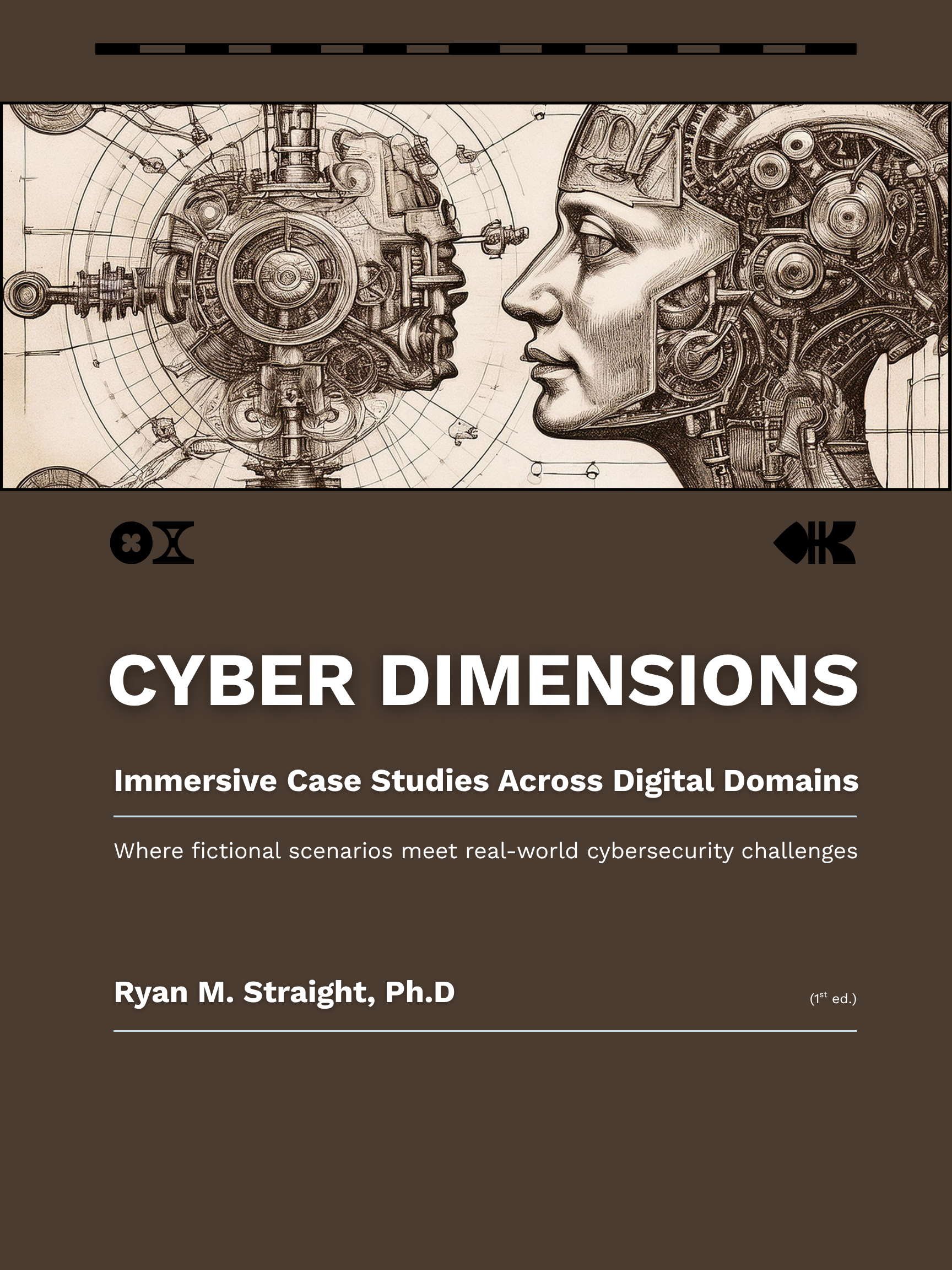
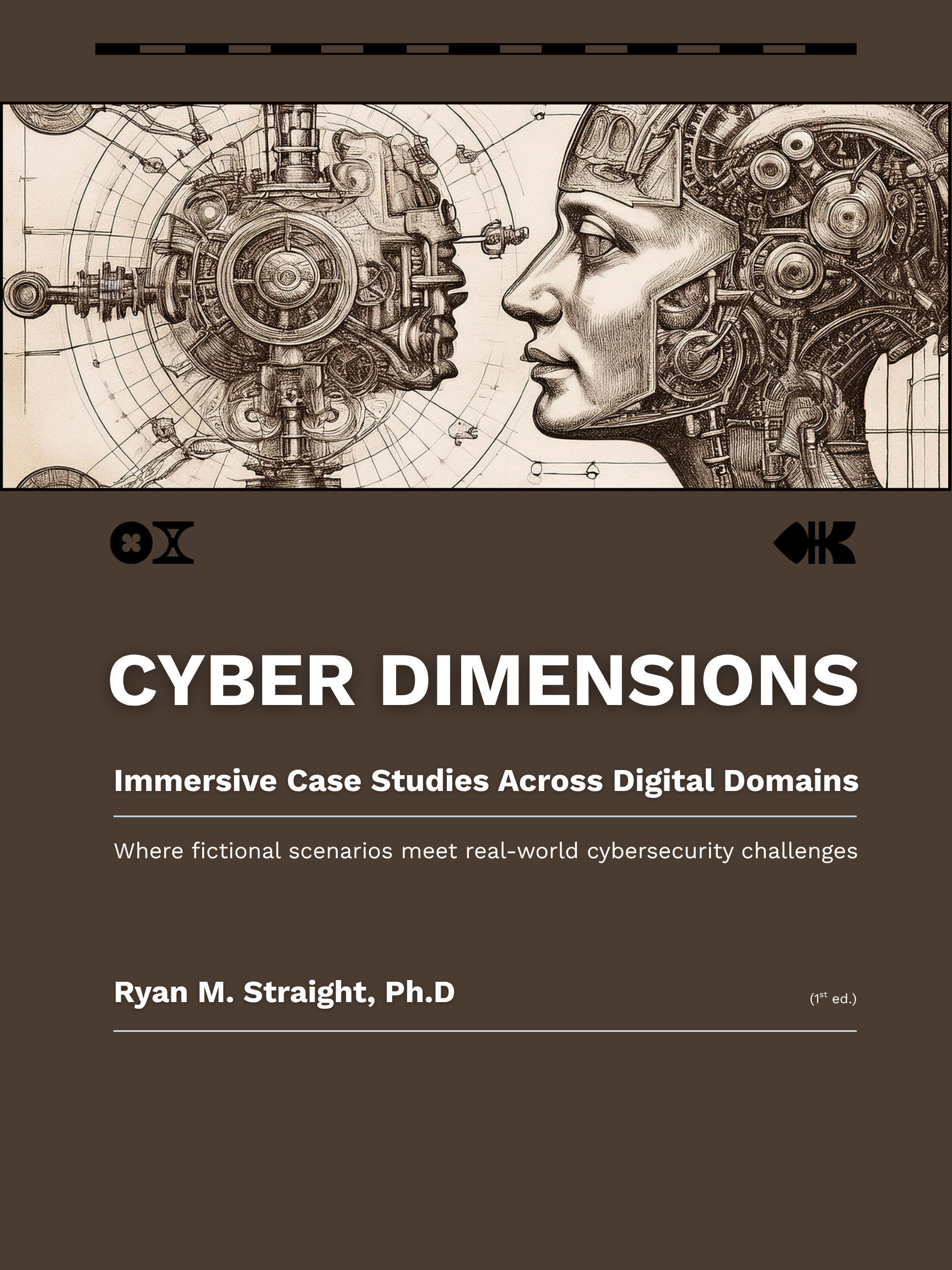
Cyber Dimensions: Immersive Case Studies Across Digital Domains
Edition: 1
Copyright: 2025
Pages: 100
Choose Your Format
Website
$75.00 USD
Transforming Cybersecurity Ethics Education Through Immersive Storytelling
Cyber Dimensions: Immersive Case Studies Across Digital Domains revolutionizes how students learn cybersecurity ethics, law, and policy by creating an interconnected fictional world where complex decisions have real consequences. Unlike traditional ethics textbooks that present isolated scenarios, this innovative approach immerses students in a living digital ecosystem where characters, organizations, and decisions span multiple cases, revealing the complex ripple effects of ethical choices in our interconnected world.
What You’ll Develop
Through engaging with these interconnected cases, you’ll develop critical competencies essential for cybersecurity professionals: advanced ethical reasoning skills for analyzing complex digital dilemmas, the ability to evaluate competing stakeholder interests in technology decisions, and professional judgment for navigating the legal, social, and technical dimensions of cybersecurity practice. Each case challenges your assumptions while building the analytical frameworks you’ll need to address real-world ethical complexities.
Core Topics Explored
The eight interconnected case studies address the most pressing ethical challenges facing cybersecurity professionals today:
- Government AI Surveillance - Navigate the balance between national security and civil liberties through classified intelligence scenarios
- Cyber Warfare & AI Weapons Ethics - Examine autonomous weapons systems and the ethics of algorithmic warfare
- Brain-Computer Interface Privacy - Explore the implications of direct neural data access and mental privacy rights
- The Right to be Forgotten - Investigate digital identity, data permanence, and personal autonomy in networked societies
- Smart Home Surveillance - Analyze privacy trade-offs in Internet of Things ecosystems and domestic monitoring
- AI Impersonation/Deep Fakes - Confront identity manipulation, consent, and authenticity in synthetic media
- Whistleblowing - Wrestle with loyalty, transparency, and moral courage in technology organizations
- Social Consequences of Anonymity - Examine accountability, free speech, and social responsibility in digital spaces
Each case study includes comprehensive assessment materials with discussion prompts, ethical analysis frameworks, and scenario-based assignments designed to develop critical thinking skills applicable to professional cybersecurity practice.
Whether you’re a student preparing for a cybersecurity career or an instructor seeking transformative pedagogical materials, Cyber Dimensions provides the immersive learning experience that prepares you to navigate the ethical complexities of our digital age with confidence and professional expertise.
Additional Resources
For instructors interested in creating their own immersive case studies, the companion Cyber Dimensions Open Educational Resource Toolkit provides complete methodology documentation, templates, and quality assurance frameworks. Additionally, a demonstration case study featuring a power grid incident (Codename: CIRCUIT) is freely available online, offering a truncated but complete preview of the immersive learning experience you’ll find throughout the textbook.
Whether you’re a student preparing for a cybersecurity career or an instructor seeking transformative pedagogical materials, Cyber Dimensions provides the immersive learning experience that prepares you to navigate the ethical complexities of our digital age with confidence and professional expertise.
Dr. Ryan Straight is an Honors & Assistant Professor of Cyber Operations in the College of Information Science at the University of Arizona, where he directs the Mixed Augmented ViRtual eXtended Reality (MA{VR}X) Lab. His unique combination of a Ph.D. in Instructional Technology from Ohio University (2015) and an M.S. in Cybersecurity from the University of Arizona (2023) positions him at the forefront of innovative cybersecurity education. Dr. Straight has taught courses in cyber ethics, law and policy, data science, and human-computer interaction.
As both a researcher and educator, Dr. Straight specializes in posthuman approaches to cybersecurity education, developing methodologies that move beyond traditional human-centric models to address the complex entanglements of humans, technologies, and systems in contemporary digital environments. His recent publications include pioneering work on posthuman analysis of the NICE Workforce Framework for Cybersecurity and postphenomenological methodology in cybersecurity education, published in leading journals including the Journal of Cybersecurity Education, Research and Practice and the Cybersecurity Pedagogy and Practice Journal. His transdisciplinary work extends to his inclusion on a $4.5 million initiative with the Center for Semiconductor Manufacturing at the University of Arizona developing an extended reality educational platform.
This textbook, Cyber Dimensions: Immersive Case Studies Across Digital Domains, represents the culmination of Dr. Straight’s innovative approach to cybersecurity ethics education. Drawing on his extensive teaching experience and research in both instructional design and cybersecurity, he has created a unique pedagogical framework that bridges theoretical ethics education with the practical realities of cybersecurity decision-making. The case studies presented here leverage AI-human collaboration and posthumanist pedagogical principles to create immersive learning experiences that prepare students for the ethical complexities they will face as cybersecurity professionals in an increasingly interconnected and technologically mediated world.
Publications Overview
Dr. Straight’s scholarship spans cybersecurity education, posthuman theory, educational technology, and pedagogical innovation. His publication record demonstrates a consistent focus on reimagining educational approaches through critical theoretical frameworks and emerging technologies.
Recent Scholarship
- “Reshaping Cybersecurity Ethics Education: Evaluating a Posthumanist Pedagogy Using Human/AI Co-Generated Case Studies” (2025, Cybersecurity Pedagogy and Practice Journal) - explores the integration of AI in developing ethics curricula
- “Beyond the Blockchain: A Comparative Analysis of Educator and Non-Educator Perspectives on Web3 in Educational Contexts” (2025, The Turkish Online Journal of Educational Technology) - examines emerging technology adoption in education
- “Beyond Human-Centric Models in Cybersecurity Education: A Pilot Posthuman Analysis of the NICE Workforce Framework for Cybersecurity” (2024, Journal of Cybersecurity Education, Research and Practice) - challenges traditional workforce frameworks through posthuman theory
- “Doing Postphenomenology in Cybersecurity Education: A Methodological Invitation” (2024, Cybersecurity Pedagogy and Practice Journal) - introduces postphenomenological methodology to cybersecurity pedagogy
- “Decentering the Human: A Posthuman Approach to Cybersecurity Education” (2024, IEEE CARS) - theoretical framework for posthuman cybersecurity education
- “Preparing Posthumanist Perspectives on AI-Human Collaboration in Developing Cyber Ethics Curricula” (2024, ISCAP) - collaborative curriculum development methodology
- “Reconceptualizing Cybersecurity Tools as Educational Actors in the Posthuman Era” (2024, EDULEARN) - reimagining the role of tools in education
- “From Parasocial to Posthuman: (Virtual) Pedagogical Agents, Parasocial Phenomena, and the Future of Immersive Learning” (2023, EdMedia) - exploring virtual agents in education
- “Bridging Complexity and Distance: Designing an Online MS Program in Cyber and Information Operations” (2023, ICERI) - curriculum design for graduate cybersecurity education
Research Impact
Dr. Straight’s work has been recognized through competitive peer review processes. His research bridges multiple disciplines, connecting posthuman philosophy with practical cybersecurity education challenges. This interdisciplinary approach has led to invited presentations at national conferences and ongoing collaborations with scholars across cybersecurity, education, and philosophy.
His current research continues to explore the intersections of AI, posthuman theory, and cybersecurity education, with particular focus on developing pedagogical approaches that prepare students for the complex sociotechnical challenges of contemporary digital security environments.