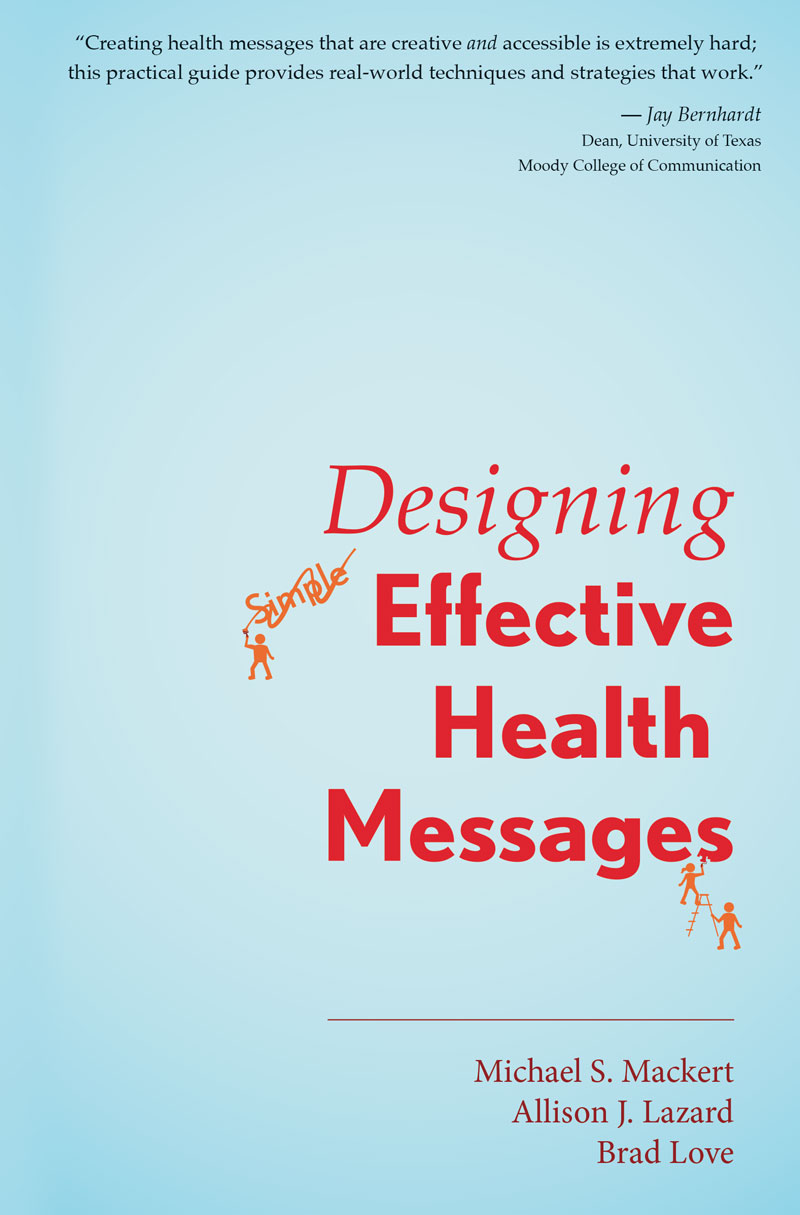

Designing Effective Health Messages
Edition: 1
Copyright: 2017
Pages: 156
Edition: 1
Copyright: 2017
Pages: 158
Choose Your Format
$58.72 USD
Ebook
$33.19 USD
New Title Now Available!
How can we make health messages culturally relevant without stereotyping?
Designing Effective Health Messages brings the perspective of advertisers to the broader health communication world. It gives straightforward overviews of relevant health communication theories, a discussion of principles of visual communication, and guidelines for plain language and clear communication.
Designing Effective Health Messages is divided into three sections:
- Section 1 provides the tools needed to design more effective health communication campaigns.
- Section 2 discusses the traditional model of health communication campaign development, execution, and evaluation.
- Section 3 uses a series of case studies to show how the authors have put these practices into action to solve real world health communication problems.
Introduction
Section 1: Building Your Toolbox
Theories: Tools for Solving Problems
Visual Communication
Principles of Clear Communication
Section 2: Developing Effective Campaigns
Campaign Development Process
Account Planning
Section 3: Case Studies
Case Study: Folic Acid Promotion
Case Study: Hand Hygiene Promotion
Case Study: Campus Napping Promotion
Case Study: Men and Prenatal Health
Conclusion
References
Michael Mackert, Ph.D., is the Director of The University of Texas at Austin Center for Health Communication and Professor in the School of Advertising & Public Relations and Department of Population Health. His research focuses primarily on the strategies that can be used in traditional and new digital media to provide effective health communication to audiences with low health literacy. He leads projects on a variety of public health issues – including tobacco cessation, opioid overdose prevention, and men's role in prenatal health – that generate evidence-based health communication strategies and contribute to health communication scholarship.
Dr. Allison Lazard investigates how we can best design messages to deliver critical health information – where and how people need and want it – to improve health outcomes. Dr. Lazard’s evidence-based communication science expertise spans visual communication, health communication and media effects research. Dr. Lazard regularly leads and collaborates on interdisciplinary health research, including but not limited to designing messages, campaigns and social media for cancer support, cancer prevention and health and wellness promotion. Dr. Lazard’s collaborative work has been funded by the National Cancer Institute, National Institute on Minority Health and Health Disparities, Robert Wood Johnson Foundation, American Cancer Society, National Institute of Drug Abuse, U.S. Food and Drug Administration and North Carolina Department of Health, among others.
She earned her Ph.D. from The University of Texas at Austin, an M.S. from Indiana University–Purdue University Indianapolis, and a B.S. from Ohio University.
Brad Love is an Associate Professor in the Stan Richards School of Advertising & Public Relations at The University of Texas at Austin. His research focuses on the persuasive power of mass media, particularly in the areas of public health and pro-social communication. He studies the social and psychological factors that influence persuasion and how digital media shapes communication processes and audience behavior.
Dr. Love’s research has been published in journals including Journalism and Mass Communication Quarterly, Journal of Computer-Mediated Communication, Journal of Postgraduate Medicine, and Disease Management and Health Outcomes. In addition to his academic work, he has experience in journalism and concert promotions and has taught at the University of Florida and Michigan State University, where he received a campus-wide teaching award for excellence in instruction.