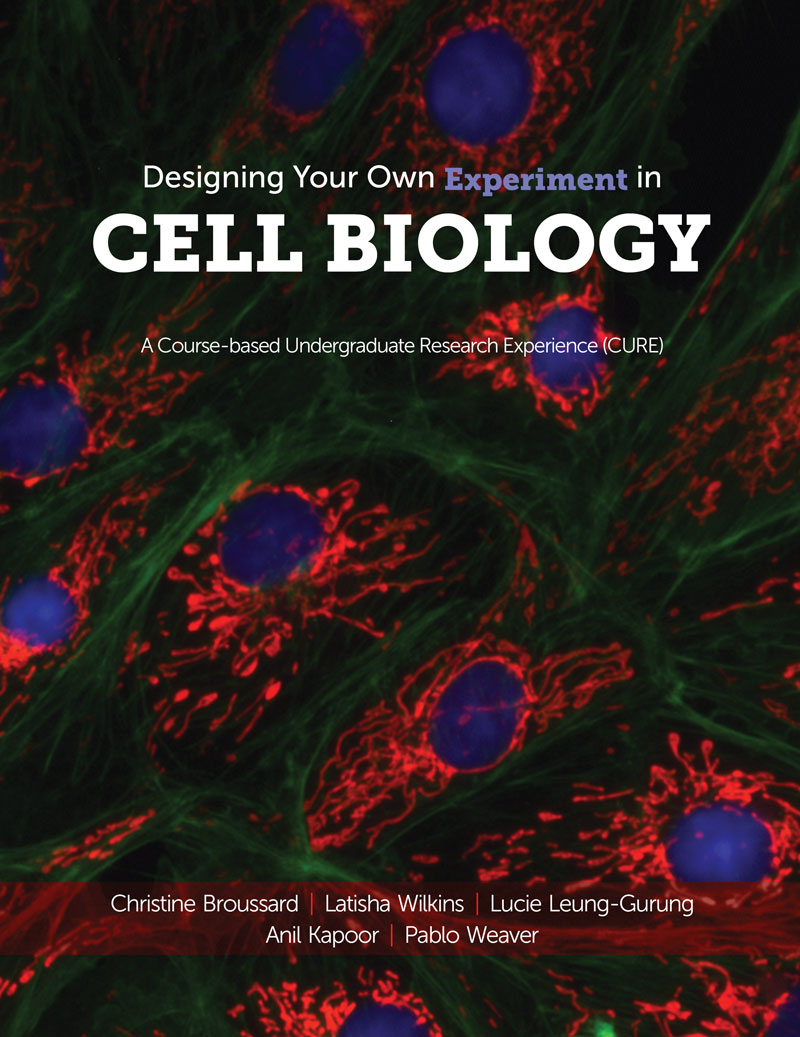
Designing Your Own Experiment in Cell Biology: A Course-based Undergraduate Research Experience
Edition: 1
Copyright: 2018
Pages: 176
Edition: 1
Copyright: 2018
Pages: 176
Choose Your Format
$66.85 USD
Ebook
$66.85 USD
Designing Your Own Experiment in Cell Biology: A Course-based Undergraduate Research Experience (CURE): is a step-by-step, interactive workbook for undergraduate biology students to learn and apply scientific research methods that will benefit them in the classroom and beyond. Students will learn best practices for sharing their research with the general public, reading scientific journal articles, designing their own experiments, and more. Filled with a plethora of spaces and tables for students to record their hypotheses, findings, drawings, etc., Designing Your Own Experiment in Cell Biology allows students to take ownership of their research as they develop skills that will last them a lifetime.
Chapter 1 Communicating Your Science
Chapter 2 Journal Club
Chapter 3 Design Your Own Experiment
Chapter 4 Modules for Cell Biology—Tissue Culture
Chapter 5 Modules for Cell Biology—Fluorescent Staining of Intracellular Organelles and Cell Cycle
Dr. Christine Broussard is a Professor of Biology at University of La Verne. Her research focuses on STEM teaching and learning, including improving student belonging, self-efficacy, and diversity in science education, as well as developmental immunotoxicology, which examines how environmental toxicants affect T cell development. She studies endocrine-disrupting chemicals, environmental health, and the use of undergraduate research experiences to improve scientific training. Dr. Broussard earned her Ph.D. from University of Texas Southwestern Medical Center and her M.S. and B.S. from Louisiana State University.
Latisha Wilkins is an Instructor of Biology in the Natural Science Division within the College of Arts & Sciences at the University of La Verne.
Lucie Leung-Gurung, MHA, is the Co-Owner, Principal, and CFO of Innovation and Intersection Associates. She specializes in behavioral and community health, community-based research, program development, data analysis, and public health education. She has experience designing research studies, creating surveys and focus groups, analyzing data, and developing reports that highlight community perspectives. She holds a B.S. in Biology and a Master’s in Health Administration from the University of La Verne and is pursuing a Ph.D. in Health Promotion Sciences with a concentration in Biostatistics from Claremont Graduate University.
Dr. Pablo Weaver is an Ecologist and Evolutionary Biologist at the University of La Verne. He leads the senior projects program in ecology and evolutionary biology and is actively involved in student research experiences through the Bob and Mary Neher Montana Research Station field trips. His research focuses on evolution in extreme environments, including freshwater ecology, fish and bird evolution, phylogenetic analysis, and environmental DNA. His work uses gene sequencing to construct phylogenetic trees and study patterns of island colonization in the Caribbean. Students working with Dr. Weaver participate in field research in Montana and the Dominican Republic, combining ecological field techniques with computer-based evolutionary analysis.