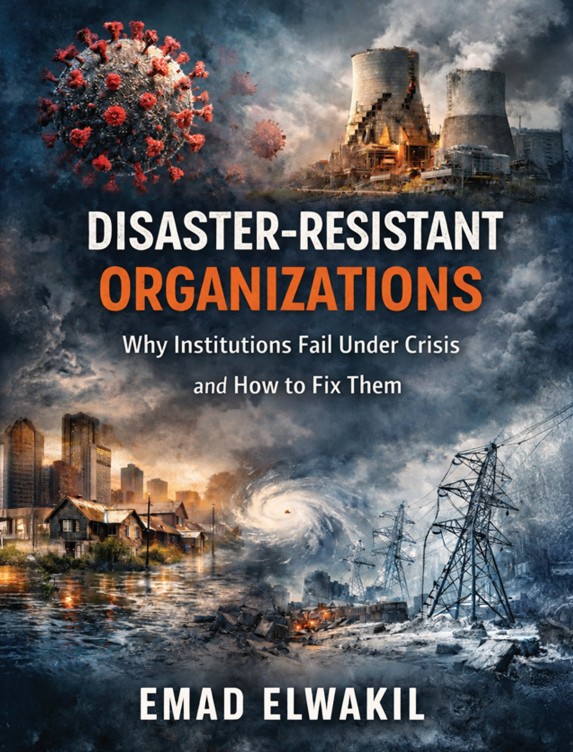
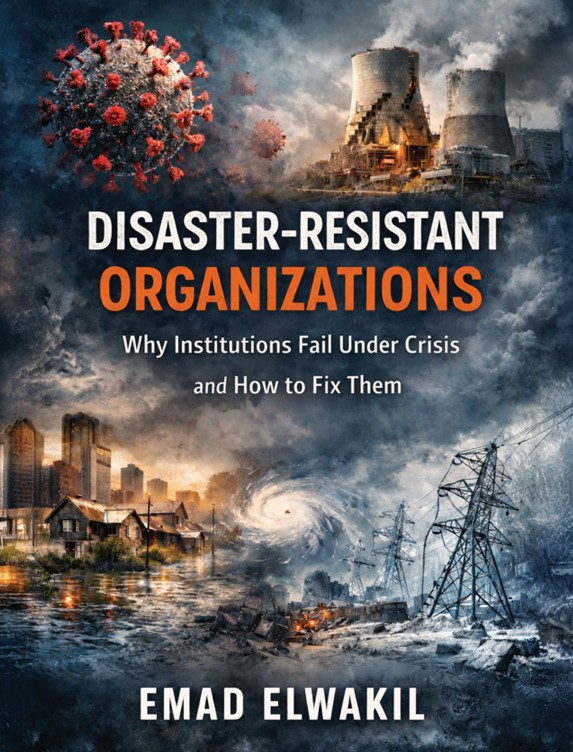
Disaster-Resistant Organizations: Why Institutions Fail Under Crisis and How to Fix Them

Author(s): Emad Elwakil

Edition: 1

Copyright: 2026

Pages: 150

Choose Your Format

Choose Your Platform | Help Me Choose

Ebook

$75.00 USD

ISBN 9798319719898

Details Electronic Delivery EBOOK 180 days

Disaster-Resistant Organizations advance a clear and urgent argument: organizational breakdown during crisis is rarely sudden or accidental. Rather, disasters expose the latent weaknesses already embedded in governance structures, decision systems, information flows, organizational culture, and accountability design. 

Moving beyond event narratives, Emad Elwakil provides a systemic analysis of why public institutions fail under extreme conditions and introduces the Disaster Performance Readiness Framework (DPRF) as a structured method for diagnosing vulnerability before a crisis reveals it publicly. Across cases involving pandemics, infrastructure disruption, public health failure, wildfire evacuation, and cyber-physical stress, the book traces recurring patterns of institutional brittleness and offers a framework for reform. 

Written for senior leaders, emergency professionals, infrastructure executives, oversight bodies, policy decision-makers, students, and scholars, this book provides a serious and practical blueprint for building organizations that can act with speed credibility, and resilience under extreme conditions.

Preface 
Why This Book Was Written 
Who This Book Is For 
How to Read This Book 
 

PART I—DISASTERS AS PERFORMANCE REVELATORS 

CHAPTER 1 Disasters Do Not Create Failure—They Expose It 
Introduction: The Moment of Truth 
The Great Institutional Deception 
Disasters as Institutional Stress Tests 
The “Unprecedented” Narrative as an Accountability Shield 
Latent Conditions: Where Failure Is Engineered 
Case Study: The COVID-19 Pandemic—Governance Failure Under Uncertainty 
The Design Challenge: Control vs. Adaptation 
The Forensic Audit: Tracing Failure to Its Source 
The Psychology of the Efficiency Trap 
Temporal Distortion: The Speed of Institutional Decay 
The Ethics of Stewardship: Design as a Moral Act 

CHAPTER 2 Organizational Performance in Public-Sector Crises: A Systems Perspective 
Introduction: Beyond the Scoreboard 
Why Traditional “Performance” Metrics Fail in Disasters 
Performance as an Emergent Property of Organizational Design 
The Logic Mismatch: Routine vs. Crisis Performance
The Five Deep Dimensions of Disaster Performance 
Performance Across Time: Built, Not Activated 
The Core of Crisis Performance: Trade-Offs 
Measuring What Matters: Capability Indicators 
Beyond High Reliability 
The Analytical Spine 

CHAPTER 3 The Disaster Landscape and Public Organizational Exposure 
Introduction: The Failure of Technical Categorization 
Why Disaster Typologies Fail Organizations 
Organizational Exposure as the Core Analytical Lens 
Temporal Exposure: The First Constraint 
Information Exposure: Interpretation and Trust 
Authority Exposure: The Responsibility Gap 
Human Exposure: Fatigue and Moral Conflict 
Infrastructure Exposure: Cascading Interdependence 
Cascading and Compound Exposure 
Chronic Exposure and Institutional Erosion 
Differential Exposure Within the Public Sector 
Misalignment: The Root of Failure 
Exposure Analysis as the Foundation of Reform 
Why Exposure Links Theory to Practice 


PART II—GOVERNANCE, DECISION, AND SENSEMAKING 

CHAPTER 4 Governance Under Pressure: Authority, Fragmentation, and the Limits of Control 
Introduction: The Institutional Architecture of Crisis 
The Core Paradox: Enabling vs. Constraining Action 
Formal Authority vs. Usable Authority 
Fragmentation as a Design Choice, Not an Accident 
The False Binary: Centralization vs. Decentralization 
Legalism and the Shadow of After-the-Fact Judgment 
The Illusion of Readiness: Emergency Powers 
Vertical Failure: Intergovernmental Misalignment 
Governance and Infrastructure Interdependence 
Governance Adaptation vs. Institutional Erosion 
Conditions of High-Performance Disaster Governance
Summary: Reform Starts with Governance 

CHAPTER 5 Decision-Making Under Extreme Uncertainty: Judgment, Delay, and the Illusion of Control 
Introduction: The Failure at the Point of Decision 
Uncertainty as a Permanent Condition 
The False Comfort of Analysis 
Delay as a Rational Organizational Strategy 
Decision Rights and the Myth of Collective Judgment
Reversibility: The Architecture of Choice
The Biological Limit: Stress and Judgment Degradation 
The Political Distortion of Decision Space 
Case Study: Early Pandemic Lockdowns—Analysis as a Substitute for Commitment 
Summary: Decision-Making as an Organizational Capability 

CHAPTER 6 Information, Communication, and Sensemaking Under Collapse Introduction: The Fog of Crisis 
Sensemaking as an Organizational Capability 
The Paradox of Information Degradation 
Hierarchy as a Filter of Truth 
The Marginalization of Frontline Knowledge 
Communication vs. Information Transfer 
Vulnerability to Misinformation and Political Sensitivity 
Designing for Shared Reality Under Stress 
Summary: The Information Triad 
 

PART III—LEADERSHIP, PEOPLE, AND CULTURE 

CHAPTER 7 Leadership Performance Under Extreme Conditions: Authority, Credibility, and Burden 
Introduction: The Myth of the Heroic Leader 
Leadership as a Performance Function 
The Three Non-Negotiable Burdens of Leadership 
Credibility: The Currency of Authority 
The Reassurance Trap 
Distributed Leadership vs. Centralized Bottlenecks 
Leadership Fatigue and Cognitive Narrowing 
The Boundary Between Political and Operational Leadership
Leadership Failure Without Villains 
What High-Performance Disaster Leadership Looks Like 
Leadership as a Design Problem 
Summary: Reframing the Mantle of Power 

CHAPTER 8 Human Performance, Stress, and Moral Injury: When Institutions Spend Their People 
Introduction: The True Limiting Factor 
Human Performance as an Institutional Output 
Cognitive Saturation and the Collapse of Judgment 
Fatigue: The Structural Choice 
Emotional Load and the Erosion of Cohesion
Moral Injury: The Institutional Betrayal
The Heroism Trap 
Case Study: Healthcare Systems During COVID-19
Designing for Human Sustainability 
Summary: The Strategic Boundary 

CHAPTER 9 Organizational Culture as a Latent Risk Factor: How Norms Decide Failure Long Before Disasters 
Introduction: The Invisible Risk 
Culture as the Operating System 
How Culture Becomes a Latent Risk 
Silence, Deference, and the Suppression of Reality 
Normalization of Deviance and the Illusion of Control 
Compliance Culture vs. Capability Culture 
Fear-Based Cultures and Risk Avoidance 
Leadership Reinforcement and Cultural Drift 
Summary: Culture as the Ultimate Integrator 
 

PART IV—OPERATIONS AND INFRASTRUCTURE 

CHAPTER 10 Operational Resilience and the Failure of Plans: Why Preparedness Collapses in Practice 
Introduction: The Planning Paradox 
The Bureaucracy of Preparedness: Auditability vs. Operability 
Plans as Scripts; Operations as Improvisation
The Violation of Silent Assumptions 
The Tyranny of Coordination and Action Fatigue 
Authority at the Point of Action: The Friction of Permission 
Redundancy, Slack, and the Efficiency Myth 
Logistics: The Invisible Backbone of Resilience 
Knowing When to Abandon the Plan 
Summary: From Prescription to Preparation 

CHAPTER 11 Infrastructure Interdependencies and Cascading Failures: Governing Systems No One Fully Controls 
Introduction: The End of the Isolated Sector 
The Architecture of Complexity: Tightly Coupled Systems 
Types of Interdependency: The Four Links 
The Governance Gap: Who Owns the Cascade? 
The Just-in-Time Trap and Inventory Depletion
The Cyber-Physical Convergence Risk
Governing the Last Mile of Failure 
Strategies for Interdependent Resilience 
Summary: Managing the Web 

CHAPTER 12 Interagency and Cross-Sector Coordination: Why Collaboration Fails When It Matters Most 
Introduction: The Accountability Crisis 
The Two Faces of Accountability 
The Chilling Effect: How Blame Creates Paralysis—and Fragmentation 
The Counterfactual Trap in Post-Disaster Reviews 
Distinguishing Error, Negligence, and System Failure
The Role of Political Oversight: Support vs. Interference
Moving Toward a Learning Accountability
Summary: Stewardship as the Ultimate Accountability 


PART V—FAILURE, ACCOUNTABILITY, AND LEARNING 

CHAPTER 13 Patterns of Organizational Failure: Why Disasters Repeat the Same Mistakes 
Introduction: Why Organizational Failure Is Patterned, Not Random 
Failure as the Interaction of Systems 
Pattern One: Authority Without Protection
Pattern Two: The Illusion of Coordination 
Pattern Three: Analysis as a Mechanism of Delay 
Pattern Four: Planning as a Substitution for Capability 
Pattern Five: Human Capacity as an Invisible Buffer 
Pattern Six: Information Distortion Up the Hierarchy 
Pattern Seven: Infrastructure Blindness 
Pattern Eight: Legitimacy Erosion Through Over-Reassurance
Pattern Nine: Scapegoating as a Learning Substitute 
Pattern Ten: Post-Disaster Amnesia
Summary: Failure Patterns as Diagnostic Tools 

CHAPTER 14 Accountability Without Scapegoating: Responsibility, Justice, and Learning After Disaster 
Introduction: The Accountability Paradox 
The Retrospective Trap and the Power of Outcome Bias 
The Scapegoating Pattern: Institutional Self-Protection 
Responsibility Without Control: The Architecture of Injustice 
Designing for a Just Culture 
Conflicting Regimes of Accountability 
Accountability as a Strategic Choice 

CHAPTER 15 Organizational Learning and Institutional Memory: Why Disasters Are Relearned the Hard Way 
Introduction: The Cycle of Forgetting 
Learning as a Political and Organizational Process 
Single-Loop vs. Double-Loop Learning 
The Decay of Institutional Memory 
The Role and Limits of After-Action Reviews 
Learning vs. Defensibility 
What Durable Learning Looks Like
Summary: Learning as a Moral Obligation 


PART VI—PERFORMANCE FRAMEWORKS AND REFORM 

CHAPTER 16 The Disaster Performance Readiness Framework: Diagnosing Capability Before Crisis 
Introduction: Why Readiness Must Be Diagnosed, Not Declared 
Principles of the Readiness Framework 
Structure of the Disaster Performance Readiness Framework 
Stress-Testing as a Diagnostic Tool 
The Readiness Maturity Model 

CHAPTER 17 Measuring Performance Under Extreme Conditions: Why Metrics Fail and What to Measure Instead 
Introduction: The Failure of Conventional Measurement
The Illusion of Precision Under Uncertainty 
Lagging Indicators and the Tyranny of Outcomes 
Activity Metrics and the Problem of “Busyness” 
Measuring What Actually Matters: Capability and Behavior Indicators 
Human Performance and Equity Indicators 
Cross-Organizational and Adaptive Measurement 
Measurement as a Tool for Learning, Not Judgment 
Integrating Measurement into the Readiness Framework 

CHAPTER 18 Reforming Public Organizations for Uncertainty: From Control to Capacity 
Introduction: The Failure of Control-Based Reform 
The False Promise of Efficiency-Oriented Reform 
Reforming Governance: Making Authority Usable 
Reforming Decision Systems: From Delay to Commitment 
Reforming Human Systems: Ending the Exploitation Model 
Reforming Information Systems: Truth Over Reassurance 
Reforming Operations and Infrastructure: Governing Interdependence 
Reforming Accountability: Protecting Learning 
Reforming Oversight: Aligning the External Environment 
Resisting Institutional Drift 
Funding Resilience: Beyond the Disaster Cycle 
Scaling Reform: From Organizations to Systems 


PART VII—STRATEGIC IMPLICATIONS AND ENDURING CAPABILITY 

CHAPTER 19 High-Performing Public Organizations in a Permanent Disaster Era: What Excellence Actually Looks Like 
Introduction: The New Standard of Performance 
The Shift From Reaction to Anticipation 
The Ambidextrous Organization: Balancing Control and Agility 
The Network Integrator: Governing Beyond Boundaries 
Radical Candor and the Reservoir of Legitimacy 
Regenerative Human Systems 
Financing for Slack: The Efficiency Rebuttal 
Summary: The Profile of the Future 

CHAPTER 20 Institutionalizing Disaster Performance Capability: Making Readiness Endure 
Introduction: The Gravity of Complacency 
The Political Economy of Preparedness 
Codifying Usable Authority
Institutionalizing the Ambidextrous Switch 
Protecting the Signal: Structural Dissent 
Human Sustainability as Policy
The Just Culture Contract 
From Tabletop Theater to Stress-Testing 
Governing the Interdependent Future 
Summary: The Anti-Fragile Institution 
The Final Charge: Stewardship as a Daily Act 
 

PART VIII—CASEBOOK: APPLYING THE DPRF ACROSS HAZARD TYPES

CHAPTER 21 Case Studies That Prove the Concept: Applying the DPRF to Real Disasters 
Introduction: Why Case Studies Are the Missing Proof Layer 
How to Read These Cases: Diagnostic, Not Narrative 
How to Read the DPRF Scorecard 
Case Study 1: Hurricane Katrina (2005) 
Case Study 2: Texas Winter Storm Uri (February 2021) 
Case Study 3: Taiwan’s Early COVID-19 Response (2020) 
Case Capsule: Fukushima Daiichi (2011) 
Synthesis: What These Cases Show (The Transferable Proof) 

CHAPTER 22 Wildfire Evacuation Under Time Compression: The 2018 Camp Fire (Butte County, California) 
Case Narrative 
DPRF Diagnosis: What Failed (And Why It Was Predictable) 
DPRF Scorecard (Camp Fire Evacuation) 
Proof of Concept: The DPRF Seam That Governed Outcomes 
Design Moves (What a Level 4+ Evacuation Capability Looks Like) 

CHAPTER 23 Cyber Disruption as a Physical Crisis: The 2021 Colonial Pipeline Ransomware Incident 
Case Narrative 
DPRF Diagnosis: The Cyber-Physical Coupling 
DPRF Scorecard (Colonial Pipeline Cyber Incident) 
Proof of Concept: the Hidden Assumption That Failed 
Design Moves (Level 4–5 Cyber Resilience for Physical Operators) 

CHAPTER 24 Public Health Contamination and Legitimacy Collapse: The Flint Water Crisis 
Case Narrative 
DPRF Diagnosis: Contamination as a Governance Disaster 
DPRF Scorecard (Flint Water Contamination) 
Proof of Concept: Legitimacy as an Operational Variable 
Design Moves (Level 4–5 Contamination Governance) 

CHAPTER 25 Comparative Synthesis: Readiness Profiles Across Hazard Types 
Introduction: Why Comparative Synthesis Matters 
The Weakest-Link Pattern Across Cases 
Recurring Failure Configurations and Predictable Seams 
A Cross-Case DPRF Comparison Matrix 
Implementation Priorities for Level 4–5 

Conclusion 
From Failure to Stewardship: Institutional Responsibility in an Age of Permanent Disaster 
References

Emad Elwakil

Disaster-Resistant Organizations advance a clear and urgent argument: organizational breakdown during crisis is rarely sudden or accidental. Rather, disasters expose the latent weaknesses already embedded in governance structures, decision systems, information flows, organizational culture, and accountability design. 

Moving beyond event narratives, Emad Elwakil provides a systemic analysis of why public institutions fail under extreme conditions and introduces the Disaster Performance Readiness Framework (DPRF) as a structured method for diagnosing vulnerability before a crisis reveals it publicly. Across cases involving pandemics, infrastructure disruption, public health failure, wildfire evacuation, and cyber-physical stress, the book traces recurring patterns of institutional brittleness and offers a framework for reform. 

Written for senior leaders, emergency professionals, infrastructure executives, oversight bodies, policy decision-makers, students, and scholars, this book provides a serious and practical blueprint for building organizations that can act with speed credibility, and resilience under extreme conditions.

Preface 
Why This Book Was Written 
Who This Book Is For 
How to Read This Book 
 

PART I—DISASTERS AS PERFORMANCE REVELATORS 

CHAPTER 1 Disasters Do Not Create Failure—They Expose It 
Introduction: The Moment of Truth 
The Great Institutional Deception 
Disasters as Institutional Stress Tests 
The “Unprecedented” Narrative as an Accountability Shield 
Latent Conditions: Where Failure Is Engineered 
Case Study: The COVID-19 Pandemic—Governance Failure Under Uncertainty 
The Design Challenge: Control vs. Adaptation 
The Forensic Audit: Tracing Failure to Its Source 
The Psychology of the Efficiency Trap 
Temporal Distortion: The Speed of Institutional Decay 
The Ethics of Stewardship: Design as a Moral Act 

CHAPTER 2 Organizational Performance in Public-Sector Crises: A Systems Perspective 
Introduction: Beyond the Scoreboard 
Why Traditional “Performance” Metrics Fail in Disasters 
Performance as an Emergent Property of Organizational Design 
The Logic Mismatch: Routine vs. Crisis Performance
The Five Deep Dimensions of Disaster Performance 
Performance Across Time: Built, Not Activated 
The Core of Crisis Performance: Trade-Offs 
Measuring What Matters: Capability Indicators 
Beyond High Reliability 
The Analytical Spine 

CHAPTER 3 The Disaster Landscape and Public Organizational Exposure 
Introduction: The Failure of Technical Categorization 
Why Disaster Typologies Fail Organizations 
Organizational Exposure as the Core Analytical Lens 
Temporal Exposure: The First Constraint 
Information Exposure: Interpretation and Trust 
Authority Exposure: The Responsibility Gap 
Human Exposure: Fatigue and Moral Conflict 
Infrastructure Exposure: Cascading Interdependence 
Cascading and Compound Exposure 
Chronic Exposure and Institutional Erosion 
Differential Exposure Within the Public Sector 
Misalignment: The Root of Failure 
Exposure Analysis as the Foundation of Reform 
Why Exposure Links Theory to Practice 


PART II—GOVERNANCE, DECISION, AND SENSEMAKING 

CHAPTER 4 Governance Under Pressure: Authority, Fragmentation, and the Limits of Control 
Introduction: The Institutional Architecture of Crisis 
The Core Paradox: Enabling vs. Constraining Action 
Formal Authority vs. Usable Authority 
Fragmentation as a Design Choice, Not an Accident 
The False Binary: Centralization vs. Decentralization 
Legalism and the Shadow of After-the-Fact Judgment 
The Illusion of Readiness: Emergency Powers 
Vertical Failure: Intergovernmental Misalignment 
Governance and Infrastructure Interdependence 
Governance Adaptation vs. Institutional Erosion 
Conditions of High-Performance Disaster Governance
Summary: Reform Starts with Governance 

CHAPTER 5 Decision-Making Under Extreme Uncertainty: Judgment, Delay, and the Illusion of Control 
Introduction: The Failure at the Point of Decision 
Uncertainty as a Permanent Condition 
The False Comfort of Analysis 
Delay as a Rational Organizational Strategy 
Decision Rights and the Myth of Collective Judgment
Reversibility: The Architecture of Choice
The Biological Limit: Stress and Judgment Degradation 
The Political Distortion of Decision Space 
Case Study: Early Pandemic Lockdowns—Analysis as a Substitute for Commitment 
Summary: Decision-Making as an Organizational Capability 

CHAPTER 6 Information, Communication, and Sensemaking Under Collapse Introduction: The Fog of Crisis 
Sensemaking as an Organizational Capability 
The Paradox of Information Degradation 
Hierarchy as a Filter of Truth 
The Marginalization of Frontline Knowledge 
Communication vs. Information Transfer 
Vulnerability to Misinformation and Political Sensitivity 
Designing for Shared Reality Under Stress 
Summary: The Information Triad 
 

PART III—LEADERSHIP, PEOPLE, AND CULTURE 

CHAPTER 7 Leadership Performance Under Extreme Conditions: Authority, Credibility, and Burden 
Introduction: The Myth of the Heroic Leader 
Leadership as a Performance Function 
The Three Non-Negotiable Burdens of Leadership 
Credibility: The Currency of Authority 
The Reassurance Trap 
Distributed Leadership vs. Centralized Bottlenecks 
Leadership Fatigue and Cognitive Narrowing 
The Boundary Between Political and Operational Leadership
Leadership Failure Without Villains 
What High-Performance Disaster Leadership Looks Like 
Leadership as a Design Problem 
Summary: Reframing the Mantle of Power 

CHAPTER 8 Human Performance, Stress, and Moral Injury: When Institutions Spend Their People 
Introduction: The True Limiting Factor 
Human Performance as an Institutional Output 
Cognitive Saturation and the Collapse of Judgment 
Fatigue: The Structural Choice 
Emotional Load and the Erosion of Cohesion
Moral Injury: The Institutional Betrayal
The Heroism Trap 
Case Study: Healthcare Systems During COVID-19
Designing for Human Sustainability 
Summary: The Strategic Boundary 

CHAPTER 9 Organizational Culture as a Latent Risk Factor: How Norms Decide Failure Long Before Disasters 
Introduction: The Invisible Risk 
Culture as the Operating System 
How Culture Becomes a Latent Risk 
Silence, Deference, and the Suppression of Reality 
Normalization of Deviance and the Illusion of Control 
Compliance Culture vs. Capability Culture 
Fear-Based Cultures and Risk Avoidance 
Leadership Reinforcement and Cultural Drift 
Summary: Culture as the Ultimate Integrator 
 

PART IV—OPERATIONS AND INFRASTRUCTURE 

CHAPTER 10 Operational Resilience and the Failure of Plans: Why Preparedness Collapses in Practice 
Introduction: The Planning Paradox 
The Bureaucracy of Preparedness: Auditability vs. Operability 
Plans as Scripts; Operations as Improvisation
The Violation of Silent Assumptions 
The Tyranny of Coordination and Action Fatigue 
Authority at the Point of Action: The Friction of Permission 
Redundancy, Slack, and the Efficiency Myth 
Logistics: The Invisible Backbone of Resilience 
Knowing When to Abandon the Plan 
Summary: From Prescription to Preparation 

CHAPTER 11 Infrastructure Interdependencies and Cascading Failures: Governing Systems No One Fully Controls 
Introduction: The End of the Isolated Sector 
The Architecture of Complexity: Tightly Coupled Systems 
Types of Interdependency: The Four Links 
The Governance Gap: Who Owns the Cascade? 
The Just-in-Time Trap and Inventory Depletion
The Cyber-Physical Convergence Risk
Governing the Last Mile of Failure 
Strategies for Interdependent Resilience 
Summary: Managing the Web 

CHAPTER 12 Interagency and Cross-Sector Coordination: Why Collaboration Fails When It Matters Most 
Introduction: The Accountability Crisis 
The Two Faces of Accountability 
The Chilling Effect: How Blame Creates Paralysis—and Fragmentation 
The Counterfactual Trap in Post-Disaster Reviews 
Distinguishing Error, Negligence, and System Failure
The Role of Political Oversight: Support vs. Interference
Moving Toward a Learning Accountability
Summary: Stewardship as the Ultimate Accountability 


PART V—FAILURE, ACCOUNTABILITY, AND LEARNING 

CHAPTER 13 Patterns of Organizational Failure: Why Disasters Repeat the Same Mistakes 
Introduction: Why Organizational Failure Is Patterned, Not Random 
Failure as the Interaction of Systems 
Pattern One: Authority Without Protection
Pattern Two: The Illusion of Coordination 
Pattern Three: Analysis as a Mechanism of Delay 
Pattern Four: Planning as a Substitution for Capability 
Pattern Five: Human Capacity as an Invisible Buffer 
Pattern Six: Information Distortion Up the Hierarchy 
Pattern Seven: Infrastructure Blindness 
Pattern Eight: Legitimacy Erosion Through Over-Reassurance
Pattern Nine: Scapegoating as a Learning Substitute 
Pattern Ten: Post-Disaster Amnesia
Summary: Failure Patterns as Diagnostic Tools 

CHAPTER 14 Accountability Without Scapegoating: Responsibility, Justice, and Learning After Disaster 
Introduction: The Accountability Paradox 
The Retrospective Trap and the Power of Outcome Bias 
The Scapegoating Pattern: Institutional Self-Protection 
Responsibility Without Control: The Architecture of Injustice 
Designing for a Just Culture 
Conflicting Regimes of Accountability 
Accountability as a Strategic Choice 

CHAPTER 15 Organizational Learning and Institutional Memory: Why Disasters Are Relearned the Hard Way 
Introduction: The Cycle of Forgetting 
Learning as a Political and Organizational Process 
Single-Loop vs. Double-Loop Learning 
The Decay of Institutional Memory 
The Role and Limits of After-Action Reviews 
Learning vs. Defensibility 
What Durable Learning Looks Like
Summary: Learning as a Moral Obligation 


PART VI—PERFORMANCE FRAMEWORKS AND REFORM 

CHAPTER 16 The Disaster Performance Readiness Framework: Diagnosing Capability Before Crisis 
Introduction: Why Readiness Must Be Diagnosed, Not Declared 
Principles of the Readiness Framework 
Structure of the Disaster Performance Readiness Framework 
Stress-Testing as a Diagnostic Tool 
The Readiness Maturity Model 

CHAPTER 17 Measuring Performance Under Extreme Conditions: Why Metrics Fail and What to Measure Instead 
Introduction: The Failure of Conventional Measurement
The Illusion of Precision Under Uncertainty 
Lagging Indicators and the Tyranny of Outcomes 
Activity Metrics and the Problem of “Busyness” 
Measuring What Actually Matters: Capability and Behavior Indicators 
Human Performance and Equity Indicators 
Cross-Organizational and Adaptive Measurement 
Measurement as a Tool for Learning, Not Judgment 
Integrating Measurement into the Readiness Framework 

CHAPTER 18 Reforming Public Organizations for Uncertainty: From Control to Capacity 
Introduction: The Failure of Control-Based Reform 
The False Promise of Efficiency-Oriented Reform 
Reforming Governance: Making Authority Usable 
Reforming Decision Systems: From Delay to Commitment 
Reforming Human Systems: Ending the Exploitation Model 
Reforming Information Systems: Truth Over Reassurance 
Reforming Operations and Infrastructure: Governing Interdependence 
Reforming Accountability: Protecting Learning 
Reforming Oversight: Aligning the External Environment 
Resisting Institutional Drift 
Funding Resilience: Beyond the Disaster Cycle 
Scaling Reform: From Organizations to Systems 


PART VII—STRATEGIC IMPLICATIONS AND ENDURING CAPABILITY 

CHAPTER 19 High-Performing Public Organizations in a Permanent Disaster Era: What Excellence Actually Looks Like 
Introduction: The New Standard of Performance 
The Shift From Reaction to Anticipation 
The Ambidextrous Organization: Balancing Control and Agility 
The Network Integrator: Governing Beyond Boundaries 
Radical Candor and the Reservoir of Legitimacy 
Regenerative Human Systems 
Financing for Slack: The Efficiency Rebuttal 
Summary: The Profile of the Future 

CHAPTER 20 Institutionalizing Disaster Performance Capability: Making Readiness Endure 
Introduction: The Gravity of Complacency 
The Political Economy of Preparedness 
Codifying Usable Authority
Institutionalizing the Ambidextrous Switch 
Protecting the Signal: Structural Dissent 
Human Sustainability as Policy
The Just Culture Contract 
From Tabletop Theater to Stress-Testing 
Governing the Interdependent Future 
Summary: The Anti-Fragile Institution 
The Final Charge: Stewardship as a Daily Act 
 

PART VIII—CASEBOOK: APPLYING THE DPRF ACROSS HAZARD TYPES

CHAPTER 21 Case Studies That Prove the Concept: Applying the DPRF to Real Disasters 
Introduction: Why Case Studies Are the Missing Proof Layer 
How to Read These Cases: Diagnostic, Not Narrative 
How to Read the DPRF Scorecard 
Case Study 1: Hurricane Katrina (2005) 
Case Study 2: Texas Winter Storm Uri (February 2021) 
Case Study 3: Taiwan’s Early COVID-19 Response (2020) 
Case Capsule: Fukushima Daiichi (2011) 
Synthesis: What These Cases Show (The Transferable Proof) 

CHAPTER 22 Wildfire Evacuation Under Time Compression: The 2018 Camp Fire (Butte County, California) 
Case Narrative 
DPRF Diagnosis: What Failed (And Why It Was Predictable) 
DPRF Scorecard (Camp Fire Evacuation) 
Proof of Concept: The DPRF Seam That Governed Outcomes 
Design Moves (What a Level 4+ Evacuation Capability Looks Like) 

CHAPTER 23 Cyber Disruption as a Physical Crisis: The 2021 Colonial Pipeline Ransomware Incident 
Case Narrative 
DPRF Diagnosis: The Cyber-Physical Coupling 
DPRF Scorecard (Colonial Pipeline Cyber Incident) 
Proof of Concept: the Hidden Assumption That Failed 
Design Moves (Level 4–5 Cyber Resilience for Physical Operators) 

CHAPTER 24 Public Health Contamination and Legitimacy Collapse: The Flint Water Crisis 
Case Narrative 
DPRF Diagnosis: Contamination as a Governance Disaster 
DPRF Scorecard (Flint Water Contamination) 
Proof of Concept: Legitimacy as an Operational Variable 
Design Moves (Level 4–5 Contamination Governance) 

CHAPTER 25 Comparative Synthesis: Readiness Profiles Across Hazard Types 
Introduction: Why Comparative Synthesis Matters 
The Weakest-Link Pattern Across Cases 
Recurring Failure Configurations and Predictable Seams 
A Cross-Case DPRF Comparison Matrix 
Implementation Priorities for Level 4–5 

Conclusion 
From Failure to Stewardship: Institutional Responsibility in an Age of Permanent Disaster 
References

Emad Elwakil
