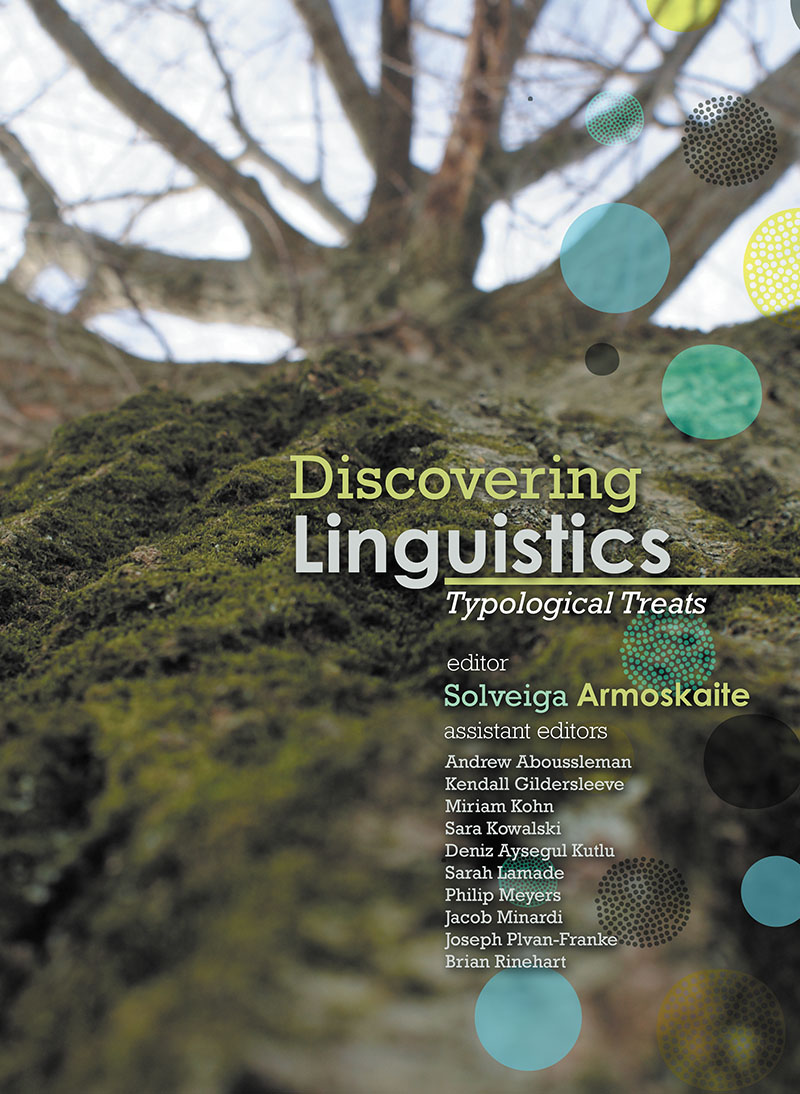
Discovering Linguistics: Typological Treats
Edition: 1
Copyright: 2016
Pages: 124
Edition: 1
Copyright: 2016
Pages: 124
Choose Your Format
Ebook
$49.52 USD
$99.04 USD
Discovering Linguistics by Solveiga Armoskaite is an introductory textbook that explores how human language is structured, used, and understood. It introduces the core areas of linguistics—including speech sounds, word formation, sentence structure, meaning, language variation, and language acquisition—while encouraging students to analyze real language data from a variety of languages. The book emphasizes that all languages are systematic and equally complex, helping readers develop a scientific understanding of language and its role in human communication, culture, and cognition.
Dehmanized
Phonetics
English: A Pope. Excerpt from the Essay on Criticism
English: brand names
English: puns
Retuarã: sound inventory
Phonology
Akoose–English–Kifuliiru: strategy comparison
Balangao: puzzle of sounds
Basque: underlying versus surface forms
Catalan: a process observed
Chol: prohibition on sound strings
Desano: a particular sound pattern
Konni: vowels in compound formation
Mandarin: tone prediction
Mundurukú and Kuruaya: relating languages
Phonology-Morphology Interface
Chechen and English: comparing a morphophonological pattern
Gĩkũyu: a morphophonological process
Konni: coining agentive nouns
Kiowa: a way to derive nouns
Latvian.Lithuanian.Prussian: a historical comparison
Mandarin: borrowings
Muyang: plurality
Rengao: causativity
Spanish: tongue twisters
Morphology
Anamuxra: a suffixal pattern
East Cree: categorical distinctions
English–Blackfoot: roots
French: grammatical gender peculiarities
Old Frisian–Modern English: a comparison
German-Lithuanian-Khasi-Alamblak: gender
Kifuliiru: a type of verb derivation
Lithuanian: participles
Portuguese: compounding
Russian: case
Spanglish: a sample of codeswitching
Retuarã–Mosetén–Lithuanian–English: pronouns
Morphology-Syntax Interface
Blackfoot: a type of nominal derivation
Syntax
English–Spanish: codeswitching moprhosyntax
Finnish: ideophones
Lithuanian: an excerpt from The Little Prince
Thai: classifier pattern
Turkish: an excerpt from The Little Prince
Syntax-Semantics Interface
English: profanity
Macedonian: determiners
Musqueam: negation
Semantics
Desano: classifier pattern
Itzaj Maya: classifier pattern
Hindi.Turkish: echo construction
German: language acquisition sample
Japanese: color name development
Lithuanian: plurality in derived nouns
Mandarin: classifier pattern
Dialect
Black English Vernacular: a sample
Discourse
English: body image expressions in language
English: presidential speech comparison
English: gendered speech
Hawaiian Pidgin English
References

Dr Solveiga Armoskaite has received her doctoral degree from the Linguistics Department at University of British Columbia (Canada). The department is known first and foremost for its dedication to the documentation and revitalization of endangered First Nations languages in British Columbia and beyond. The emphasis is on the balance between primary data collection, theoretical analysis cultural partnerships with the communities in question. As a result of this training, Dr Armoskaite became an experienced fieldworker and typologist. She worked on: Yoruba (Kwa), Plains Cree, East Cree and Blackfoot (all three Algonquian), Finnish (Fino-Ugric), Lithuanian and Russian (Balto-Slavic). The research equipped her with experiences working in diverse languages and cultures. Most of her current courses address intercultural communication, with an additional twist of focusing on underrepresented indigenous thought.
Dr Armoskaite has extensive teaching experience at diverse universities, primarily in North America. She has taught at Carleton University, which has a great number of international students and the highest number (at the time, in the province of Ontario) of first time college applicants. She also taught at Ottawa University, one of the bilingual universities of Canada. Here at Rochester (US), Dr Armoskaite served yet another student population: REJI (Rochester Education Justice Initiative). As stated on the mission page of REJI, ‘college can be a sustaining and transformative force in the lives of incarcerated individuals, furnishing them with skills and resources to enable community reintegration.’
Besides culture-oriented courses, Dr Armoskaite focuses on language. She has enjoyed teaching linguistics, English and academic writing since 2002. Her MA degree in TESOL and her Ph D in linguistics make her a good fit for the Writing program; however, she also teaches linguistic courses on Modern English Grammar and Language in Advertising. Lastly, she volunteers as an art docent at the Memorial Art Gallery, indulging in the life-long passion for art and art history.
Discovering Linguistics by Solveiga Armoskaite is an introductory textbook that explores how human language is structured, used, and understood. It introduces the core areas of linguistics—including speech sounds, word formation, sentence structure, meaning, language variation, and language acquisition—while encouraging students to analyze real language data from a variety of languages. The book emphasizes that all languages are systematic and equally complex, helping readers develop a scientific understanding of language and its role in human communication, culture, and cognition.
Dehmanized
Phonetics
English: A Pope. Excerpt from the Essay on Criticism
English: brand names
English: puns
Retuarã: sound inventory
Phonology
Akoose–English–Kifuliiru: strategy comparison
Balangao: puzzle of sounds
Basque: underlying versus surface forms
Catalan: a process observed
Chol: prohibition on sound strings
Desano: a particular sound pattern
Konni: vowels in compound formation
Mandarin: tone prediction
Mundurukú and Kuruaya: relating languages
Phonology-Morphology Interface
Chechen and English: comparing a morphophonological pattern
Gĩkũyu: a morphophonological process
Konni: coining agentive nouns
Kiowa: a way to derive nouns
Latvian.Lithuanian.Prussian: a historical comparison
Mandarin: borrowings
Muyang: plurality
Rengao: causativity
Spanish: tongue twisters
Morphology
Anamuxra: a suffixal pattern
East Cree: categorical distinctions
English–Blackfoot: roots
French: grammatical gender peculiarities
Old Frisian–Modern English: a comparison
German-Lithuanian-Khasi-Alamblak: gender
Kifuliiru: a type of verb derivation
Lithuanian: participles
Portuguese: compounding
Russian: case
Spanglish: a sample of codeswitching
Retuarã–Mosetén–Lithuanian–English: pronouns
Morphology-Syntax Interface
Blackfoot: a type of nominal derivation
Syntax
English–Spanish: codeswitching moprhosyntax
Finnish: ideophones
Lithuanian: an excerpt from The Little Prince
Thai: classifier pattern
Turkish: an excerpt from The Little Prince
Syntax-Semantics Interface
English: profanity
Macedonian: determiners
Musqueam: negation
Semantics
Desano: classifier pattern
Itzaj Maya: classifier pattern
Hindi.Turkish: echo construction
German: language acquisition sample
Japanese: color name development
Lithuanian: plurality in derived nouns
Mandarin: classifier pattern
Dialect
Black English Vernacular: a sample
Discourse
English: body image expressions in language
English: presidential speech comparison
English: gendered speech
Hawaiian Pidgin English
References
Dr Solveiga Armoskaite has received her doctoral degree from the Linguistics Department at University of British Columbia (Canada). The department is known first and foremost for its dedication to the documentation and revitalization of endangered First Nations languages in British Columbia and beyond. The emphasis is on the balance between primary data collection, theoretical analysis cultural partnerships with the communities in question. As a result of this training, Dr Armoskaite became an experienced fieldworker and typologist. She worked on: Yoruba (Kwa), Plains Cree, East Cree and Blackfoot (all three Algonquian), Finnish (Fino-Ugric), Lithuanian and Russian (Balto-Slavic). The research equipped her with experiences working in diverse languages and cultures. Most of her current courses address intercultural communication, with an additional twist of focusing on underrepresented indigenous thought.
Dr Armoskaite has extensive teaching experience at diverse universities, primarily in North America. She has taught at Carleton University, which has a great number of international students and the highest number (at the time, in the province of Ontario) of first time college applicants. She also taught at Ottawa University, one of the bilingual universities of Canada. Here at Rochester (US), Dr Armoskaite served yet another student population: REJI (Rochester Education Justice Initiative). As stated on the mission page of REJI, ‘college can be a sustaining and transformative force in the lives of incarcerated individuals, furnishing them with skills and resources to enable community reintegration.’
Besides culture-oriented courses, Dr Armoskaite focuses on language. She has enjoyed teaching linguistics, English and academic writing since 2002. Her MA degree in TESOL and her Ph D in linguistics make her a good fit for the Writing program; however, she also teaches linguistic courses on Modern English Grammar and Language in Advertising. Lastly, she volunteers as an art docent at the Memorial Art Gallery, indulging in the life-long passion for art and art history.