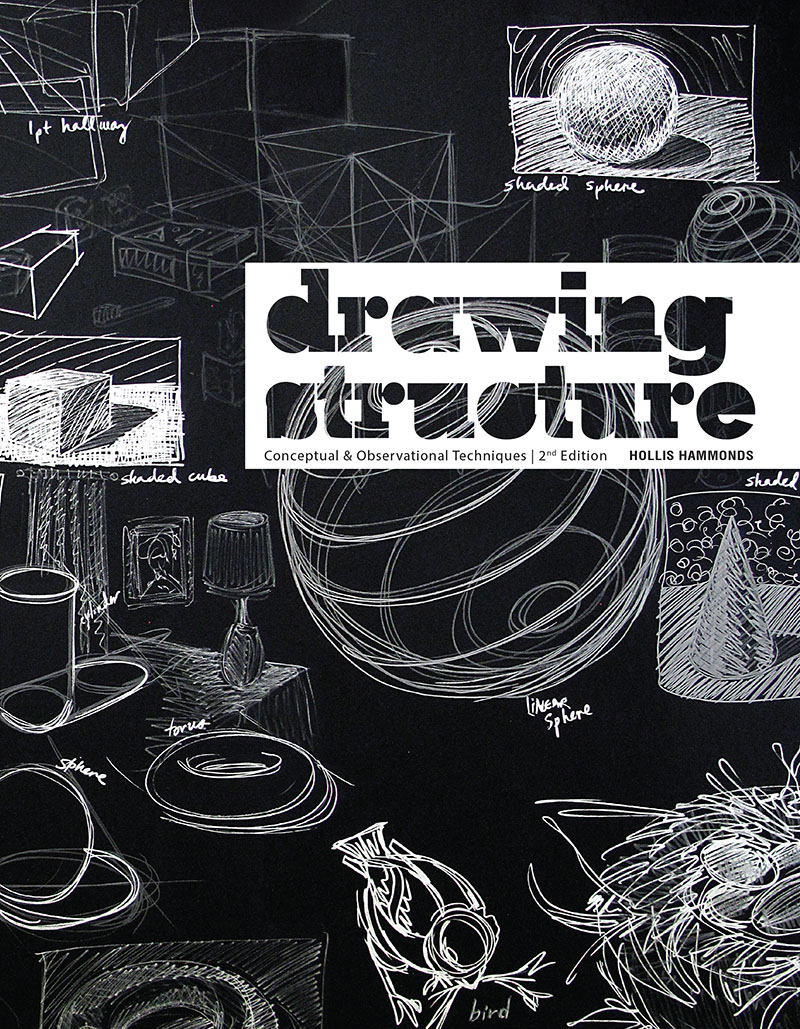
Drawing Structure: Conceptual and Observational Techniques
Edition: 1
Copyright: 2014
Pages: 156
Edition: 2
Copyright: 2014
Pages: 158
Choose Your Format
Ebook
$54.69 USD
$76.58 USD
This book provides an introduction to the technical aspects of representational drawing. Whether you have little to no experience with drawing, or have been drawing all of your life, this text is structured so that every student will leave with a set of analytic drawing tools, which will enable them to render almost any form realistically. As beginners, it is essential to learn the language of drawing through the study of representation. We will practice both conceptual and observational drawing techniques, with the goal of creating an accurate or believable sense of realism, depth, value, volume and illusion in our drawings. We will establish the conceptual rules of linear perspective, eye level, convergence and ideal volumes, while we also practice observing and recording the real world through perceptual tools and techniques.
Preface
Chapter 1: Drawing Basics
1. What Is Drawing?
2. Conceptual & Observational Drawing
3. Basic Volumes
4. Media, Substrates & Techniques
Assignments
5. Proper Drawing Form
Chapter 2: The Importance of Gesture
1. Gesture Drawing
2. Preparatory Gestures
3. Keeping a Sketchbook
Assignments
Chapter 3: Vocabulary of Line
1. Defining Line
2. Line Weight
3. Drawing Freehand
Assignments
Chapter 4: Perspective & Eye Level
1. Perspective Basics
2. Linear Perspective
3. Eye Level
Assignments
Chapter 5: Cubes
1. One-Point Cubes
2. Two-Point Cubes
Assignments
3. Rules of Convergence
4. Common Mistakes
5. Multiplying & Dividing the Cube
Assignments
Chapter 6: Drawing from Observation
1. Sighting
2. Organizational Line
3. Negative Shapes
4. Transparent Linear Boxes
Assignments
Chapter 7: Ellipse & Curvilinear Volumes
1. Anatomy of an Ellipse
2. Linear Cylinder
3. Linear Cone
4. Linear Sphere
5. Linear Torus
Assignments
Chapter 8: Value
1. Shading
2. Shaded Cube
Assignments
3. Shaded Cylinder
4. Shaded Cone
Assignments
5. Shaded Sphere
6. Shaded Torus
Assignments
Chapter 9: Conceptual Drawings
1. Complex Volumes
2. Designing a Composition
3. Conceptual Compositions
4. Combining Conceptual & Observational Drawing
5. Uses for Conceptual Drawing
Chapter 10: Observational Drawing
1. Glass & Transparency
Assignments
2. Finding Structure in Irregular Forms
Assignments
3. Planar Structure
Chapter 11: Additional Projects
Glossary of Terms
Index
Hollis Hammonds is an Associate Professor of Art and Design specializing in Visualization at Texas A&M University. She is a multimedia artist whose work explores social issues through memory, public collective consciousness, and visual storytelling. Her dystopian drawings and found-object installations address topics such as economic inequality, state violence, environmental degradation, and human-made disasters. Her artwork has been widely exhibited across the United States, including solo exhibitions at Women & Their Work in Austin, Redux Contemporary Art Center in Charleston, the Dishman Art Museum in Beaumont, and the Reed Gallery in Cincinnati. She is also part of the collaborative artist team Hammonds + West, whose multimedia projects focus on climate grief and making visible individual contributions to climate change.