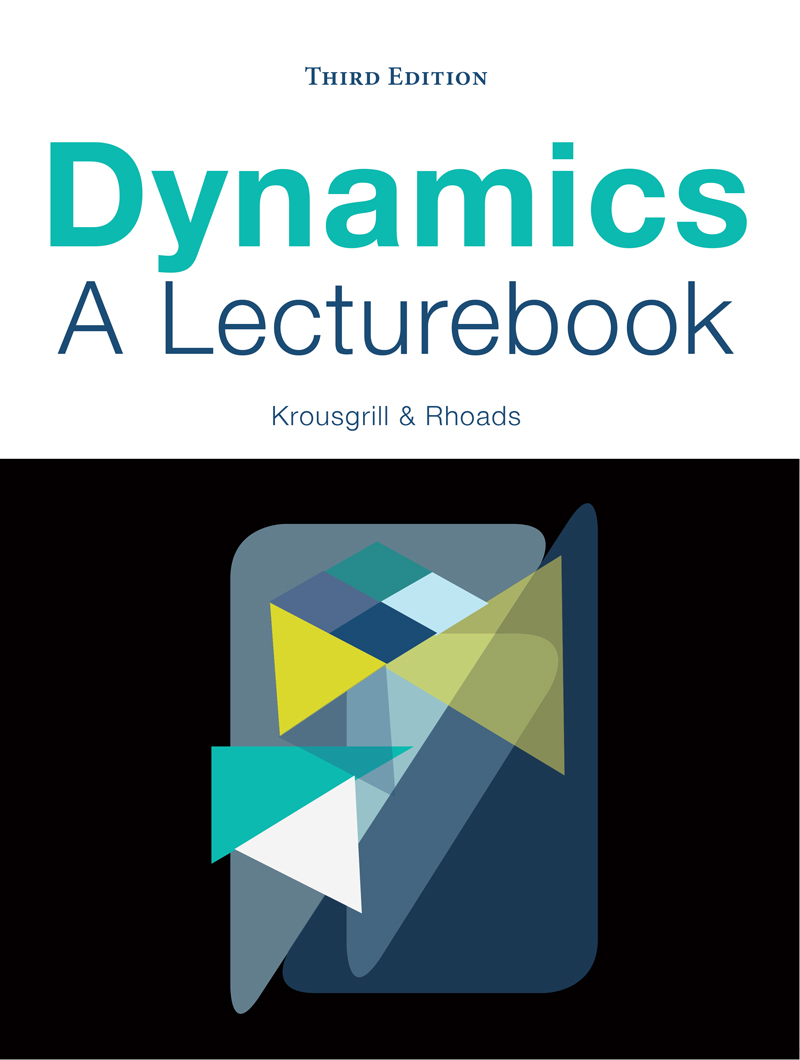
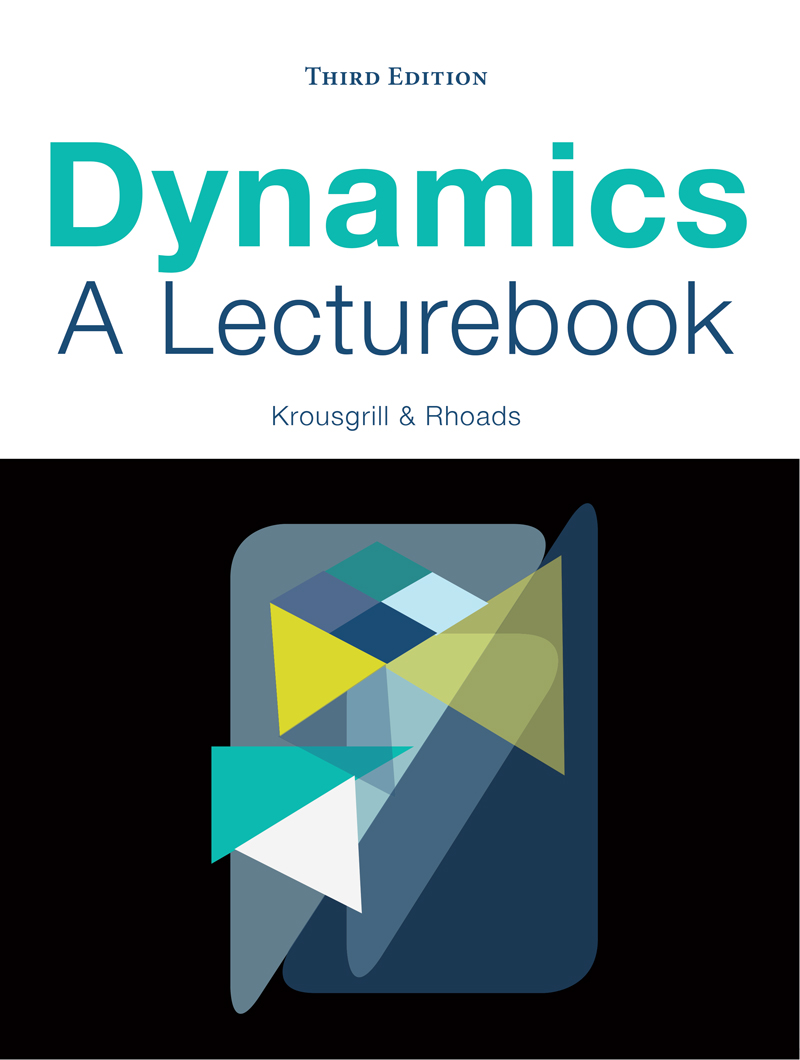
Dynamics: A Lecturebook
Edition: 3
Copyright: 2021
Pages: 450
Choose Your Format
$90.78 USD
"This hybrid textbook/lecture notes set is designed to provide an undergraduate-level, engineering-focused introduction to the topic of dynamics. To this end, the text covers the following key topical areas:
• Particle and Rigid Body Kinematics, including Cartesian, path, polar, and cylindrical descriptions of motion; relative and constrained motion; vector kinematics; instantaneous centers of rotation; and 2D and 3D moving reference frames.
• Particle and Rigid Body Kinetics, including Newtons Laws of Motion; the work-energy equation; and the linear and angular impulse-momentum equations.
• Introduction to Mechanical Vibrations, including equation of motion development; free vibration response; harmonic forced vibrations; base excitation; and rotating imbalance, all as applied to single-degree-of-freedom systems.
The text provides pertinent background information, while emphasizing fundamental engineering principles, conceptual understanding, and optimal problem solving techniques. The Lecturebook also incorporates an extensive array of practical examples with which students can hone their skills.
Key distinctions between the Lecturebook and most conventional texts include:
• Complete integration of factual information and student-produced notes
• Removal of extraneous factual information
• The inclusion of conceptual problems designed to exercise higher levels of learning
• Lecture example, homework solution, and demonstration videos designed to aid asynchronous learning
The hybrid textbook/lecture note format provides most factual information in full, while brief and extended examples are provided with ample white space, allowing students to actively work the problems with the instructor's assistance in a classroom environment, or outside of the classroom on their own or with the assistance of online videos."
Chapter 0: Fundamentals and Review Materials
Chapter 1: Particle Kinematics
Chapter 2: Planar Rigid Body Kinematics
Chapter 3: Moving Reference Frame Kinematics
Chapter 4: Particle Kinetics
Chapter 5: Planar Rigid Body Kinetics
Chapter 6: Vibrations
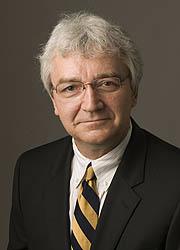
Charles M. Krousgrill: Charles M. Krousgrill is a Professor in the School of Mechanical Engineer-ing at Purdue University. He received his M.S. in mechanical engineering from Purdue University in 1975, and his M.S. and Ph.D. in applied mechanics from the California Institute of Technology in 1976 and 1980, respectively. During his more than 30 years at Purdue University, few, if any, individuals have had a greater impact on the university’s undergraduate students and the institu-tion’s commitment to engineering education. Dr. Krousgrill’s efforts in this regard have garnered numerous awards and international accolades. To date, these include the Purdue University School of Mechanical Engineering’s Harry L. Solberg Best Teacher Award (eight times), the Purdue Uni-versity College of Engineering’s Potter Best Teacher Award (four times), the Purdue University Murphy Best Teacher Award, the 2010 Purdue University Helping Students Learn Award, the 2010 Purdue Alumni Association Special Boilermaker Award and the American Society of Engineering Education’s 2011 Archie Higdon Distinguished Educator Award – the de facto lifetime achieve-ment award for educational accomplishments in the field of mechanics. In January 2018, it was announced that Dr. Krousgrill had been awarded the named 150th Anniversary Professorship by Purdue University. Outside of the classroom, Dr. Krousgrill conducts research in the general areas of dynamics and mechanical vibration.
Jeffrey F. Rhoads: Jeffrey F. Rhoads is a Professor in the School of Mechanical Engineering at Purdue University and is affiliated with both the Birck Nanotechnology Center and Ray W. Herrick Laboratories at the same institution. He also serves as the Director of Practice for MEERCat Purdue: The Mechanical Engineering Education Research Center at Purdue University and the Associate Director of PERC: The Purdue Energetics Research Center. Dr. Rhoads received his B.S., M.S., and Ph.D. degrees, each in mechanical engineering, from Michigan State University in 2002, 2004, and 2007, respectively. Dr. Rhoads’ current research interests include the predictive design, analysis, and implementation of resonant micro/nanoelectromechanical systems (MEMS/NEMS) for use in chemical and biological sensing, electromechanical signal processing, and computing; the dynamics of parametrically-excited systems and coupled oscillators; the thermomechanics of energetic materials (including explosives, pyrotechnics, and propellants); additive manufacturing; and mechanics education. Dr. Rhoads is a Member of the American Society for Engineering Education (ASEE) and a Fellow of the American Society of Mechanical Engineers (ASME), where he serves on the Design Engineering Division’s Technical Committee on Vibration and Sound. Dr. Rhoads is a recipient of numerous research and teaching awards, including the National Science Foundation’s Faculty Early Career Development (CAREER) Award; the Purdue University School of Mechanical Engineering’s Harry L. Solberg Best Teacher Award (twice), the Robert W. Fox Outstanding Instructor Award, the and B.F.S. Schaefer Outstanding Young Faculty Scholar Award; the ASEE Mechanics Division’s Ferdinand P. Beer and E. Russell Johnston, Jr. Outstanding New Mechanics Educator Award; and the ASME C. D. Mote Jr., Early Career Award. In 2014, Dr. Rhoads was included in ASEE Prism Magazine’s 20 Under 40.
"This hybrid textbook/lecture notes set is designed to provide an undergraduate-level, engineering-focused introduction to the topic of dynamics. To this end, the text covers the following key topical areas:
• Particle and Rigid Body Kinematics, including Cartesian, path, polar, and cylindrical descriptions of motion; relative and constrained motion; vector kinematics; instantaneous centers of rotation; and 2D and 3D moving reference frames.
• Particle and Rigid Body Kinetics, including Newtons Laws of Motion; the work-energy equation; and the linear and angular impulse-momentum equations.
• Introduction to Mechanical Vibrations, including equation of motion development; free vibration response; harmonic forced vibrations; base excitation; and rotating imbalance, all as applied to single-degree-of-freedom systems.
The text provides pertinent background information, while emphasizing fundamental engineering principles, conceptual understanding, and optimal problem solving techniques. The Lecturebook also incorporates an extensive array of practical examples with which students can hone their skills.
Key distinctions between the Lecturebook and most conventional texts include:
• Complete integration of factual information and student-produced notes
• Removal of extraneous factual information
• The inclusion of conceptual problems designed to exercise higher levels of learning
• Lecture example, homework solution, and demonstration videos designed to aid asynchronous learning
The hybrid textbook/lecture note format provides most factual information in full, while brief and extended examples are provided with ample white space, allowing students to actively work the problems with the instructor's assistance in a classroom environment, or outside of the classroom on their own or with the assistance of online videos."
Chapter 0: Fundamentals and Review Materials
Chapter 1: Particle Kinematics
Chapter 2: Planar Rigid Body Kinematics
Chapter 3: Moving Reference Frame Kinematics
Chapter 4: Particle Kinetics
Chapter 5: Planar Rigid Body Kinetics
Chapter 6: Vibrations
Charles M. Krousgrill: Charles M. Krousgrill is a Professor in the School of Mechanical Engineer-ing at Purdue University. He received his M.S. in mechanical engineering from Purdue University in 1975, and his M.S. and Ph.D. in applied mechanics from the California Institute of Technology in 1976 and 1980, respectively. During his more than 30 years at Purdue University, few, if any, individuals have had a greater impact on the university’s undergraduate students and the institu-tion’s commitment to engineering education. Dr. Krousgrill’s efforts in this regard have garnered numerous awards and international accolades. To date, these include the Purdue University School of Mechanical Engineering’s Harry L. Solberg Best Teacher Award (eight times), the Purdue Uni-versity College of Engineering’s Potter Best Teacher Award (four times), the Purdue University Murphy Best Teacher Award, the 2010 Purdue University Helping Students Learn Award, the 2010 Purdue Alumni Association Special Boilermaker Award and the American Society of Engineering Education’s 2011 Archie Higdon Distinguished Educator Award – the de facto lifetime achieve-ment award for educational accomplishments in the field of mechanics. In January 2018, it was announced that Dr. Krousgrill had been awarded the named 150th Anniversary Professorship by Purdue University. Outside of the classroom, Dr. Krousgrill conducts research in the general areas of dynamics and mechanical vibration.
Jeffrey F. Rhoads: Jeffrey F. Rhoads is a Professor in the School of Mechanical Engineering at Purdue University and is affiliated with both the Birck Nanotechnology Center and Ray W. Herrick Laboratories at the same institution. He also serves as the Director of Practice for MEERCat Purdue: The Mechanical Engineering Education Research Center at Purdue University and the Associate Director of PERC: The Purdue Energetics Research Center. Dr. Rhoads received his B.S., M.S., and Ph.D. degrees, each in mechanical engineering, from Michigan State University in 2002, 2004, and 2007, respectively. Dr. Rhoads’ current research interests include the predictive design, analysis, and implementation of resonant micro/nanoelectromechanical systems (MEMS/NEMS) for use in chemical and biological sensing, electromechanical signal processing, and computing; the dynamics of parametrically-excited systems and coupled oscillators; the thermomechanics of energetic materials (including explosives, pyrotechnics, and propellants); additive manufacturing; and mechanics education. Dr. Rhoads is a Member of the American Society for Engineering Education (ASEE) and a Fellow of the American Society of Mechanical Engineers (ASME), where he serves on the Design Engineering Division’s Technical Committee on Vibration and Sound. Dr. Rhoads is a recipient of numerous research and teaching awards, including the National Science Foundation’s Faculty Early Career Development (CAREER) Award; the Purdue University School of Mechanical Engineering’s Harry L. Solberg Best Teacher Award (twice), the Robert W. Fox Outstanding Instructor Award, the and B.F.S. Schaefer Outstanding Young Faculty Scholar Award; the ASEE Mechanics Division’s Ferdinand P. Beer and E. Russell Johnston, Jr. Outstanding New Mechanics Educator Award; and the ASME C. D. Mote Jr., Early Career Award. In 2014, Dr. Rhoads was included in ASEE Prism Magazine’s 20 Under 40.