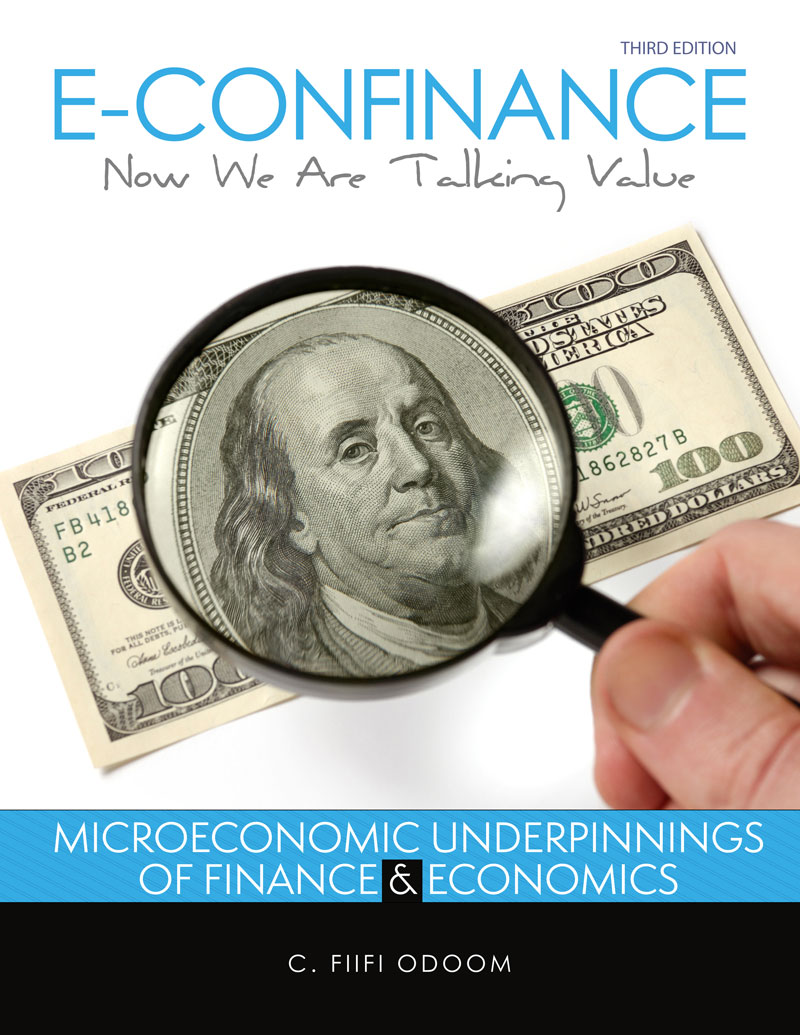
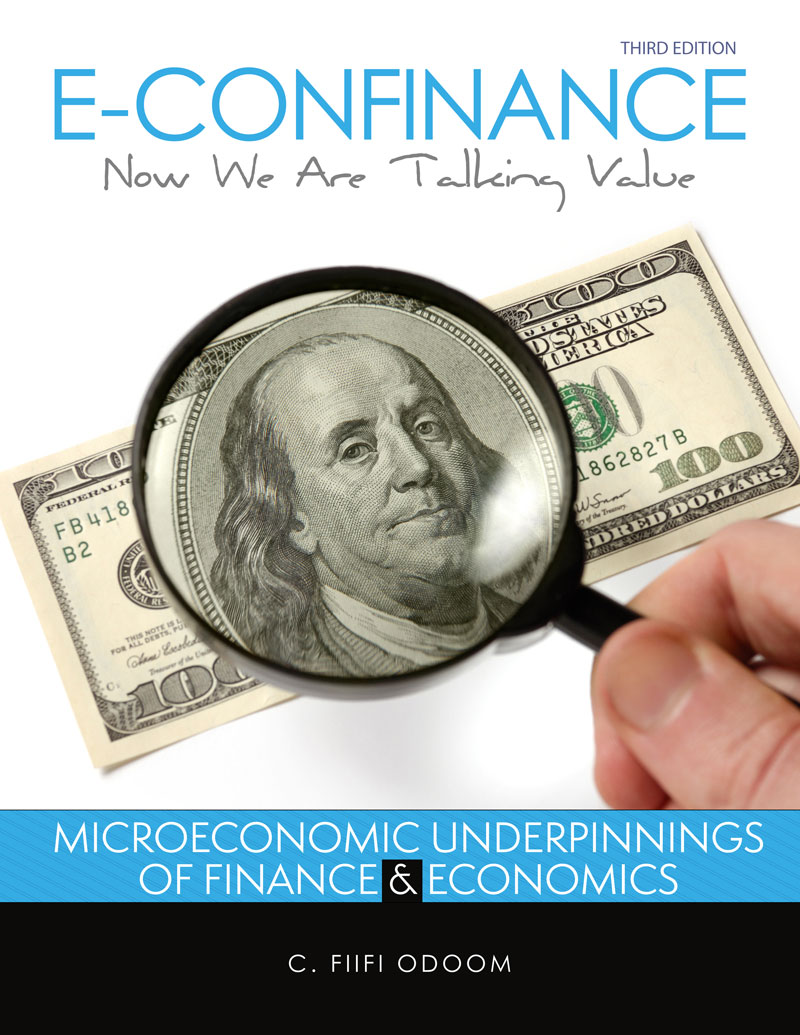
E-Confinance: Now We Are Talking Value
Edition: 3
Copyright: 2018
Choose Your Format
Ebook Package
$49.78 USD
We are getting richer as a society and even as individuals but increasingly unhappy. Money, the argument goes, goes only so far in accomplishing this all-important social goal of happiness. This has led to calls to bring back old post-war values of expansive public spaces, for us to socially engage, at little or no cost to us individually when we go to public parks, to work training facilities, to libraries, to museums, to hunting grounds, to crown lands, and so forth, areas held in trust on the public’s behalf by the state, the same spaces that developers are intent on turning into private spaces where exclusion is done by introducing hefty prices. Such prices bestow a different kind of value that we see in condominiums, houses for single families, golf courses, and so forth. As with all opposites, over time, a ‘bridge’ has emerged to take on a quasi-public trait with unique demand patterns.
So, how much value in these quasi-private spaces—the Apple Inc.’s, the Google’s, the Facebook’s, the PetroCan’s?
- Just google them. You might very well be lucky in coming up with the value of Apple Inc. or Facebook.
- How did we arrive at such (Blue Book) value, by stock or bonds route?
- How come we could not value it adequately this way when the space was public?
- What role does labor play in the creation of such ‘private value’?
- What role do big businesses (oligopolists) play in such private value creation?
- Is the economist’s lingo on value and its creation consistent with that of finance professionals?
- What are the familiar value-creating techniques used?
These are the questions that should be, hopefully, answered in this book.
SECTION I
Chapter 1 Preface: The Concept of Value
The what, how, where, and resources needed to meet the demands of the ‘economic man,’ and relevant theories that explain such behaviors.
Chapter 2 Exploring Value in Public Spaces
I. Elbow Room, Anyone, in Public Spaces?
II. Diamonds Are Scare, and Pricey. How About a New York Yankee? Any Price on Him?
Chapter 3 Defining Public Spaces, and Valuing Them
I. Introduction: Grandma’s as a Public Good
II. Theoretical Justification for Petro-Canada’s Birth
III. Problems with Valuation of (Quasi) State Enterprises
IV. Some Methods for Valuing (Quasi) State Enterprises
V. Pure Private Good
Chapter 4 Valuing the Private Sector, and,Perhaps, the Governments Too
I. A Country’s ‘Value’/GDP
II. Blending Supply- and Demand-Sides: Broad Measures of Our Value, of Government Value
Chapter 5 Creating Value, with Monopoly, Especially in Public Spaces
I. Introduction
II. Monopoly Bad for Us?
III. Can Monopoly Be Good for Us?
IV. Public/Government No-Fault Monopolies versus Private/Tort-Based (Liability) Oligopolies
V. If Monopoly Could Be Good for Us, Could Related Discrimination Be Good as Well?
SECTION II
Chapter 6 Demand Theory
I. Value in Demand
II. The In-Betweens
III. Importance of Demand
IV. It’s All About Earnings
V. Demand and Revenue Relationship
VI. Managing our Insatiable Appetite: Relating Income Constraint to Taste/Indifferent Curves
VII. Demand Defined
VIII. On the Stability of Sales: Elasticity of Demand/Supply
IX. The Mathematics of Elasticity
Chapter 7 Demand Theory—Applications
I. Government Interventions in Markets
II. Still Room for (Demand) Management?
III. How Low Will (Supply) Managers Hold On?
IV. To Tax, or Not to Tax
SECTION III
Chapter 8 Cost
I. Introduction: Understanding Different Accents on Costs
II. Cost, to a Student Registering for One, Three, Four, Five, or Six Courses
III. Cost, a Technical Definition
IV. Deriving the Supply Curve from the Cost Curve
V. So, Does Cost Really Matter? Well, Whom Are You Talking To?
Appendix
Chapter 9 Price as Outcome, and as Market Maker
I. Introduction
II. Line of Work, Price, and Markups
• The Grocery Market and the Milk Story
• Types of Markets, and the Milk Market
• A Simplified Example: Commodities and Futures Markets Revisited
III. The Milk Market
IV. Types of Pricing
• The One-Price AVC Rule for All Business Types
• The Big Business Advantage
• Dumping
• Utilities and Their Pricing
• Unit Pricing
• Cost Volume Profit Analysis (CVP)
SECTION IV
Chapter 10 Stocks as Value
I. Introduction: The Making of Wall Street
II. Types of Shares: Importance of Such Differentiation
III. Go Public or Stay Family (‘Private’)? Stocks as a Control Thing
IV. Stockmania: The Stock Market, a Natural?
V. Going Public a Natural?
Chapter 11 Bonds as Value
I. Introduction: The Bond Market in a Debt Society
II. The Bond Market, and Its Size
III. Financial Instruments
IV. Money Market Instruments
V. Business IOUs
VI. Long-Term Bond Values and Associated ‘Interest Rates’
VII. Types of Interest Rates (Returns/Yields)
VIII. Other Risks with Bonds
IX. Ways You Can Lose Your Shirt in a Bond Market
X. What to Do for Protection
Chapter 12 Valuing Average Firms, and MCI Inc.
I. Introduction: How Apple Inc. Saw Green, for Real, with Stock Price Surge
II. The Case of Dairy Queen
III. The MCI Love Story
• Verizon’s Flirtatious First Move: The Bond Game
• The Stock Route
IV. Where Does This Patchwork of Theories and Ratios on Worth Fit in All This?
V. Googling Google’s Value
SECTION V
Chapter 13a The Oligopolist, and the Little Guy, the Monopolistic Competitor
I. The Little Guy: The Monopolistic Competitor
II. What Is Big Business?
III. The Theory
IV. Shades of Oligopoly
V. The Power of Big Business
Chapter 13b Types of Oligopolies
I. The Dominant/Follower Model
II. Duopoly Goes International: Commercial Aircraft Makers
III. Room for Competition?
Chapter 13c Motivations for Marriage/Merger
I. Introduction: Strategic Positioning 101
II. Most Cited Reasons for Mergers
III. Mergers and Their Types
IV. A Brief Tutorial on Game Theory, with Applications to Mergers
Chapter 13d Heading to Splitsville
I. Introduction: Simple Rationale for Breakup/Divorce
II. Industry Example: Breakup of Conglomerates
Chapter 13e Case Studies in Mergers
I. Industry Example: Worry Not! You’re Linked in to Microsoft, for Only $26 Billion
II. Industry Example: Lowe’s then Number Three, Now Number One in Canada
III. Industry Example: Life’s a Real-Life Movie
IV. Industry Example: The Chicken Run
V. Industry Example: Food Fight
VI. Industry Example: Churches
VII. Industry Example: Communications
VIII. Industry Example: The Stock Exchange Game
IX. Industry Example: It’s a Rental!
X. Industry Example: The Beer Industry
XI. Industry Example: Air Travel
XII. Industry Example: Life’s a Movie in Canada
XIII. Our Textbook Case, and College Football Bowls
XIV. Industry Example: Prescription Drugs
XV. Industry Example: Chips, Anyone?
XVI. Industry Example: Satellite Radio
XVII. Industry Example: Banks, Pooling More Than Your
Money
SECTION VI
Chapter 14a Traditional Views on Wage Determination
I. Introduction: The Truths in the Stereotypes, in Labor Supply and Demand
II. Labor Supply and Demand: The $686 Million Man vs. the $11/Hour Circuit City Man
III. Labor Demand
IV. Labor Supply
V. Stories, as Examples: Labor in Prices, or Prices in Labor, in Two Neighborhoods
Chapter 14b Labor in Stock Value: A Political Economy Twist
I. Introduction: Political Factors in Global Labor Demand
Chapter 14c Labor as a Social Institution
I. Introduction
II. Role of Unions
III. Specific Areas of Union Activism
• Demand Improvement
• Craft (Exclusive) Unionism
• Inclusive Unions
IV. Governments as Active Institutional Builders
• Living Wage
• Public Good: The Other Extreme
V. Justifying Premiums
VI. Remedies for Discrimination
Fiifi Odoom is a research director at Asibir House, a consultancy group, and a professor at Douglas College in New Westminster, British Columbia, Canada. His academic and professional work focuses on economic systems, financial markets, and social policy.