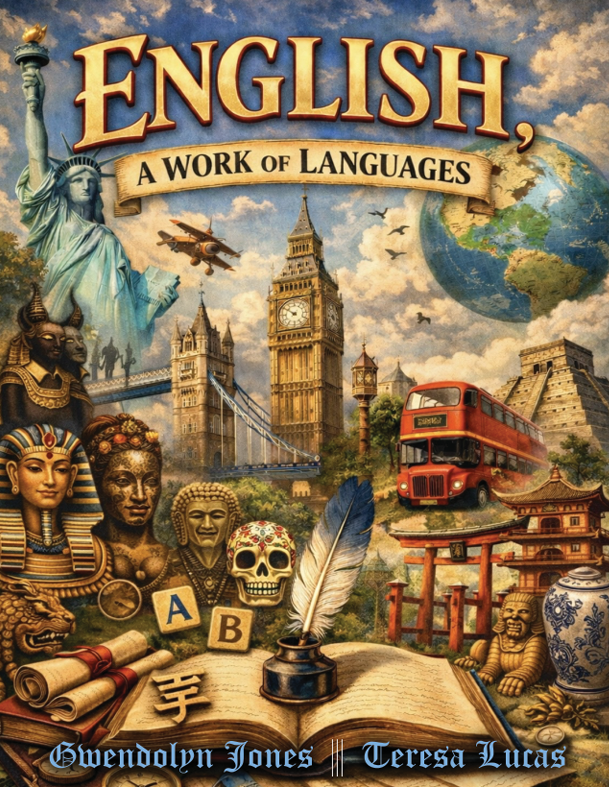
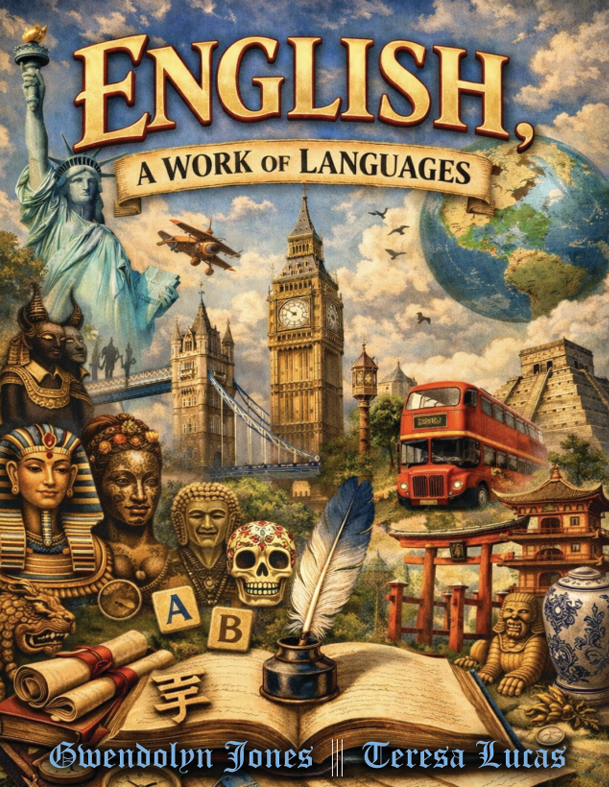
English, A Work of Languages

Edition: 1

Copyright: 2026

Pages: 94

Choose Your Format

Choose Your Platform | Help Me Choose

Ebook

$50.00 USD

ISBN 9798319719157

Details Electronic Delivery EBOOK 180 days

Communication is an art that improves with practice, envelops not only the reader, but the author. You will notice in ENR098 that words evolve like living organisms. Definitions may change, spellings may change, pronunciation may change, but the dynamic principles for writing as a process is constant, English is not. The English language evolved from cultural, political and eco
nomic relationships both negative (e.g. invasion) and positive (e.g. trade, academia, the arts.) Global colonialism and trade incorporated thousands of words from indigenous European, Asian, and African cultures, creating a diverse, evolving vocabulary with German, French and Latin being the major contributors to 80% of the English language.

Comprised of human experiences from a multitude of cultures and a plethora of countries that are the basis for “real’ life experiences. Our words describe people, places, things and ideas. The role of etymology is to deepen your understanding of written language and how the meaning and spelling of words add authenticity to your writing. As your writing improves, and it will, your reading skills will improve regardless of your writing being for academic, or personal. Confidence leads to Competence.”

It may amaze you when you find yourself developing a passion for writing and etymology. Other students will seek your knowledge of words and their definitions when they realize it is easier to ask you, than spending ten minutes attempting the find the word in the dictionary on their smart phone. You will officially have become a word “geek.” Remember words have power and sometimes they proceed you, so choose them carefully.

Prologue 
Acknowledgments 
Section I – Writing Well is Developing the Right Attitude
Chapter 1 – Who, Why, What, When, Where and How 
Chapter 2 – Vocabulary: A Step Toward Understanding 
Chapter 3 – What’s in a Note? 
Chapter 4 – The Art of Rhetoric in Writing and Speaking 
Section II – Who is ADEN? A mnemonic for four types of essays
Chapter 5 – All Sentences are Clauses, But Not all Clauses are Sentences

Chapter 6 – Types of Essays
Chapter 7 – From Paintings to Prose 
Section III – Making the Connection
Chapter 8 – Modern Language Association (MLA) 
Chapter 9 – Writing in the Real World 
Chapter 10 – Make the Connection 
Epilogue   
Section IV – Appendices
Appendix A 
  Poem 
  Images 
Appendix B 
  Articles 
Appendix C: Articles by the Electric Typewriter 
  Apocalypse 
  Artificial Intelligence  
  Brain Rot 
  Education 
  Climate Change 
  Body Image 
  Language and Linguistic 
  AI 
  Work 
  Crime and Punishment

Gwendolyn Jones
Teresa Lucas
