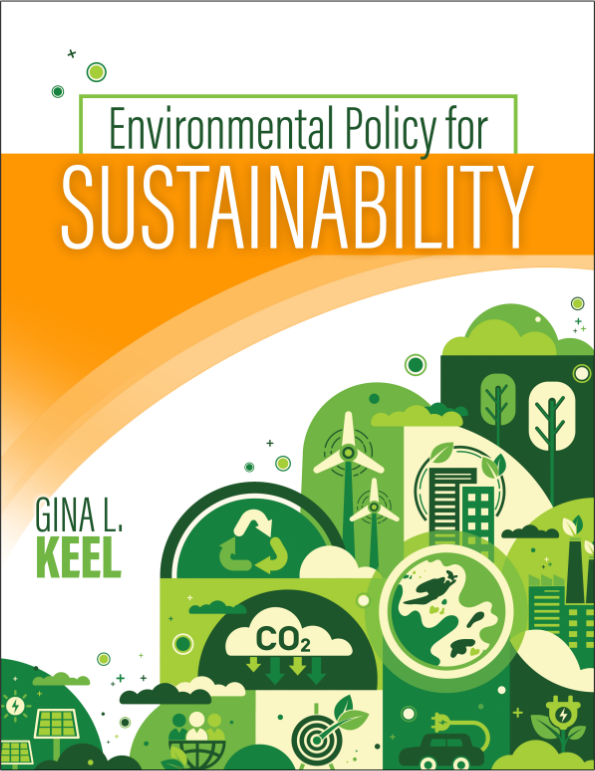
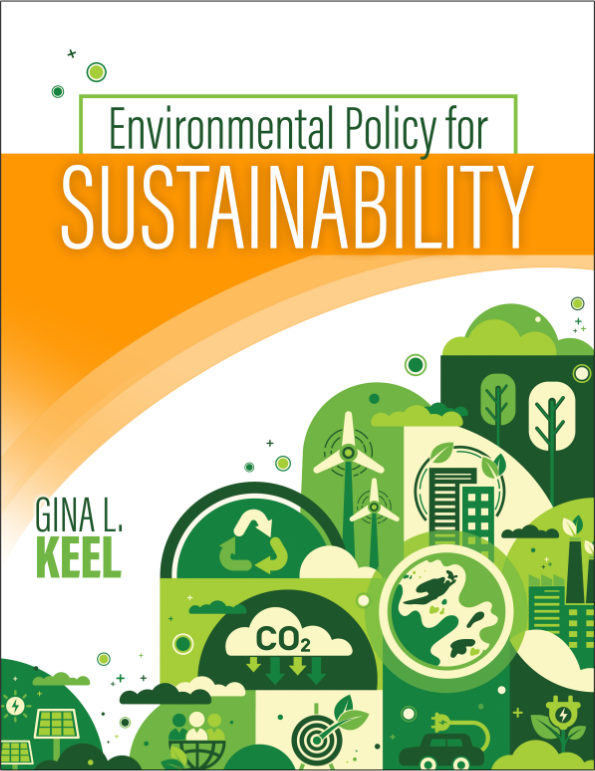
Environmental Policy for Sustainability
Edition: 1
Copyright: 2026
Pages: 200
Choose Your Format
Choose Your Platform | Help Me Choose


Ebook
$75.00 USD
Environmental Policy for Sustainability introduces environmental policy and U.S. environmental history through a sustainability-centered, interdisciplinary lens that integrates science, economics, politics, law, and social equity. Written for undergraduate students, the text emphasizes systems thinking, clear definitions, and real-world relevance, supported by digital resources, case studies, and applied activities that extend learning beyond the classroom. Opening chapters ground students in what sustainability is, why it matters, and how social and economic forces shape environmental outcomes in the context of the Anthropocene.
Building from these foundations, the book examines political institutions, environmental movements, and the implementation of environmental laws, with sustained attention to trade-offs, equity, and evidence-based policymaking. Topical chapters explore major policy domains—including air and water quality, energy and clean energy transitions, waste and toxics, and federal land and biodiversity management—while incorporating current policy debates and regulatory change. The concluding focus on local sustainability highlights pathways for action, equipping students with the analytical tools and civic perspective needed to understand environmental policy and to see themselves as active participants in advancing sustainable solutions.
Introduction
Chapter 1 What Is Sustainability? Why Do We Need It?
Chapter 2 Social and Economic Dimensions of Sustainability
Chapter 3 Political Institutions, Actors, Interests, and Policy
Chapter 4 Environmental Movements and Advocacy
Chapter 5 Implementing Environmental Laws
Chapter 6 Mitigating Harms, Setting Priorities, and Confronting Trade-offs
Chapter 7 Air Quality and Pollution Regulation
Chapter 8 Water Quality, Access, and Pollution Regulation
Chapter 9 Energy Policy to Promote Development and Transitions
Chapter 10 Clean Energy Policies: The Rise of Renewables, Conservation, and Efficiency
Chapter 11 Waste Management and Controlling Toxics
Chapter 12 Federal Land Management and Biodiversity
Chapter 13 Sustainability at the Local Level
Glossary
Gina Keel is Professor of Political Science at the State University of New York, Oneonta, and a campus leader on sustainability education. She conducts research and writes about public policy. She has contributed book chapters and articles to A Relentless Threat: Scholars Respond to Teens on Weaponized School Violence (2021), Food Labeling Politics and Policy in the United States (2020), First Amendment Studies (2014), Governing America (2010), Encyclopedia of the U.S. Government and the Environment (2011), and Class in America (2007). Dr. Keel earned a B.A. in Political Economy of Industrial Societies from the University of California, Berkeley, and a Ph.D. in Politics from Brandeis University. Previously, she worked for civic education organizations, The Freedom Forum and Commonwealth Club of California. She is the recipient of the SUNY Chancellor's Award for Excellence in Teaching (2019) and the
Ashok Kumar Malhotra SEVA Compassionate Service Award (2015).