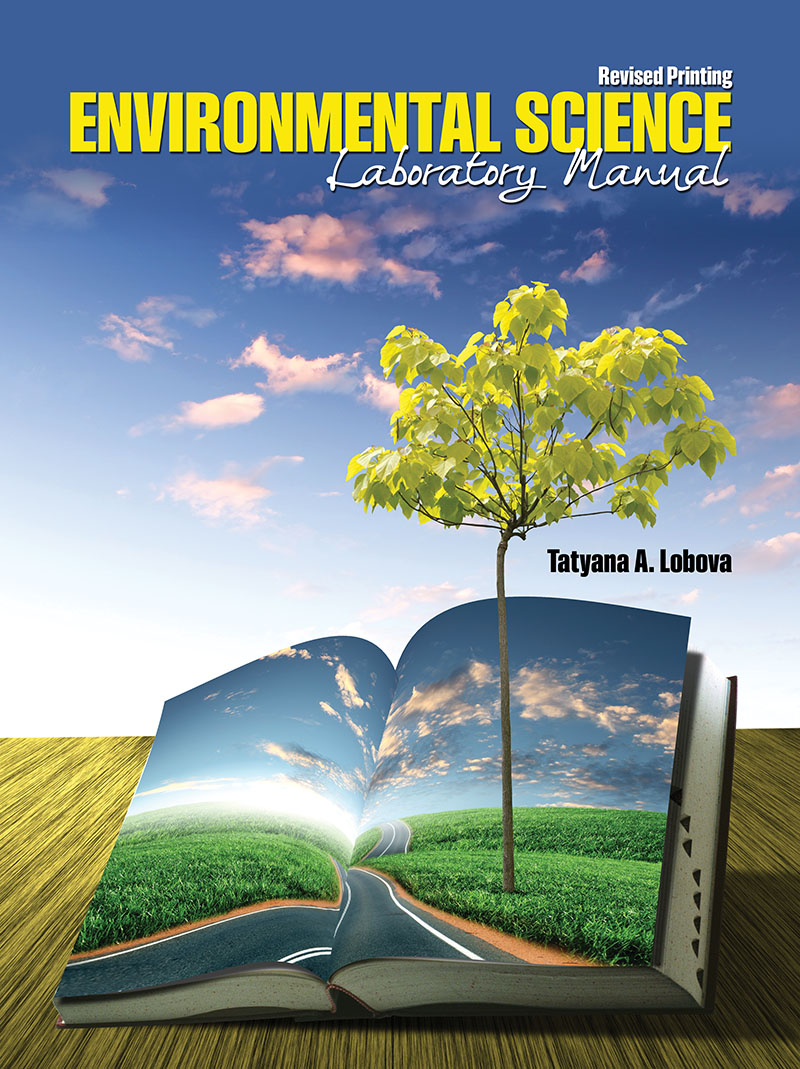
Environmental Science Laboratory Manual
Edition: 1
Copyright: 2011
Pages: 248
Choose Your Format
$101.87 USD
This laboratory manual introduces students to the scientific method and environmental science through a series of inquiry-based investigations and field activities. Beginning with laboratory safety, scientific inquiry, experimental design, and data analysis, students develop essential scientific skills in hypothesis testing, graphing, and interpreting results. The course then explores major Earth and environmental science topics, including plate tectonics, evolution by natural selection, ecosystem dynamics, predator-prey relationships, population ecology, soil characterization, energy use, and global climate change. Throughout the laboratory experience, students collect and analyze data, evaluate scientific evidence, and apply ecological and conservation principles to real-world environmental issues, culminating in a conservation project that integrates the concepts learned throughout the course.
About This Lab Manual and Notebook
Lab Safety Rules
Lab Policies
Emergency Information
Lab 1 Scientific Inquiry
Activity 1: Defining a Problem
Activity 2: The Elements of an Experiment
Activity 3: Designing an Experiment
Activity 4: Critique of the Sample Proposal
Lab 2 Graphing and Scientific Method
Activity 1: Data Presentation: Tables and Graphs
Activity 2: Graphing Practice
Activity 3: Interpreting Information on a Graph
Activity 4: Hypothesis Testing
Lab 3 Earth Structure and Plate Tectonics
Activity 1: Film “Secrets in Stone”
Activity 2: Modeling Convection
Activity 3: Evidence of Pangaea
Activity 4: OmniGlobe
Lab 4 Darwinian Snails
Activity 1: A Model of Evolution by Natural Selection
Activity 2: The Requirements for Evolution by Natural Selection
Activity 3: Darwin’s Theory of Evolution by Natural Selection
Activity 4: The Source of Variation Among Individuals
Lab 5 Isle Royale
Activity 1 Review of Data Collection for Energy Lab
Activity 2 The Moose Arrive
Activity 3 The Wolves Arrive
Activity 4 Changes in the Weather
Lab 6 Keystone Predator
Activity 1 Flexing Your Mussels
Activity 2: You are What You Eat
Activity 3: Who Rules the Rock?
Activity 4: Species Reintroduction
Lab 7 Survivorship in Populations
Activity 1: Human Sata Collection
Activity 2: Comparison of Curves
Lab 8 Soil Characterization
Activity 1: Soil Texture
Activity 2: Soil pH and Nutrient Content
Lab 9 Personal Energy Inventory and Global Climate Change
Personal Energy Inventory. Activity 1: Data Collection
Personal Energy Inventory. Activity 2: Data Compilation
Global Climate Change. Activity: 1 Global Warming- An Inconvenient Truth
Lab 10 Work on Conservation Project
Appendix I Conservation Project
Appendix II Blank Data Sheets
Tatyana Lobova, Ph.D. is a Master Lecturer in the Department of Biological Sciences at Old Dominion University. She earned her Ph.D. in Botany from the Komarov Botanical Institute of the Russian Academy of Sciences and her M.S. in Biology/Botany from St. Petersburg State University. Dr. Lobova’s expertise lies in botany and plant biology, with a strong emphasis on plant–animal interactions, tropical ecology, and conservation. Her research includes biotic surveys, plant dispersal by animals, and biodiversity inventory projects, particularly in Neotropical forest ecosystems.