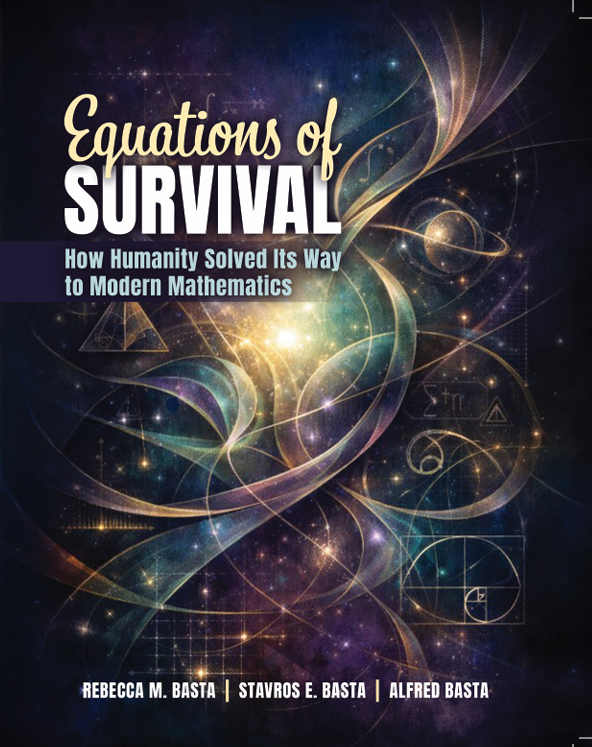
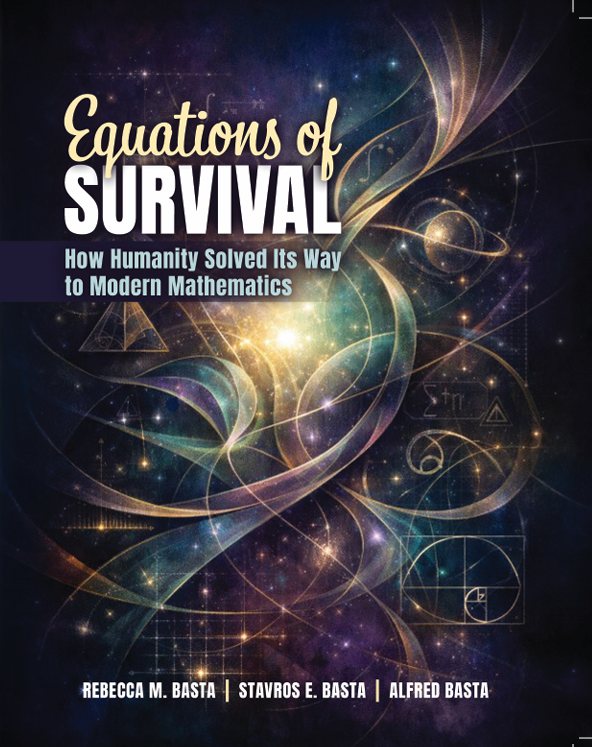
Equations of Survival: How Humanity Solved Its Way to Modern Mathematics

Edition: 1

Copyright: 2026

Pages: 640

Choose Your Format

Ebook

$80.00 USD

ISBN 9798319728050

Details Electronic Delivery EBOOK 180 days

Before the algorithm, there was the abacus. Before the spreadsheet, there was the counting stone. Before the equation, there was a human being facing an impossible problem, and refusing to stop until they solved it.

Mathematics was not invented in ivory towers. It was forged in the fires of necessity, by merchants who needed to count, farmers who needed to measure, engineers who needed to build, and scientists who needed to understand a universe that refused to stand still. Equations of Survival: How Humanity Solved Its Way to Modern Mathematics is the sweeping, exhilarating story of how our greatest intellectual tool was shaped, century by century, crisis by crisis, by the relentless demands of human survival and ambition.

From the first primitive marks scratched into bone to the quantum algorithms rewriting the boundaries of computation, the book traces the full arc of the mathematical history, not as a sequence of abstract discoveries, but as a deeply human narrative of ingenuity, and the extraordinary power of a mind determined to find order in chaos.
 

About the Authors
Video Library
Introduction

Chapter 1: Introduction to Mathematical Problem Solving
 Introduction to Mathematical Problem Solving
 Historical Context of Problem Solving
 Introduction to Systematic Approaches
 Types of Mathematical Problems
 Objectives of This Journey
 Wrapping Up

Chapter 2: The Origins of Counting Systems
 Exploring Primitive Counting Techniques
 Early Counting Methods and the Transition to Numerals
 Advancements in Numeral Systems
 The Influence of Counting on Trade and Societal Development
 Cultural Variations and the Need for Standardization
 Lessons Learned
 Main Points Recap

Chapter 3: Ancient Geometry: Solving Space Problems
 The Birth of Geometry: Origins and Foundations
 Significant Contributions From Ancient Civilizations
 Practical Applications of Geometry in Daily Life
 Foundational Early Theorems of Geometry
 Transition From Practical to Theoretical Geometry
 Final Thoughts

Chapter 4: The Rise of Algebra: Formalizing Problems
 Understanding Algebraic Thinking
 From Arithmetic to Algebraic Expressions
 Influential Mathematicians in Algebra
 Real-Life Applications of Algebra
 The Transformative Impact of Algebra on Mathematics
 Bringing It All Together

Chapter 5: The Scientific Revolution and Mathematics
 The Intersection of Science and Mathematics
 Developing Mathematical Frameworks and Statistical Techniques for Empirical Data
 Advancements During the Renaissance
 Key Mathematical Innovations
 The Influence of Mathematicians on Science
 Final Thoughts

Chapter 6: Calculus: Solving Change and Motion Problems
 The Origins of Calculus
 Key Figures in Development
 Fundamental Concepts of Calculus
 Applications of Calculus in Physics
 The Legacy of Calculus
 Final Thoughts

Chapter 7: Statistics: Understanding Data and Uncertainty
 Introduction to Statistics and Its Importance
 Historical Development of Statistical Methods
 Contributions of Key Figures in Statistics
 Practical Applications of Statistics
 The Evolution of Statistical Thinking
 Final Thoughts

Chapter 8: The Age of Reason: Logic and Mathematics
 The Emergence of Mathematical Logic
 Influential Philosophers: Euclid and Aristotle
 Influential Mathematicians: Descartes and Cantor
 Principles of Mathematical Reasoning
 Application of Logic in Solving Problems
 Final Thoughts

Chapter 9: Modeling the World: The Role of Mathematics in Engineering
 Defining Mathematical Modeling in Engineering
 Historical Applications of Mathematics in Engineering
 The Necessity of Mathematical Accuracy in Engineering
 Case Studies of Practical Mathematical Solutions
 Emerging Trends in Engineering Mathematics
 Final Insights

Chapter 10: Mathematics in Economics: Addressing Scarcity
 Defining Mathematical Economics and Its Significance
 Applications of Mathematics in Economics
 Historical Foundations of Economic Mathematics
 Classical Economic Theories and Industrial Advances
 Economic Decision-Making and Modern Applications of Mathematics
 Final Insights

Chapter 11: Mathematics and Computer Science: Algorithms and Logic
 Understanding Algorithms: Definition and Importance
 Historical Evolution of Algorithms
 Influential Figures in Computer Science
 Practical Applications of Algorithms in Diverse Fields
 Emerging Trends in Algorithm Development
 Final Thoughts

Chapter 12: Mathematics and the Arts: Harmonizing Numbers and Creativity
 The Intersection of Mathematics and Art
 Historical Examples of Mathematical Art
 Mathematical Patterns in Nature
 Using Mathematics in Artistic Creation
 The Role of Mathematics in Music
 Final Thoughts

Chapter 13: Mathematics and Social Sciences: Analyzing Society
 Mathematics’ Role in Social Sciences
 Quantitative Research Methodologies
 Case Studies Demonstrating Statistical Applications
 Challenges in Mathematical Modeling
 Future Directions for Mathematics in Social Sciences
 Final Thoughts

Chapter 14: Mathematical Ethics: The Responsibility of Data Use
 Defining Mathematical Ethics
 Ethical Issues in Data Handling
 Historical Cases of Ethical Dilemmas in Mathematics
 The Role of Ethics in Mathematical Decision-Making
 Future of Ethics in Mathematical Applications
 Final Insights

Chapter 15: Mathematics and Medicine: Solving Health Problems
 The Role of Statistics in Medicine
 Historical Development of Medical Mathematics
 Key Mathematical Models in Epidemiology
 Applications of Math in Clinical Trials
 Future Trends in Medical Mathematics
 Final Thoughts

Chapter 16: Mathematics and Environmental Science: Modeling Ecological Systems
 The Importance of Mathematics in Environmental Studies
 Case Studies in Environmental Modeling
 Mathematical Approaches to Resource Management
 Ethical Considerations in Environmental Mathematics
 Future Challenges and Opportunities in Environmental Mathematics
 Final Thoughts

Chapter 17: Mathematics and Transportation: Solving Logistics Problems
 Defining Transportation Mathematics: Foundations and Applications
 Historical Overview of Logistics Challenges: Key Developments
 Key Mathematical Models in Transportation: Frameworks for Solutions
 Applications of Mathematics in Traffic Management: Enhancements in Practice
 The Future of Mathematics in Transportation Solutions: Innovations Ahead
 Wrapping Up

Chapter 18: Mathematics and Climate Change: A Calculated Approach
 Defining Climate Mathematics and Its Frameworks
 Statistical Analysis Techniques for Climate Data
 Mathematical Models for Accurate Climate Predictions
 The Role of Mathematics in Influencing Policy Decisions
 Future Directions and Innovations in Climate Mathematics
 Bringing It All Together

Chapter 19: Globalization and Mathematics: Solving Worldwide Challenges
 Mathematics in Globalization
 Cross-Cultural Collaborations in Mathematics
 Challenges in Global Mathematics Education
 Mathematics in International Development
 The Future of Mathematics in a Global Context
 Final Thoughts

Chapter 20: The Future of Mathematics: Emerging Concepts and Technologies
 Innovations in Mathematical Research: Complexity Theory and Topological Data Analysis
 Innovations in Mathematical Research: Modeling in Pandemic Response and AI Developments
 The Role of Technology in Mathematical Advancement: Software Tools and Online Resources
 Emerging Fields in Mathematics: Data Science and Cryptography
 The Importance of Math Education in the Future: Foundations and Inclusivity
 Final Thoughts

Chapter 21: Mathematics in Society: Historical Perspectives and Modern Impacts
 The Historical Role of Mathematics in Society
 Modern Applications of Mathematics in Society
 The Impact of Mathematics on Social Justice
 The Relationship Between Mathematics and Public Policy
 Future Trends in Mathematics for Societal Development
 Final Thoughts

Chapter 22: Reflections on Mathematics: A Journey Through Time and Space
 Recap of Key Themes in Mathematical History
 Personal Reflections on Mathematics’ Impact
 The Continual Evolution of Mathematics
 Interconnections Between Mathematics and Other Fields
 The Importance of Embracing Mathematics in Life
 Wrapping Up

Chapter 23: The Enduring Power of Mathematics
 Summary of the Mathematical Journey
 The Ongoing Relevance of Mathematics
 Mathematics as a Universal Language
 Encouragement for Lifelong Learning in Mathematics
 What We’ve Learned

Further Readings

Index

Alfred Basta

Dr. Alfred Basta is a distinguished Professor of Cybersecurity, Computer Science, Information Technology, and Mathematics with a PhD in Cryptography and a Master’s in Computer Science. With nearly 3 decades of academic leadership and industry expertise spanning since 1997, Dr. Basta has established himself as a towering figure in both cybersecurity education and research.
Dr. Basta’s expertise is underscored by an exceptional portfolio of 60+ professional certifications representing the highest levels across multiple security and technology domains. His credentials span security leadership (ISO 27001:2022 Lead Auditor, CCISO, CISM, CGEIT, CISA, CRISC), penetration testing and ethical hacking (OSCP, CRTO, CPENT, Licensed Penetration Testing Master, CEH, CHFI), governance and compliance (Certified CMMC Professional, Lead Certified CMMC Assessor), cloud architecture (AWS Certified Solutions Architect Professional, Google Cloud Certified Professional Cloud Architect and Data Engineer), Microsoft cloud security (Azure Security Engineer, Security Operations Analyst, Microsoft 365 Security Administrator), incident response and forensics (CHFI, ECIH), health care security (CHPSE), and infrastructure (CompTIA comprehensive security suite including CASP+, CySA+, PenTest+, Security+, Linux+, and Cloud+). Beyond traditional teaching, Dr. Basta has been a visionary architect of distance education, collaborating with faculty and administrators to design, implement, and assess transformative online learning programs. Dr. Basta represents a rare synthesis of scholarly rigor, practical expertise, and spiritual depth.

Rebecca M Basta

Rebecca M. Basta is a distinguished bioinformatics and cybersecurity education specialist with deep expertise at the critical intersection of health care technology, data science, and cybersecurity. Holding a Master of Science in Bioinformatics and a Bachelor of Science in Biochemistry with a Minor in Biotechnology, Basta combines advanced academic credentials with hands-on laboratory and educational expertise.
With an impressive portfolio of 30+ professional certifications spanning health care data analytics, AI governance, cybersecurity, risk management, and emerging security technologies, Basta demonstrates exceptional breadth across intersecting disciplines. Her credentials include Certified Health Data Analyst (CHDA), Certified Information Privacy Professional/United States (CIPP/US), Artificial Intelligence Governance Professional (AIGP), ISO 27001 and ISO 42001 Certified Lead Auditor, Certified Analytics Professional Expert (CAP), Certified Lean Six Sigma Master Black Belt, Certified Red Team Operations Management (CRTOM), and Certified Artificial Intelligence Security & Risk (CAISR). This diverse certification landscape reflects her commitment to understanding security from multiple angles: defensive, offensive, and governance perspectives. Basta’s research and publication record is exceptionally prolific, focusing on the convergence of health care security and advanced data analytics.

Stavros E Basta

Stavros E. Basta is an accomplished cybersecurity professional and published researcher 
specializing in industrial control systems (ICS) security and critical infrastructure protection. Holding a Master of Science in Cybersecurity and a Bachelor of Science in Cybersecurity, Basta brings advanced academic credentials alongside extensive industry experience.
With an impressive portfolio of 25+ professional certifications spanning security leadership, penetration testing, risk management, and cloud security, including GIAC Global Industrial Cyber Security Professional (GICSP), Certified Information Security Manager (CISM), Licensed Penetration Testing Master (LPTM), GIAC Security Leadership (GSLC), and Certified Penetration Testing Professional (CPENT), Basta demonstrates deep expertise across the cybersecurity landscape. Basta’s research investigates the critical gap between traditional cybersecurity frameworks and the unique vulnerabilities of industrial control systems and critical infrastructure. 

Before the algorithm, there was the abacus. Before the spreadsheet, there was the counting stone. Before the equation, there was a human being facing an impossible problem, and refusing to stop until they solved it.

Mathematics was not invented in ivory towers. It was forged in the fires of necessity, by merchants who needed to count, farmers who needed to measure, engineers who needed to build, and scientists who needed to understand a universe that refused to stand still. Equations of Survival: How Humanity Solved Its Way to Modern Mathematics is the sweeping, exhilarating story of how our greatest intellectual tool was shaped, century by century, crisis by crisis, by the relentless demands of human survival and ambition.

From the first primitive marks scratched into bone to the quantum algorithms rewriting the boundaries of computation, the book traces the full arc of the mathematical history, not as a sequence of abstract discoveries, but as a deeply human narrative of ingenuity, and the extraordinary power of a mind determined to find order in chaos.
 

About the Authors
Video Library
Introduction

Chapter 1: Introduction to Mathematical Problem Solving
 Introduction to Mathematical Problem Solving
 Historical Context of Problem Solving
 Introduction to Systematic Approaches
 Types of Mathematical Problems
 Objectives of This Journey
 Wrapping Up

Chapter 2: The Origins of Counting Systems
 Exploring Primitive Counting Techniques
 Early Counting Methods and the Transition to Numerals
 Advancements in Numeral Systems
 The Influence of Counting on Trade and Societal Development
 Cultural Variations and the Need for Standardization
 Lessons Learned
 Main Points Recap

Chapter 3: Ancient Geometry: Solving Space Problems
 The Birth of Geometry: Origins and Foundations
 Significant Contributions From Ancient Civilizations
 Practical Applications of Geometry in Daily Life
 Foundational Early Theorems of Geometry
 Transition From Practical to Theoretical Geometry
 Final Thoughts

Chapter 4: The Rise of Algebra: Formalizing Problems
 Understanding Algebraic Thinking
 From Arithmetic to Algebraic Expressions
 Influential Mathematicians in Algebra
 Real-Life Applications of Algebra
 The Transformative Impact of Algebra on Mathematics
 Bringing It All Together

Chapter 5: The Scientific Revolution and Mathematics
 The Intersection of Science and Mathematics
 Developing Mathematical Frameworks and Statistical Techniques for Empirical Data
 Advancements During the Renaissance
 Key Mathematical Innovations
 The Influence of Mathematicians on Science
 Final Thoughts

Chapter 6: Calculus: Solving Change and Motion Problems
 The Origins of Calculus
 Key Figures in Development
 Fundamental Concepts of Calculus
 Applications of Calculus in Physics
 The Legacy of Calculus
 Final Thoughts

Chapter 7: Statistics: Understanding Data and Uncertainty
 Introduction to Statistics and Its Importance
 Historical Development of Statistical Methods
 Contributions of Key Figures in Statistics
 Practical Applications of Statistics
 The Evolution of Statistical Thinking
 Final Thoughts

Chapter 8: The Age of Reason: Logic and Mathematics
 The Emergence of Mathematical Logic
 Influential Philosophers: Euclid and Aristotle
 Influential Mathematicians: Descartes and Cantor
 Principles of Mathematical Reasoning
 Application of Logic in Solving Problems
 Final Thoughts

Chapter 9: Modeling the World: The Role of Mathematics in Engineering
 Defining Mathematical Modeling in Engineering
 Historical Applications of Mathematics in Engineering
 The Necessity of Mathematical Accuracy in Engineering
 Case Studies of Practical Mathematical Solutions
 Emerging Trends in Engineering Mathematics
 Final Insights

Chapter 10: Mathematics in Economics: Addressing Scarcity
 Defining Mathematical Economics and Its Significance
 Applications of Mathematics in Economics
 Historical Foundations of Economic Mathematics
 Classical Economic Theories and Industrial Advances
 Economic Decision-Making and Modern Applications of Mathematics
 Final Insights

Chapter 11: Mathematics and Computer Science: Algorithms and Logic
 Understanding Algorithms: Definition and Importance
 Historical Evolution of Algorithms
 Influential Figures in Computer Science
 Practical Applications of Algorithms in Diverse Fields
 Emerging Trends in Algorithm Development
 Final Thoughts

Chapter 12: Mathematics and the Arts: Harmonizing Numbers and Creativity
 The Intersection of Mathematics and Art
 Historical Examples of Mathematical Art
 Mathematical Patterns in Nature
 Using Mathematics in Artistic Creation
 The Role of Mathematics in Music
 Final Thoughts

Chapter 13: Mathematics and Social Sciences: Analyzing Society
 Mathematics’ Role in Social Sciences
 Quantitative Research Methodologies
 Case Studies Demonstrating Statistical Applications
 Challenges in Mathematical Modeling
 Future Directions for Mathematics in Social Sciences
 Final Thoughts

Chapter 14: Mathematical Ethics: The Responsibility of Data Use
 Defining Mathematical Ethics
 Ethical Issues in Data Handling
 Historical Cases of Ethical Dilemmas in Mathematics
 The Role of Ethics in Mathematical Decision-Making
 Future of Ethics in Mathematical Applications
 Final Insights

Chapter 15: Mathematics and Medicine: Solving Health Problems
 The Role of Statistics in Medicine
 Historical Development of Medical Mathematics
 Key Mathematical Models in Epidemiology
 Applications of Math in Clinical Trials
 Future Trends in Medical Mathematics
 Final Thoughts

Chapter 16: Mathematics and Environmental Science: Modeling Ecological Systems
 The Importance of Mathematics in Environmental Studies
 Case Studies in Environmental Modeling
 Mathematical Approaches to Resource Management
 Ethical Considerations in Environmental Mathematics
 Future Challenges and Opportunities in Environmental Mathematics
 Final Thoughts

Chapter 17: Mathematics and Transportation: Solving Logistics Problems
 Defining Transportation Mathematics: Foundations and Applications
 Historical Overview of Logistics Challenges: Key Developments
 Key Mathematical Models in Transportation: Frameworks for Solutions
 Applications of Mathematics in Traffic Management: Enhancements in Practice
 The Future of Mathematics in Transportation Solutions: Innovations Ahead
 Wrapping Up

Chapter 18: Mathematics and Climate Change: A Calculated Approach
 Defining Climate Mathematics and Its Frameworks
 Statistical Analysis Techniques for Climate Data
 Mathematical Models for Accurate Climate Predictions
 The Role of Mathematics in Influencing Policy Decisions
 Future Directions and Innovations in Climate Mathematics
 Bringing It All Together

Chapter 19: Globalization and Mathematics: Solving Worldwide Challenges
 Mathematics in Globalization
 Cross-Cultural Collaborations in Mathematics
 Challenges in Global Mathematics Education
 Mathematics in International Development
 The Future of Mathematics in a Global Context
 Final Thoughts

Chapter 20: The Future of Mathematics: Emerging Concepts and Technologies
 Innovations in Mathematical Research: Complexity Theory and Topological Data Analysis
 Innovations in Mathematical Research: Modeling in Pandemic Response and AI Developments
 The Role of Technology in Mathematical Advancement: Software Tools and Online Resources
 Emerging Fields in Mathematics: Data Science and Cryptography
 The Importance of Math Education in the Future: Foundations and Inclusivity
 Final Thoughts

Chapter 21: Mathematics in Society: Historical Perspectives and Modern Impacts
 The Historical Role of Mathematics in Society
 Modern Applications of Mathematics in Society
 The Impact of Mathematics on Social Justice
 The Relationship Between Mathematics and Public Policy
 Future Trends in Mathematics for Societal Development
 Final Thoughts

Chapter 22: Reflections on Mathematics: A Journey Through Time and Space
 Recap of Key Themes in Mathematical History
 Personal Reflections on Mathematics’ Impact
 The Continual Evolution of Mathematics
 Interconnections Between Mathematics and Other Fields
 The Importance of Embracing Mathematics in Life
 Wrapping Up

Chapter 23: The Enduring Power of Mathematics
 Summary of the Mathematical Journey
 The Ongoing Relevance of Mathematics
 Mathematics as a Universal Language
 Encouragement for Lifelong Learning in Mathematics
 What We’ve Learned

Further Readings

Index

Alfred Basta

Dr. Alfred Basta is a distinguished Professor of Cybersecurity, Computer Science, Information Technology, and Mathematics with a PhD in Cryptography and a Master’s in Computer Science. With nearly 3 decades of academic leadership and industry expertise spanning since 1997, Dr. Basta has established himself as a towering figure in both cybersecurity education and research.
Dr. Basta’s expertise is underscored by an exceptional portfolio of 60+ professional certifications representing the highest levels across multiple security and technology domains. His credentials span security leadership (ISO 27001:2022 Lead Auditor, CCISO, CISM, CGEIT, CISA, CRISC), penetration testing and ethical hacking (OSCP, CRTO, CPENT, Licensed Penetration Testing Master, CEH, CHFI), governance and compliance (Certified CMMC Professional, Lead Certified CMMC Assessor), cloud architecture (AWS Certified Solutions Architect Professional, Google Cloud Certified Professional Cloud Architect and Data Engineer), Microsoft cloud security (Azure Security Engineer, Security Operations Analyst, Microsoft 365 Security Administrator), incident response and forensics (CHFI, ECIH), health care security (CHPSE), and infrastructure (CompTIA comprehensive security suite including CASP+, CySA+, PenTest+, Security+, Linux+, and Cloud+). Beyond traditional teaching, Dr. Basta has been a visionary architect of distance education, collaborating with faculty and administrators to design, implement, and assess transformative online learning programs. Dr. Basta represents a rare synthesis of scholarly rigor, practical expertise, and spiritual depth.

Rebecca M Basta

Rebecca M. Basta is a distinguished bioinformatics and cybersecurity education specialist with deep expertise at the critical intersection of health care technology, data science, and cybersecurity. Holding a Master of Science in Bioinformatics and a Bachelor of Science in Biochemistry with a Minor in Biotechnology, Basta combines advanced academic credentials with hands-on laboratory and educational expertise.
With an impressive portfolio of 30+ professional certifications spanning health care data analytics, AI governance, cybersecurity, risk management, and emerging security technologies, Basta demonstrates exceptional breadth across intersecting disciplines. Her credentials include Certified Health Data Analyst (CHDA), Certified Information Privacy Professional/United States (CIPP/US), Artificial Intelligence Governance Professional (AIGP), ISO 27001 and ISO 42001 Certified Lead Auditor, Certified Analytics Professional Expert (CAP), Certified Lean Six Sigma Master Black Belt, Certified Red Team Operations Management (CRTOM), and Certified Artificial Intelligence Security & Risk (CAISR). This diverse certification landscape reflects her commitment to understanding security from multiple angles: defensive, offensive, and governance perspectives. Basta’s research and publication record is exceptionally prolific, focusing on the convergence of health care security and advanced data analytics.

Stavros E Basta

Stavros E. Basta is an accomplished cybersecurity professional and published researcher 
specializing in industrial control systems (ICS) security and critical infrastructure protection. Holding a Master of Science in Cybersecurity and a Bachelor of Science in Cybersecurity, Basta brings advanced academic credentials alongside extensive industry experience.
With an impressive portfolio of 25+ professional certifications spanning security leadership, penetration testing, risk management, and cloud security, including GIAC Global Industrial Cyber Security Professional (GICSP), Certified Information Security Manager (CISM), Licensed Penetration Testing Master (LPTM), GIAC Security Leadership (GSLC), and Certified Penetration Testing Professional (CPENT), Basta demonstrates deep expertise across the cybersecurity landscape. Basta’s research investigates the critical gap between traditional cybersecurity frameworks and the unique vulnerabilities of industrial control systems and critical infrastructure.