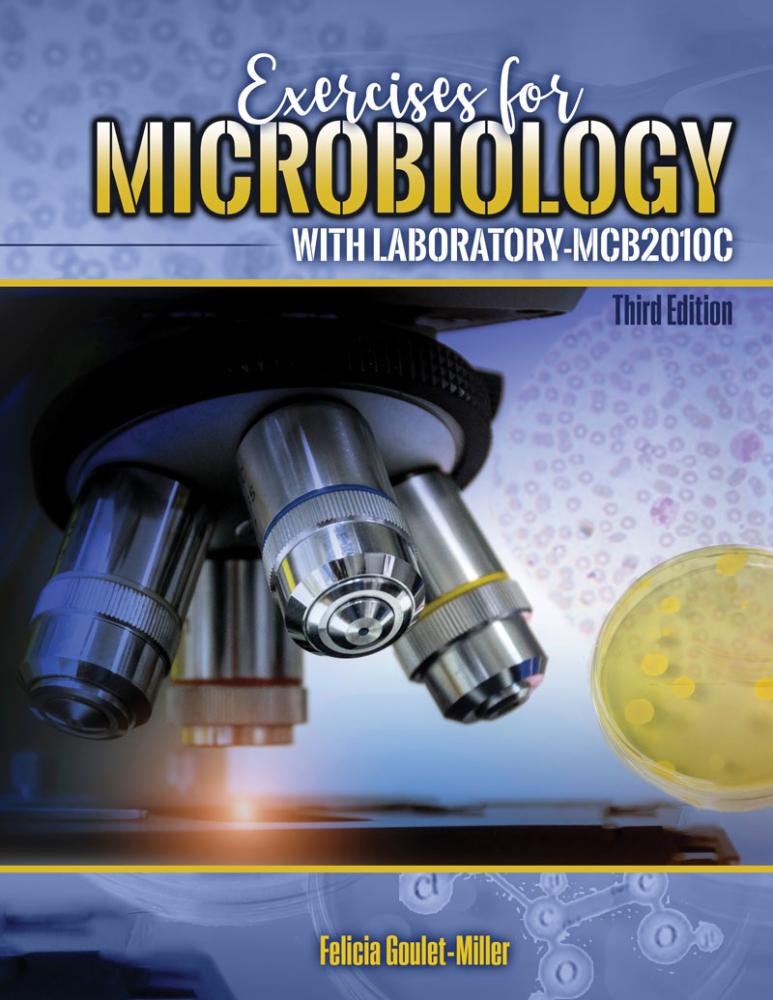
Exercises for Microbiology with Laboratory: MCB2010C
Edition: 3
Copyright: 2022
Pages: 118
Choose Your Format
$40.79 USD
This laboratory manual introduces students to fundamental microbiology concepts and techniques through hands-on experiments and applied investigations. Topics include microscopy, staining methods, microbial diversity, culturing techniques, microbial control, genetics, immunology, diagnostic testing, identification methods, and environmental and food microbiology. Through exercises involving bacteria, fungi, protozoans, parasites, and clinical applications, students develop skills in observation, experimentation, data analysis, and the identification and study of microorganisms.
1. General Safety Rules and Procedures for Microbiology Laboratory
Exercise 1: Ubiquity
Exercise 2: The Microscope
Exercise 3: Simple Stain
Exercise 4: Gram Stain
Exercise 5: Fungi
Exercise 6: Protozoans
Exercise 7: Streak Plate
Exercise 8: Serial Dilution and Standard Plate Count
Exercise 9: Bacterial Transformation
Exercise 10: Effect of Temperature on Microbes
Exercise 11: Chemical Control of Microorganisms
Exercise 12: Antibiotic Control of Microorganisms
Exercise 13: Epidemic Simulation
Exercise 14: Lysozyme Action in Tears
Exercise 15: Total White Blood Cell Count
Exercise 16: Artificial Blood Typing
Exercise 17: ELISA
Exercise 18: Enzyme Tests: Catalase, Oxidase, and Coagulase
Exercise 19: Selective, Differential, and Enriched Plates
Exercise 20: Differential Media (Tubes)
Exercise 21: Unknown Identification Using Dichotomous Keys
Exercise 22: Snyder Test
Exercise 23: Food Microbiology
Exercise 24: Helminths
Exercise 25: Enterotube
Exercise 26: Water Quality (Coli Count)
Felicia Goulet-Miller, M.S., is an Instructor in the Department of Biological Sciences at Florida Gulf Coast University, specializing in microbiology education. She has over 15 years of experience teaching biology and microbiology in higher education, with a focus on preparing students in nursing and healthcare-related fields. Goulet-Miller has developed microbiology curriculum, including clinical case studies and laboratory materials, and serves as an advisor for the Tau Beta Chapter of the Beta Beta Beta National Biological Honor Society. She earned a Master of Science in Microbiology from Texas A&M University and a Bachelor of Science in Biology with honors from Trinity College.