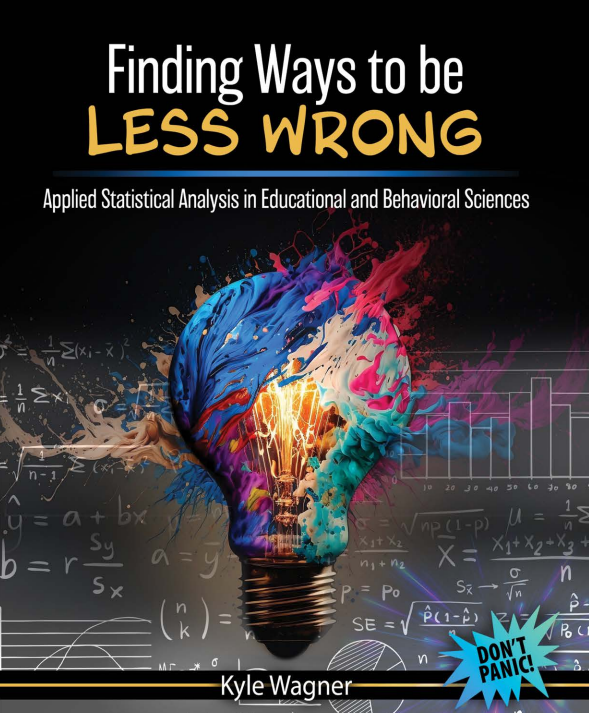
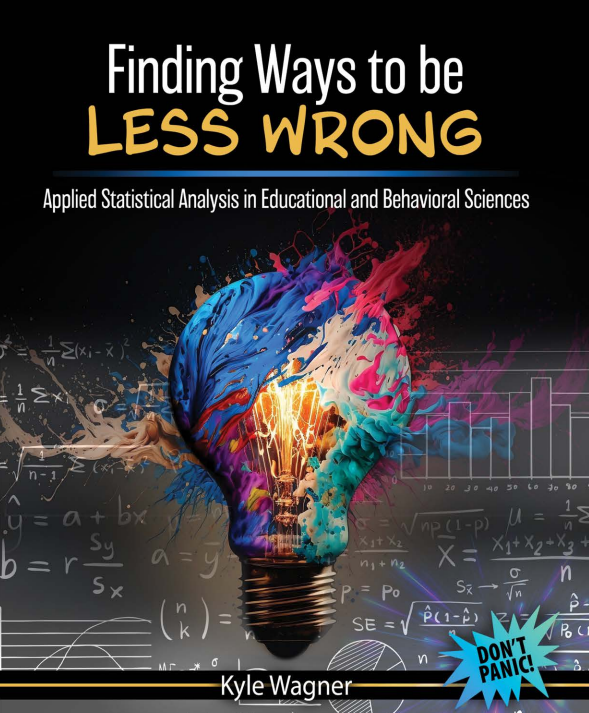
Finding Ways to Be Less Wrong: Applied Statistical Analysis in Educational and Behavioral Sciences
Edition: 1
Copyright: 2026
Pages: 250
Edition: 1
Copyright: 2026
Pages: 250
Choose Your Format
Choose Your Platform | Help Me Choose


Print Package
$90.00 USD
Ebook Package
$45.00 USD
Finding Ways to Be Less Wrong manages to combine rigor with approachability. Written in a conversational, engaging style, this text presents statistics as a discipline that anyone can learn (and maybe even enjoy). Wagner invites readers into a friendly dialogue about data, emphasizing logic and understanding over memorization.
Step by step, students are guided through the reasoning behind common statistical analyses and shown how to conduct them using Microsoft Excel, JASP, and R Studio. Each example is designed to build confidence and deepen comprehension through hands-on application.
Students who may begin the course feeling anxious about statistics will find in this book an encouraging companion that (hopefully) replaces fear with curiosity and clarity.
Ideal for undergraduate and master’s-level courses emphasizing applied understanding and practical use of statistical concepts, this text helps readers not just calculate correctly, but think statistically (and be just a little less wrong in the process).
Chapter 1 Introduction
Chapter 2 Software
Chapter 3 Data
Chapter 4 Central Tendency
Chapter 5 Distributions
Chapter 6 Correlation
Chapter 7 T-Tests
Chapter 8 ANOVA
Chapter 9 Factorial ANOVA, ANCOVA, and Regression
Chapter 10 Chi-Square
Appendix Stuff That Didn’t Fit Well into the Chapters
Index