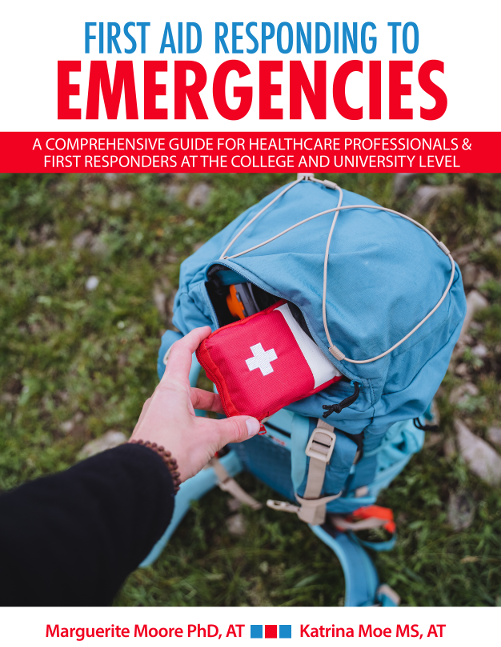
First Aid Responding to Emergencies: A Comprehensive Guide for Healthcare Professionals & First Responders at the College and University Level

Edition: 1

Copyright: 2025

Pages: 542

Choose Your Format

Choose Your Platform | Help Me Choose

Ebook

$87.00 USD

ISBN 9798385172962

Details Electronic Delivery EBOOK 180 days

First Aid and Responding to Emergencies: A Comprehensive Guide for Healthcare Professionals and First Responders at the College and University Level provides students with a comprehensive foundation in the principles, skills, and decision-making processes necessary for effective emergency care. Designed for college and university courses, this text integrates historical perspectives, current evidence-based guidelines, and practical application to prepare future healthcare professionals, educators, and community responders.
The textbook progresses logically from foundational knowledge such as anatomy, physiology, vital signs, and scene size-up into specialized chapters on sudden illness, musculoskeletal injuries, CPR/AED, environmental emergencies, wound care, poisoning, burns, childbirth, and more. Each chapter emphasizes mechanisms of injury, recognition of life-threatening conditions, and the practical steps required to stabilize and support patients until advanced care arrives.

Unique to this text is the integration of case studies, cultural perspectives, historical insights, and Haddon Matrix analyses, which challenge students to critically evaluate both prevention and response. Practical labs, key terms, learning objectives, and end-of-chapter review questions support classroom learning and skill development.

Aligned with American Heart Association and American Red Cross guidelines (2024), this textbook also prepares students for certification in CPR, AED, and First Aid. By blending research, clinical practice, and engaging educational strategies, it equips learners not only to respond confidently in emergencies, but also to think critically about the broader social, environmental, and ethical dimensions of care.
 

CHAPTER 1 Social Issues and Ethics of Responding in Rural  and Urban Societies 

CHAPTER 2 The Human Body: Communicating with Emergency  Professionals 

CHAPTER 3 Processes of Finding the Problem 

CHAPTER 4 Sudden Illness 

CHAPTER 5 Cardiopulmonary Resuscitation, Rescue Breathing,  and Automated External Defibrillator 

CHAPTER 6 Shock 

CHAPTER 7 Bites and Stings 

CHAPTER 8 Poisoning Emergencies 

CHAPTER 9 Cold-Related Illness 

CHAPTER 10 Heat-Related Illness 

CHAPTER 11 Burn-Related Emergency 

CHAPTER 12 Bleeding and Wound Care 

CHAPTER 13 Bone, Muscle, and Joint Injuries 

CHAPTER 14 Chest, Abdomen, Pelvis, and Back Injuries and Conditions 

CHAPTER 15 Head, Face, Neck, Spine, and Throat Injuries 

CHAPTER 16 Wilderness First Aid and Moving Injured People  

CHAPTER 17 Water Emergencies 

CHAPTER 18 Childbirth and Gynecological Emergencies  

CHAPTER 19 Psychological Emergencies, Abuse, and  Special Populations  

CHAPTER 20 Disaster Planning and Response 

Marguerite Moore

Dr. Marguerite “Maggy” Moore, PhD, ATC is the Mark and Eileen Lovell Endowed Professor at Northern Michigan University, where she has taught for nearly two decades and is the Program Director for the Graduate Program in Athletic Training. She is the founding director of the NMU Concussion Research Clinic and a recognized educator and researcher in concussion, migraine, and emergency care. Dr. Moore is passionate about preparing future healthcare professionals through evidence-based education, mentorship, and clinical training. She earned her BS from NMU, MS from California University of Pennsylvania, and PhD from Michigan State University. She lives in the UP of Michigan, with her husband Craig and three sons, Jace, Boden and Maverick enjoying all the outdoor activities. 

Katrina Moe

Katrina Moe, MS, ATC is a recreation and wellness professional with more than two decades of experience in Higher Education, Athletic Training, Recreation, and Aquatics Management. As an American Red Cross Instructor Trainer in Lifeguarding, CPR/First Aid, and Water Safety, she has certified numerous students and staff in lifesaving skills. Her career reflects a deep commitment to health, safety, and leadership in emergency response and recreational sports.

First Aid and Responding to Emergencies: A Comprehensive Guide for Healthcare Professionals and First Responders at the College and University Level provides students with a comprehensive foundation in the principles, skills, and decision-making processes necessary for effective emergency care. Designed for college and university courses, this text integrates historical perspectives, current evidence-based guidelines, and practical application to prepare future healthcare professionals, educators, and community responders.
The textbook progresses logically from foundational knowledge such as anatomy, physiology, vital signs, and scene size-up into specialized chapters on sudden illness, musculoskeletal injuries, CPR/AED, environmental emergencies, wound care, poisoning, burns, childbirth, and more. Each chapter emphasizes mechanisms of injury, recognition of life-threatening conditions, and the practical steps required to stabilize and support patients until advanced care arrives.

Unique to this text is the integration of case studies, cultural perspectives, historical insights, and Haddon Matrix analyses, which challenge students to critically evaluate both prevention and response. Practical labs, key terms, learning objectives, and end-of-chapter review questions support classroom learning and skill development.

Aligned with American Heart Association and American Red Cross guidelines (2024), this textbook also prepares students for certification in CPR, AED, and First Aid. By blending research, clinical practice, and engaging educational strategies, it equips learners not only to respond confidently in emergencies, but also to think critically about the broader social, environmental, and ethical dimensions of care.
 

CHAPTER 1 Social Issues and Ethics of Responding in Rural  and Urban Societies 

CHAPTER 2 The Human Body: Communicating with Emergency  Professionals 

CHAPTER 3 Processes of Finding the Problem 

CHAPTER 4 Sudden Illness 

CHAPTER 5 Cardiopulmonary Resuscitation, Rescue Breathing,  and Automated External Defibrillator 

CHAPTER 6 Shock 

CHAPTER 7 Bites and Stings 

CHAPTER 8 Poisoning Emergencies 

CHAPTER 9 Cold-Related Illness 

CHAPTER 10 Heat-Related Illness 

CHAPTER 11 Burn-Related Emergency 

CHAPTER 12 Bleeding and Wound Care 

CHAPTER 13 Bone, Muscle, and Joint Injuries 

CHAPTER 14 Chest, Abdomen, Pelvis, and Back Injuries and Conditions 

CHAPTER 15 Head, Face, Neck, Spine, and Throat Injuries 

CHAPTER 16 Wilderness First Aid and Moving Injured People  

CHAPTER 17 Water Emergencies 

CHAPTER 18 Childbirth and Gynecological Emergencies  

CHAPTER 19 Psychological Emergencies, Abuse, and  Special Populations  

CHAPTER 20 Disaster Planning and Response 

Marguerite Moore

Dr. Marguerite “Maggy” Moore, PhD, ATC is the Mark and Eileen Lovell Endowed Professor at Northern Michigan University, where she has taught for nearly two decades and is the Program Director for the Graduate Program in Athletic Training. She is the founding director of the NMU Concussion Research Clinic and a recognized educator and researcher in concussion, migraine, and emergency care. Dr. Moore is passionate about preparing future healthcare professionals through evidence-based education, mentorship, and clinical training. She earned her BS from NMU, MS from California University of Pennsylvania, and PhD from Michigan State University. She lives in the UP of Michigan, with her husband Craig and three sons, Jace, Boden and Maverick enjoying all the outdoor activities. 

Katrina Moe

Katrina Moe, MS, ATC is a recreation and wellness professional with more than two decades of experience in Higher Education, Athletic Training, Recreation, and Aquatics Management. As an American Red Cross Instructor Trainer in Lifeguarding, CPR/First Aid, and Water Safety, she has certified numerous students and staff in lifesaving skills. Her career reflects a deep commitment to health, safety, and leadership in emergency response and recreational sports.

